SLAC National Accelerator Laboratory
SLAC National Accelerator Laboratory is one of 17 Department of Energy (DOE) National Laboratories, and operated by Stanford University on behalf of the DOE. SLAC develops and operates some of the world’s premier science facilities, including the first hard X-ray free-electron laser. Research at SLAC explores the structure and function of matter and the properties of energy, space and time, at the smallest, largest and fastest scales, all with the goal of solving problems facing society and advancing human knowledge.
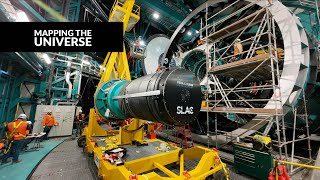
LSST Camera: 8 year time lapse

Human in the Loop: AI and the Accelerator Control Room

Tiny Mic: Detector prototypes and applications for our high energy X-ray laser

Advancing toward sustainable solutions for global plant growth and ecosystem health

Do we know all objects in our solar system and Milky Way?

Meet Gustavo Cezar: Can We Transition to a Less Fossil Fuel-Based Grid While Ensuring Reliability?

What is Dark Energy?

Meet Molleigh Preefer: how do synchrotrons help develop fast-charging batteries?

How did SLAC ship the largest digital camera to Chile?

Что такое темная материя?

Vera Rubin Observatory will create a massive timelapse of the universe

How can we recycle and create more sustainable plastics?

Что представляет собой камера LSST для обсерватории Рубина?

What is the Vera Rubin Observatory?

Картографирование Вселенной: камера 3,2 гигапикселя для 10-летней покадровой съемки Вселенной!

What are SYNCHROTRONs?

What is CRYOEM?

Secretary Granholm Speech during SLAC's LCLS first light celebration

Can scientists visualize how plants use light to capture CO2?

What is an X-ray Laser? And what can you do with it? #SLACexplains

What is an X-ray Free Electron Laser or XFEL?

How did Synchrotrons become global X-ray powerhouses?

SSRL allows to produce molecular images of genetic code transcription

How did SSRL produce its first X-ray beam?

Building the largest digital camera for a 10-year survey of the universe

Getting LCLS-II to 2 kelvins

О SLAC

The creation of a powerful X-ray laser

Revolutionary 3-D Views of Viral RNA Using Cryogenic Electron Microscopy by Rachael Kretsch

SLAC's early history: A "monster" of an idea changed how we see the universe