HTC-Grid: Scaling 100,000 Cores for Financial Risk on Kubernetes | Flamur Gogolli
Автор: FINOS
Загружено: 2025-12-27
Просмотров: 67
🔑 FINOS HPC Demo: Scaling 100K Cores with HTC-Grid Cloud-Native Architecture | Flamur Gogolli
🚀 Welcome to the FINOS Open Source in Finance Developer Day at apidays Paris!
💻 HTC-Grid GitHub: https://github.com/finos/htc-grid LinkedIn: 🌐 More about FINOS: https://www.finos.org/
📧 Join our newsletter: https://www.finos.org/sign-up
📥 Download the State of Open Source in Financial Services report: https://www.finos.org/state-of-open-s...
🎙️ Listen to our Open Source in Finance Podcast: / @finos
🗣️ Attend the next Open Source in Finance Forum: https://hubs.ly/Q03z9D9D0
LinkedIn: / finosfoundation
In this technical deep dive, Flamur Gogolli (AWS) explores the modernization of financial grid computing. He explains how HTC-Grid solves the scaling bottlenecks of traditional on-premise grids by shifting the focus from High Performance Computing (HPC) to High Throughput Computing (HTC).
📉 The Problem: Volatility and Short-Task Overhead
Financial risk calculations, such as Monte Carlo simulations for regulatory compliance, involve millions of loosely coupled tasks.
The Performance Gap: In volatile markets, banks may run 270 million tasks per day. Since 40% of these tasks finish in under two seconds, any "scheduler overhead" results in massive performance waste.
The Solution: HTC-Grid focuses on high throughput and low latency, reducing scheduling overhead to allow millions of short-duration tasks to run efficiently.
⚙️ HTC-Grid Performance & Architecture
HTC-Grid uses a modular, serverless-first design that scales down to near-zero cost when idle:
Scale: Supports up to 80,000 vCPUs in a single installation.
Throughput: Delivers over 30,000 tasks per second.
Latency: Achieves a round-trip scheduling time of just 0.3 seconds.
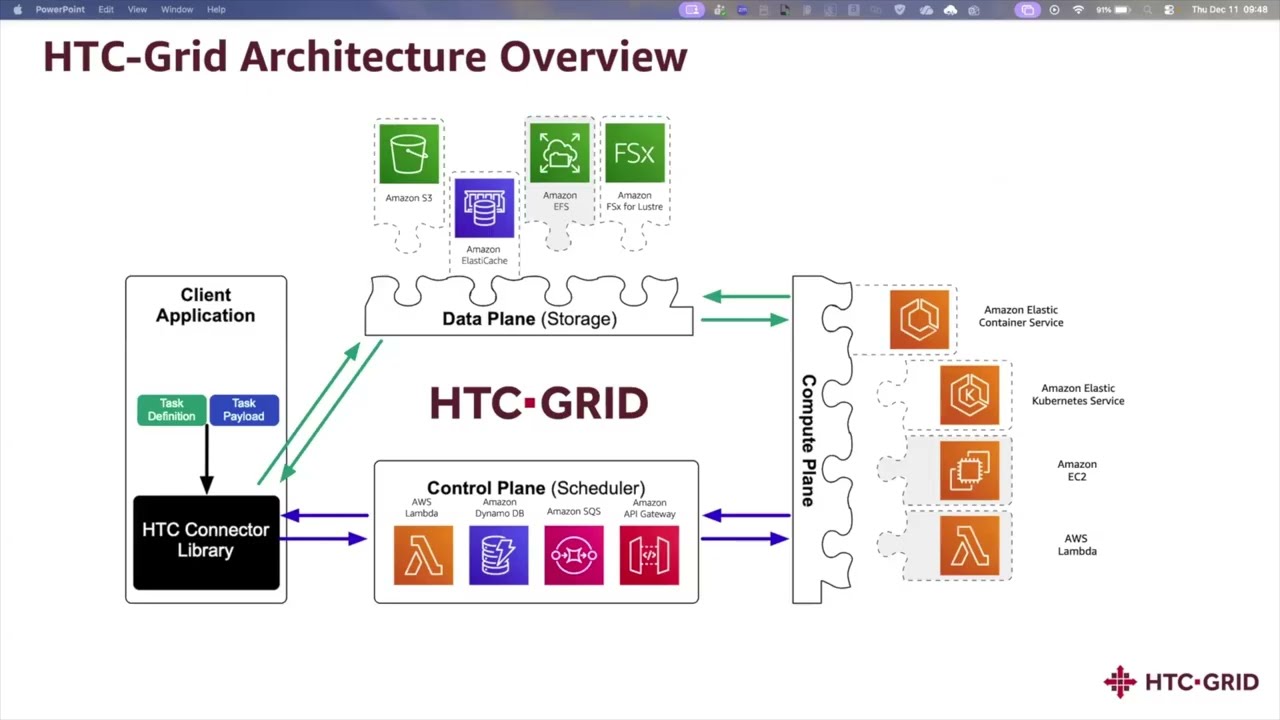
The Four Functional Planes:
Client Side: Uses a connector library to separate "Task Definitions" (metadata) from "Task Payloads" (data).
Data Plane: Leverages scalable storage like S3, Redis, or FSx.
Control Plane: Built on serverless components (AWS Lambda, DynamoDB, SQS) to manage task lifecycle and scaling.
Compute Plane: A pull-based system (typically on EKS/Kubernetes) using KEDA for horizontal autoscaling based on queue depth.
🤖 "All Compute is a Lambda"
One of the most innovative tenets of HTC-Grid is its approach to proprietary analytics. Every compute node (Pod) contains an Agent and a Lambda Container.
Standardized Interface: By speaking the Lambda API (Function Name, Input, Output), banks can plug in their own "Secret Sauce" quant libraries without rewriting the grid infrastructure.
Portability: This containerized approach ensures the grid can run across different compute planes and cloud providers while maintaining a consistent developer experience.
The takeaway: HTC-Grid is the industry blueprint for moving from static, licensed HPC grids to dynamic, cloud-native high-throughput environments. By treating all compute as a Lambda function and utilizing serverless control planes, financial institutions can scale to 100,000+ cores for risk management while achieving massive cost savings and operational agility.
#FINOS #apidays #HTCGrid #HPC #HighThroughputComputing #AWS #Kubernetes #Serverless #FinTech #RiskManagement #MonteCarlo #EKS #CloudNative
Доступные форматы для скачивания:
Скачать видео mp4
-
Информация по загрузке: