Horizontal and Vertical Scanning in Radar | How Radar Find its Target? | www.studymaterial.org
Автор: Master Ji
Загружено: 2020-04-18
Просмотров: 1459
This video is about the #Horizontal and #Vertical #Scanning in #Radar.
How Radar Works? How Radar Scan? How Radar find a target?
In Horizontal Scanning, the radar antenna rotates around the horizon and continuously transmits #electromagnetic waves in different directions.
In vertical scanning, the azimuth angle of the radar antenna is kept constant and the elevation angle is varied so radar antenna moves up and down.
For more details, visit my website: www.studymaterial.org
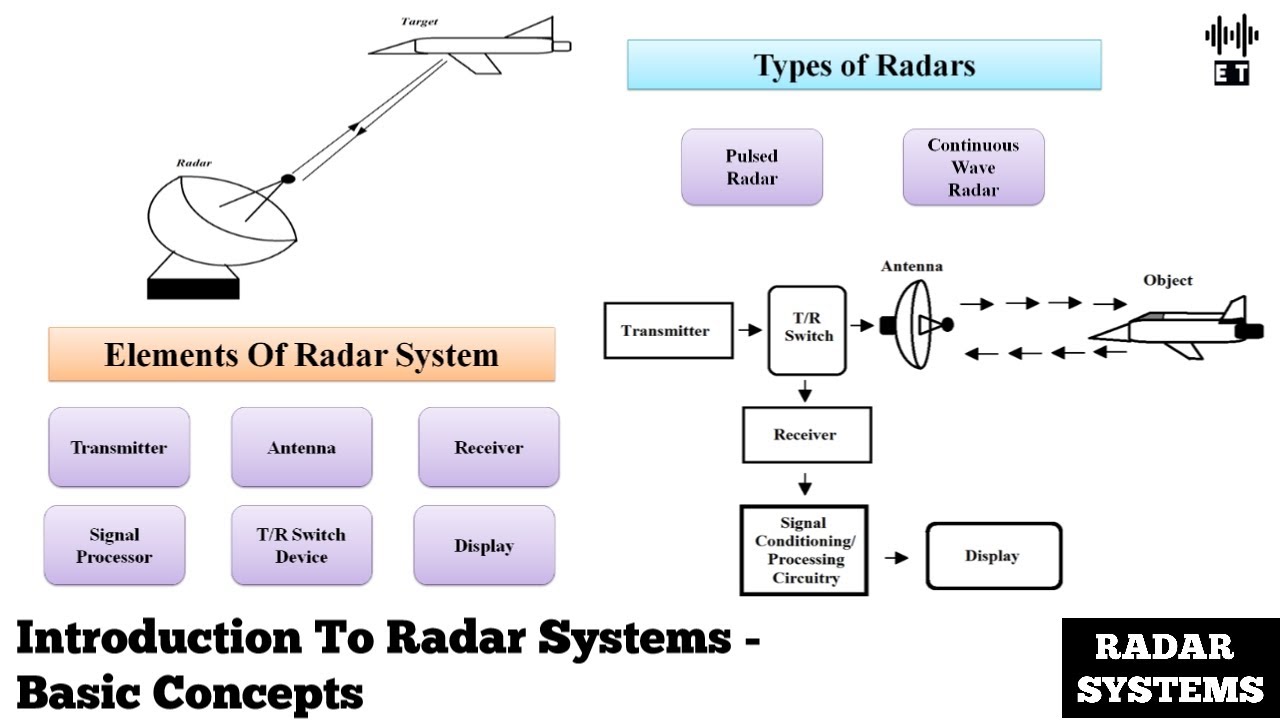
Radar (radio detection and ranging) is a detection system that uses radio waves to determine the distance (ranging), angle, and radial velocity of objects relative to the site. It can be used to detect aircraft, ships, spacecraft, guided missiles, motor vehicles, weather formations, and terrain. A radar system consists of a transmitter producing electromagnetic waves in the radio or microwaves domain, a transmitting antenna, a receiving antenna (often the same antenna is used for transmitting and receiving) and a receiver and processor to determine properties of the object(s). Radio waves (pulsed or continuous) from the transmitter reflect off the object and return to the receiver, giving information about the object's location and speed.
Radar is a system that uses electromagnetic waves to identify the range, altitude, direction, or speed of both moving and fixed objects such as aircraft, ships, motor vehicles, weather formations, and terrain. A transmitter emits radio waves, which are reflected by the target and detected by a receiver, typically in the same location as the transmitter. Although the radio signal returned is usually very weak, radio signals can easily be amplified. This enables a radar to detect objects at ranges where other emissions, such as sound or visible light, would be too weak to detect. Radar is used in many contexts, including meteorological detection of precipitation, air traffic control, police detection of speeding traffic, and by the military. It was originally called RDF (Radio Direction Finder) in Britain. The term RADAR was coined in 1941 as an acronym for Radio Detection and Ranging. The term has since entered the English language as a standard word, radar, losing the capitalization in the process.
Polarization
In the transmitted radar signal, the electric field is perpendicular to the direction of propagation, and this direction of the electric field is the polarization of the wave. Radars use horizontal, vertical, linear and circular polarization to detect different types of reflections. For example, circular polarization is used to minimize the interference caused by rain. Linear polarization returns usually indicate metal surfaces. m polarization returns usually indicate a fractal surface, such as rocks or soil, and are used by navigation radars.
Interference
Radar systems must overcome several different sources of unwanted signals in order to focus only on the actual targets of interest. These unwanted signals may originate from internal and external sources, both passive and active. The ability of the radar system to overcome these unwanted signals defines its signal-to-noise ratio (SNR): the higher a system's SNR, the better it is in isolating actual targets from the surrounding noise signals.
Noise
Signal noise is an internal source of random variations in the signal, which is inherently generated to some degree by all electronic components. Noise typically appears as random variations superimposed on the desired echo signal received in the radar receiver. The lower the power of the desired signal, the more difficult it is to discern it from the noise (similar to trying to hear a whisper while standing near a busy road). Therefore, the most important noise sources appear in the receiver and much effort is made to minimize these factors. Noise figure is a measure of the noise produced by a receiver compared to an ideal receiver, and this needs to be minimized.
Noise is also generated by external sources, most importantly the natural thermal radiation of the background scene surrounding the target of interest. In modern radar systems, due to the high performance of their receivers, the internal noise is typically about equal to or lower than the external scene noise. An exception is if the radar is aimed upwards at clear sky, where the scene is so cold that it generates very little thermal noise.
There will be also Flicker noise due to electrons transit, but depending on 1/f, will be much lower than thermal noise wether the frequency is high. Hence, in pulse radar, the system will be always heterodyne. See intermediate frequency.

Доступные форматы для скачивания:
Скачать видео mp4
-
Информация по загрузке: