How to Configure ESLint to Catch Undeclared Local Variables
Автор: vlogize
Загружено: 2025-09-14
Просмотров: 0
Learn how to set up ESLint to properly identify undeclared local variables in your JavaScript code, ensuring cleaner, more reliable code.
---
This video is based on the question https://stackoverflow.com/q/62176494/ asked by the user 'Sohrab Saran' ( https://stackoverflow.com/u/1509789/ ) and on the answer https://stackoverflow.com/a/62431963/ provided by the user 'Sohrab Saran' ( https://stackoverflow.com/u/1509789/ ) at 'Stack Overflow' website. Thanks to these great users and Stackexchange community for their contributions.
Visit these links for original content and any more details, such as alternate solutions, latest updates/developments on topic, comments, revision history etc. For example, the original title of the Question was: How to configure ESLint to catch undeclared local variables
Also, Content (except music) licensed under CC BY-SA https://meta.stackexchange.com/help/l...
The original Question post is licensed under the 'CC BY-SA 4.0' ( https://creativecommons.org/licenses/... ) license, and the original Answer post is licensed under the 'CC BY-SA 4.0' ( https://creativecommons.org/licenses/... ) license.
If anything seems off to you, please feel free to write me at vlogize [AT] gmail [DOT] com.
---
How to Configure ESLint to Catch Undeclared Local Variables
When writing JavaScript code, it's essential to maintain a clean and error-free environment. One common issue developers face is the usage of undeclared variables, which can lead to bugs and unpredictable behavior. In this guide, we’ll explore how to configure ESLint to flag such undeclared variables, helping you write better and more maintainable code.
Understanding the Problem
In the example below, a function attempts to assign a value to a variable named v1, but it has not been declared previously. This can lead to silent failures and hard-to-trace bugs.
[[See Video to Reveal this Text or Code Snippet]]
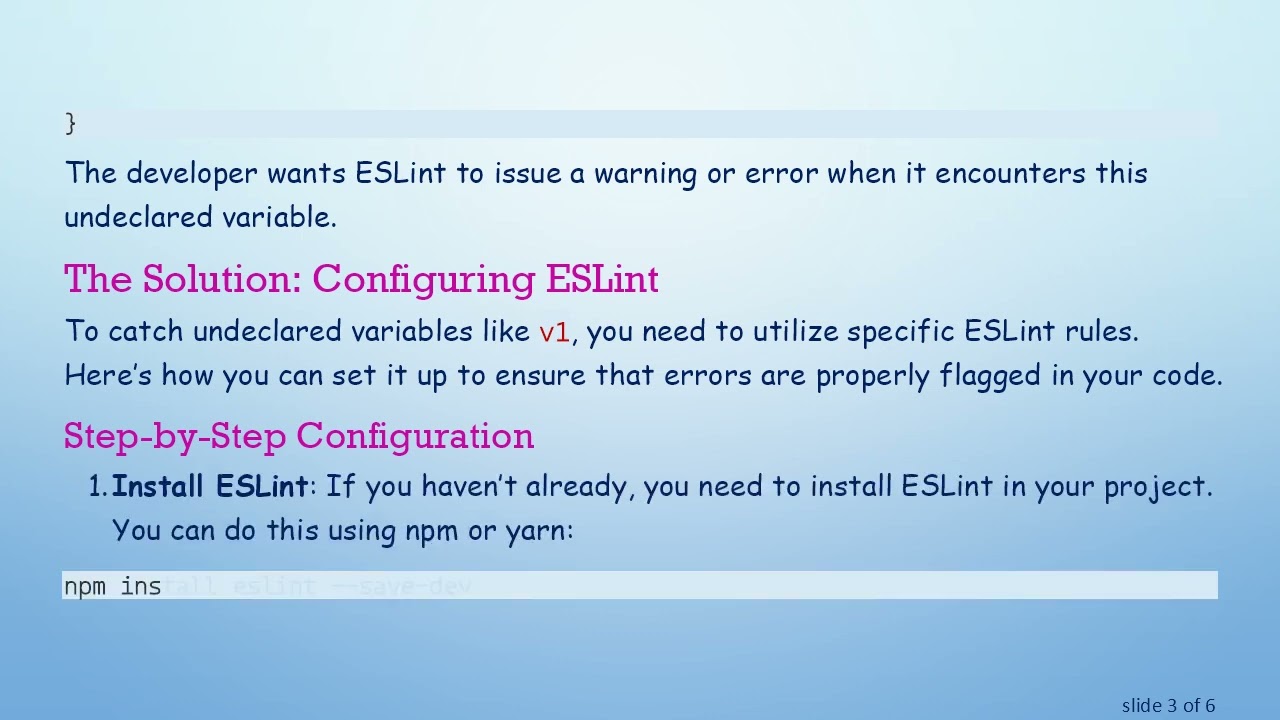
The developer wants ESLint to issue a warning or error when it encounters this undeclared variable.
The Solution: Configuring ESLint
To catch undeclared variables like v1, you need to utilize specific ESLint rules. Here’s how you can set it up to ensure that errors are properly flagged in your code.
Step-by-Step Configuration
Install ESLint: If you haven’t already, you need to install ESLint in your project. You can do this using npm or yarn:
[[See Video to Reveal this Text or Code Snippet]]
Create or Update Your ESLint Configuration File:
Make sure your ESLint configuration file (usually .eslintrc.js or .eslintrc.json) has the appropriate rules set.
Below is an example configuration which includes the necessary rules for catching undeclared variables:
[[See Video to Reveal this Text or Code Snippet]]
Testing Your Configuration: After setting up your ESLint configuration, run ESLint against your JavaScript code. You can do this using the command line:
[[See Video to Reveal this Text or Code Snippet]]
Expected Output
If configured correctly, ESLint will provide an error message for the undeclared variable. For instance, you might see output similar to:
[[See Video to Reveal this Text or Code Snippet]]
This confirms that ESLint successfully caught the undeclared variable, allowing you to address the issue before it leads to potential bugs in your application.
Conclusion
By following the steps outlined above, you can easily configure ESLint to catch undeclared local variables within your JavaScript code. This keeps your code cleaner and helps you maintain better coding practices.
Whether you're a beginner or looking to refine your skills, incorporating ESLint is a vital step in ensuring quality and reliability in your codebase.
If you have questions or need further assistance with ESLint, feel free to leave a comment below!
Доступные форматы для скачивания:
Скачать видео mp4
-
Информация по загрузке: