Resolving the MockMVC Mystery: Why Does Your JsonPath Response Come Back Empty?
Автор: vlogize
Загружено: 2025-08-12
Просмотров: 0
Discover solutions for the common `MockMVC` issue where you encounter an empty body in JSON responses, affecting your unit tests and application behavior.
---
This video is based on the question https://stackoverflow.com/q/65157415/ asked by the user 'JosV' ( https://stackoverflow.com/u/14769129/ ) and on the answer https://stackoverflow.com/a/65168973/ provided by the user 'Tom' ( https://stackoverflow.com/u/11506404/ ) at 'Stack Overflow' website. Thanks to these great users and Stackexchange community for their contributions.
Visit these links for original content and any more details, such as alternate solutions, latest updates/developments on topic, comments, revision history etc. For example, the original title of the Question was: MockMVC JsonPath response has empty body?
Also, Content (except music) licensed under CC BY-SA https://meta.stackexchange.com/help/l...
The original Question post is licensed under the 'CC BY-SA 4.0' ( https://creativecommons.org/licenses/... ) license, and the original Answer post is licensed under the 'CC BY-SA 4.0' ( https://creativecommons.org/licenses/... ) license.
If anything seems off to you, please feel free to write me at vlogize [AT] gmail [DOT] com.
---
Resolving the MockMVC Mystery: Why Does Your JsonPath Response Come Back Empty?
If you're a Java developer working with MockMVC and testing REST controllers, you may have encountered a frustrating error when trying to verify the contents of your JSON responses. Specifically, you might see an assertion failure stating: "No value at JSON path $.firstName." This often indicates that the body of the response is empty, leaving you puzzled about what went wrong. Let’s take a closer look at this problem and how to resolve it effectively.
Understanding the Problem
In your unit tests, you mock service calls to test your controller's functionality. The intention is to ensure that when you send an employee object to the addEmployee endpoint, the response contains the expected data. However, if you encounter an empty body in your MockMVC response, this usually signals that something is amiss in the way you're configuring your mocks.
Context of the Error
When testing the createEmployeeAPI method, you might see output similar to the following:
[[See Video to Reveal this Text or Code Snippet]]
Here, the body of the response appears to be empty, leading to the failure in the .jsonPath assertion.
Digging Deeper: The Root Cause
The root of the issue lies within how you're using Mockito to set up the behavior of your mock service. In your test, you're configuring the service with this line:
[[See Video to Reveal this Text or Code Snippet]]
The Equals Problem
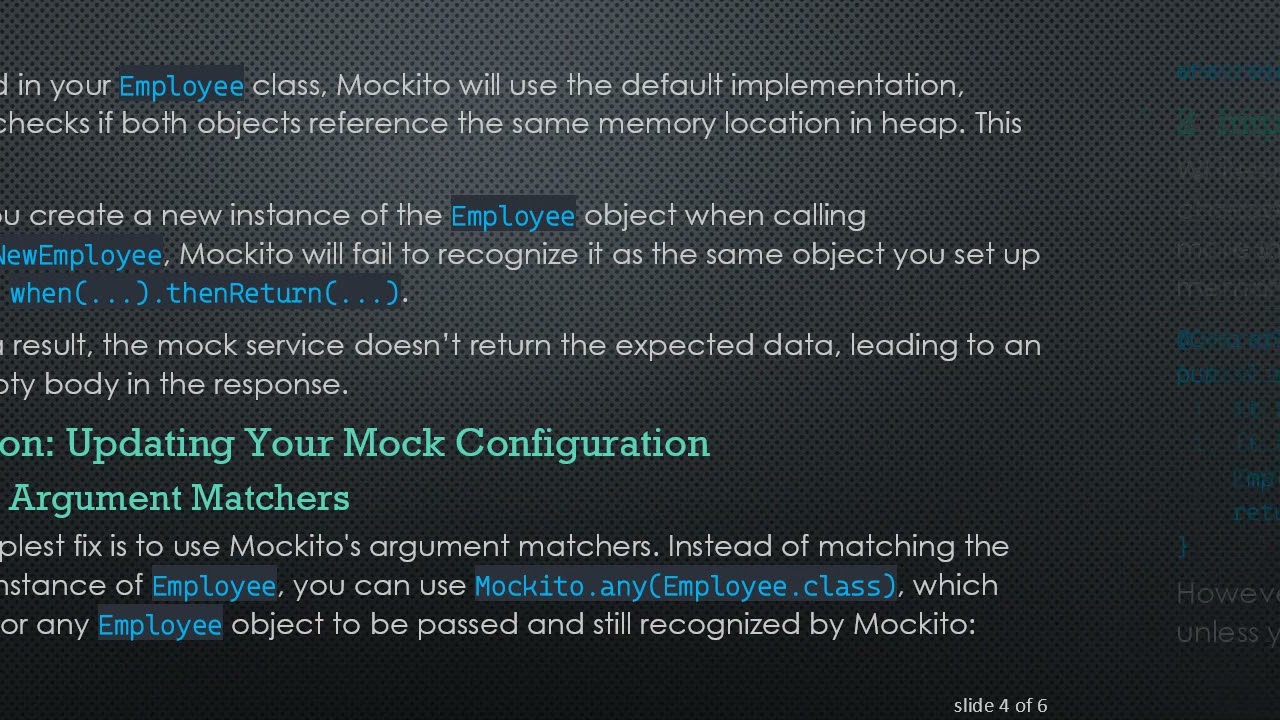
Internally, Mockito uses the equals() method of the Object class to compare the arguments passed to its mocked methods. If you haven't overridden the equals() method in your Employee class, Mockito will use the default implementation, which checks if both objects reference the same memory location in heap. This means:
If you create a new instance of the Employee object when calling addNewEmployee, Mockito will fail to recognize it as the same object you set up with when(...).thenReturn(...).
As a result, the mock service doesn’t return the expected data, leading to an empty body in the response.
Solution: Updating Your Mock Configuration
1. Use Argument Matchers
The simplest fix is to use Mockito's argument matchers. Instead of matching the exact instance of Employee, you can use Mockito.any(Employee.class), which allows for any Employee object to be passed and still recognized by Mockito:
[[See Video to Reveal this Text or Code Snippet]]
2. Implementing the Equals Method (Optional)
While using argument matchers is often the quickest solution, you may also choose to override the equals() method in the Employee class. This can lead to more intuitive comparisons based on the properties of the object rather than just memory addresses:
[[See Video to Reveal this Text or Code Snippet]]
However, using argument matchers is generally recommended during testing unless you require deep equality checks in your application logic.
Conclusion
By addressing the way you handle mock responses in your tests, you can eliminate frustrating errors related to empty response bodies. Utilizing Mockito's argument matchers provides a cleaner, more robust solution that allows your tests to run as expected, ensuring that your controller logic is validated against the conditions you design.
Remember, thorough testing not only verifies the functionality of your code but also significantly aids in understanding how different components of your system interact. Happy coding!
Доступные форматы для скачивания:
Скачать видео mp4
-
Информация по загрузке: