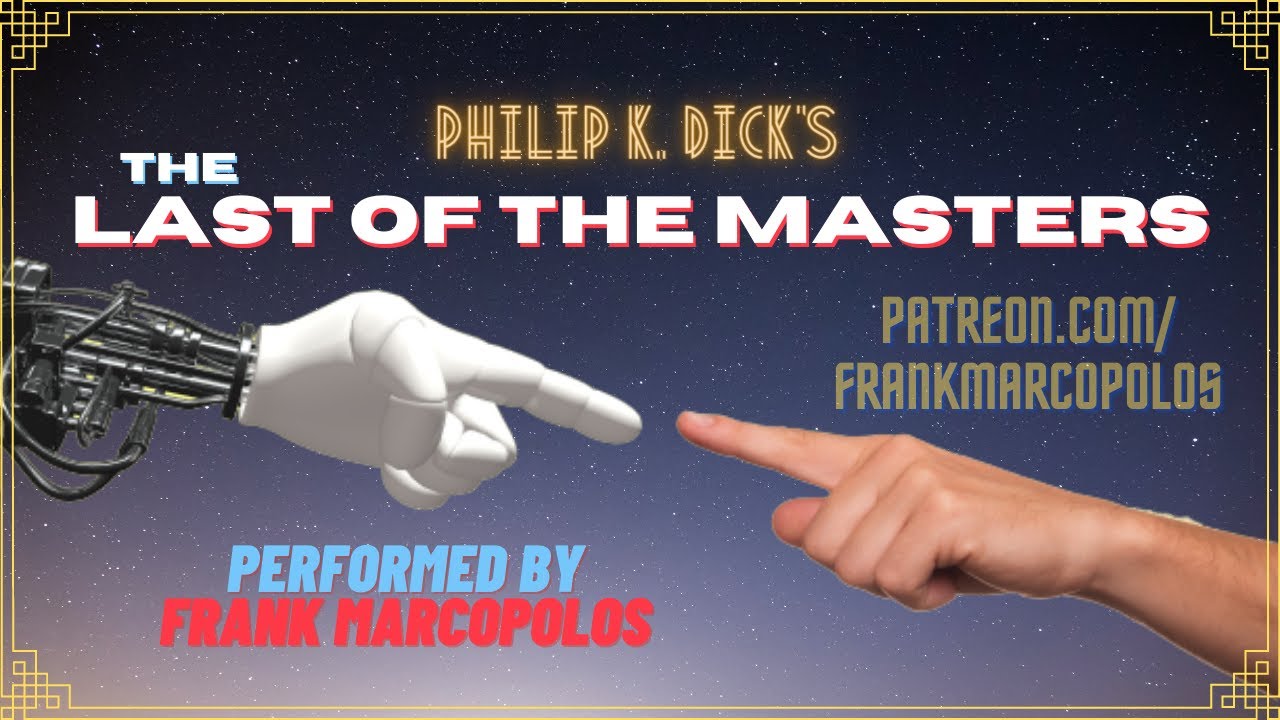
The Last of the Masters (aka Protection Agency) by Philip K. Dick (Audio) | Read by Frank Marcopolos
Автор: Frank's Lit Spot
Загружено: 2024-05-05
Просмотров: 3855
"The Last of the Masters" (also known as "Protection Agency") is a science fiction novelette by American writer Philip K. Dick. It is now in the public domain world-wide. The performance is copyright 2024 by Frank Marcopolos.
Buy *The Dain Curse*, written by Dashiell Hammett and performed by Frank Marcopolos at these retailers:
https://apple.co/41tAk4q
https://www.barnesandnoble.com/w/the-...
"The Last of the Masters" depicts a society 200 years after a global anarchist revolution has toppled the national governments of the world (the exact year is unstated). Civilization has stagnated due to the loss of scientific knowledge and industry during the legendary revolt. Elsewhere, the last state, governing a highly centralized and efficient society, conceals itself from the Anarchist League, a global militia preventing the recreation of any government. When three agents of the League are sent to investigate rumors of the microstate's existence, the government arranges for them to be killed, leading to the death of one and the capture of another. Tensions rapidly escalate after the agents of the state realize that the third has escaped. Assuming he will report the state's existence, the government mobilizes for total war. In actuality, the surviving anarchist elects to attempt his comrades' rescue and assassinate the head of state: the last surviving "government robot."
The primary theme of the story is the conflict between anarchism and statism, the political and ethical dimensions of which are explored through the characters' dialogue. Though the attention the story received was limited prior to the author's death in 1982, it has since seen greater circulation in Philip K. Dick story collections, and has been reviewed and analyzed for its postmodern critique of technology and its political implications.
In his 1980 commentary on the story, Dick also suggested that his reasoning for making Bors sympathetic was a result of a form of trust he advanced towards robots, as opposed to androids. "Perhaps", he suggested, "it's because a robot does not try to deceive you as to what it is". One of the themes that runs throughout all of Dick's fiction is the "power of empathy" and he uses it as the "key element defining the authentic human being". For example, when Silvia meets the robot that runs the government, she exclaims "My God, you have no understanding of us. You run all this, and you're incapable of empathy. You're nothing but a mechanical computer."
Christopher Palmer, of La Trobe University, has written on the postmodern literary themes of Dick's early short stories, analyzing stories in which "breakdown and ignorance" are the result of social upheaval. Palmer proposed that Dick often created post-apocalyptic scenarios of ruined worlds which held high tech gadgets in an attempt to present a view of postmodern materialism. Common to many of Dick's short stories were settings in which the outgrowth of modernity is a world where that which is natural is in ruin, and what is artificial is reshaped through science into a fantastically high tech form. Palmer presented "The Last of the Masters" as an example of this, as well as "The Variable Man" and The Penultimate Truth, two other post-apocalyptic works by Dick. Palmer contended that these shared themes were "...not simply the expression of dystopian malaise, or of Luddism treacherously taking up residence in popular SF... It points to a coherent interpretation of industrialism and post-industrialism."
Suggesting that many of the philosophical and political underpinnings of the author's short stories stemmed from his views on domestic life, Palmer's focus turned to Dick's common use of sterility as a metaphor. In "The Gun", "Second Variety", The Penultimate Truth, and "The Last of the Masters", people and sometimes the earth itself have been driven to sterility. As Palmer noted of "The Last of the Masters", Bors can be interpreted as a symbol of infertility: "It is not clear why he does not replicate himself, or educate his human servants: it is simply a given that he is sterile. The old, technologically advanced, highly organized civilization is a civilization of production, but now under Bors it can do no more than maintain itself." Following an inspection of other short stories with similar references to sterility, Palmer asserts that Dick's work presented a social and existential protest. Palmer interpreted Dick's social critique to be that if the act of creation validates existence, and genuinely expresses a form of individuality, then the process of reproduction is alienating, oppressive, and retards an individual's liberty. As Palmer explains, "...this process disempowers consumers, and even technocrats, by making them dependent on a process of which they have become entirely ignorant."
Доступные форматы для скачивания:
Скачать видео mp4
-
Информация по загрузке:



![Prize Ship | Philip K. Dick [ Sleep Audiobook - Full Length Peaceful Tranquil Cozy Bedtime Story ]](https://imager.clipsaver.ru/8OPNDMGibaw/max.jpg)