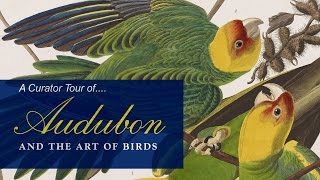
John James Audubon (1785-1851) Illustration from Birds of America (1827)
Автор: Master Painters
Загружено: 2019-02-03
Просмотров: 4498
John James Audubon (1785-1851) was an American ornithologist, naturalist, and painter. He was notable for his extensive studies documenting all types of American birds and for his detailed illustrations that depicted the birds in their natural habitats. His major work, a color-plate book entitled The Birds of America, is considered one of the finest ornithological works ever completed. Audubon identified 25 new species.
With his wife's support Audubon took his growing collection of work to England. He sailed from New Orleans to Liverpool on the cotton hauling ship Delos, reaching England in the autumn of 1826 with his portfolio of over 300 drawings. With letters of introduction to prominent Englishmen, Audubon gained their quick attention. "I have been received here in a manner not to be expected during my highest enthusiastic hopes."
The British could not get enough of Audubon's images of backwoods America and its natural attractions. He met with great acceptance as he toured around England and Scotland, and was lionized as "the American woodsman." He raised enough money to begin publishing his The Birds of America. This monumental work consists of 435 hand-colored, life-size prints of 497 bird species, made from engraved copper plates of various sizes depending on the size of the image. They were printed on sheets measuring about 39 by 26 inches (660 mm). The work contains slightly more than 700 North American bird species, of which some was based on specimens collected by fellow ornithologist John Kirk Townsend on his journey across America with Thomas Nuttall in 1834 as part of Nathaniel Jarvis Wyeth's second expedition across the Rocky Mountains to the Pacific Ocean.
The cost of printing the entire work was $115,640 (over $2,000,000 today), paid for from advance subscriptions, exhibitions, oil painting commissions, and animal skins, which Audubon hunted and sold. Audubon's great work was a remarkable accomplishment. It took more than 14 years of field observations and drawings, plus his single-handed management and promotion of the project to make it a success. A reviewer wrote,
Colorists applied each color in assembly-line fashion (over fifty were hired for the work). The original edition was engraved in aquatint by Robert Havell, Jr., who took over the task after the first ten plates engraved by W. H. Lizars were deemed inadequate. Known as the Double Elephant folio after its double elephant paper size, it is often regarded as the greatest picture book ever produced and the finest aquatint work. By the 1830s, the aquatint process was largely superseded by lithography. A contemporary French critic wrote, "A magic power transported us into the forests which for so many years this man of genius has trod. Learned and ignorant alike were astonished at the spectacle ... It is a real and palpable vision of the New World."
Audubon sold oil-painted copies of the drawings to make extra money and publicize the book. A potential publisher had his portrait painted by John Syme, who clothed the naturalist in frontier clothes. The portrait was hung at the entrance of his exhibitions, promoting his rustic image. (The painting is now held in the White House art collection, and is not frequently displayed.). The New-York Historical Society holds all 435 of the preparatory watercolors for The Birds of America. Lucy Audubon sold them to the society after her husband's death. All but 80 of the original copper plates were melted down when Lucy Audubon, desperate for money, sold them for scrap to the Phelps Dodge Corporation.
King George IV was among the avid fans of Audubon and subscribed to support publication of the book. London's Royal Society recognized Audubon's achievement by electing him as a fellow. He was the second American to be elected after statesman Benjamin Franklin. While in Edinburgh to seek subscribers for the book, Audubon gave a demonstration of his method of supporting birds with wire at professor Robert Jameson's Wernerian Natural History Association. Student Charles Darwin was in the audience. Audubon also visited the dissecting theatre of the anatomist Robert Knox. Audubon was a hit in France as well, gaining the King and several of the nobility as subscribers.
The Birds of America became very popular during Europe's Romantic era. Audubon's dramatic portraits of birds appealed to people in this period's fascination with natural history.
Audubon's final work dealt with mammals; he prepared The Viviparous Quadrupeds of North America (1845–1849) in collaboration with his good friend Rev John Bachman of Charleston, South Carolina, who supplied much of the scientific text. His son, John Woodhouse Audubon, drew most of the plates. The work was completed by Audubon's sons, and the second volume was published posthumously in 1851.
Thank you, please subscribe for future videos
/ @masterpainters1706

Доступные форматы для скачивания:
Скачать видео mp4
-
Информация по загрузке: