Optimize Your Python Code: Efficiently Reading Files and Writing to Excel Sheets
Автор: vlogize
Загружено: 2025-10-08
Просмотров: 0
Discover how to read data from a text file and write it to an existing Excel sheet using Python, while optimizing performance to reduce execution time significantly.
---
This video is based on the question https://stackoverflow.com/q/64678707/ asked by the user 'Amrita Tapadar' ( https://stackoverflow.com/u/14576427/ ) and on the answer https://stackoverflow.com/a/64679821/ provided by the user 'Serial Lazer' ( https://stackoverflow.com/u/10208481/ ) at 'Stack Overflow' website. Thanks to these great users and Stackexchange community for their contributions.
Visit these links for original content and any more details, such as alternate solutions, latest updates/developments on topic, comments, revision history etc. For example, the original title of the Question was: Want to read an a file and write to existing excel sheet using python
Also, Content (except music) licensed under CC BY-SA https://meta.stackexchange.com/help/l...
The original Question post is licensed under the 'CC BY-SA 4.0' ( https://creativecommons.org/licenses/... ) license, and the original Answer post is licensed under the 'CC BY-SA 4.0' ( https://creativecommons.org/licenses/... ) license.
If anything seems off to you, please feel free to write me at vlogize [AT] gmail [DOT] com.
---
Optimize Your Python Code: Efficiently Reading Files and Writing to Excel Sheets
When working with data files in Python, especially those intending to manipulate or transfer data into Excel sheets, performance can be a pressing concern. If you've ever faced long execution times, like the 700 seconds noted in a recent project, you might be looking for ways to enhance your code's efficiency. This guide will guide you through a streamlined solution for reading a delimited text file and writing the data to an Excel sheet, ensuring that you can do it faster and more effectively.
The Problem
In a specific scenario, a user needed to read data from a text file that was delimited with pipes (|) and write it to an existing Excel sheet. Despite having a working code, the process was incredibly slow due to the data size (approximately 45kb). The significant execution time highlighted a need for optimizing the code to improve performance.
Analyzing the Existing Code
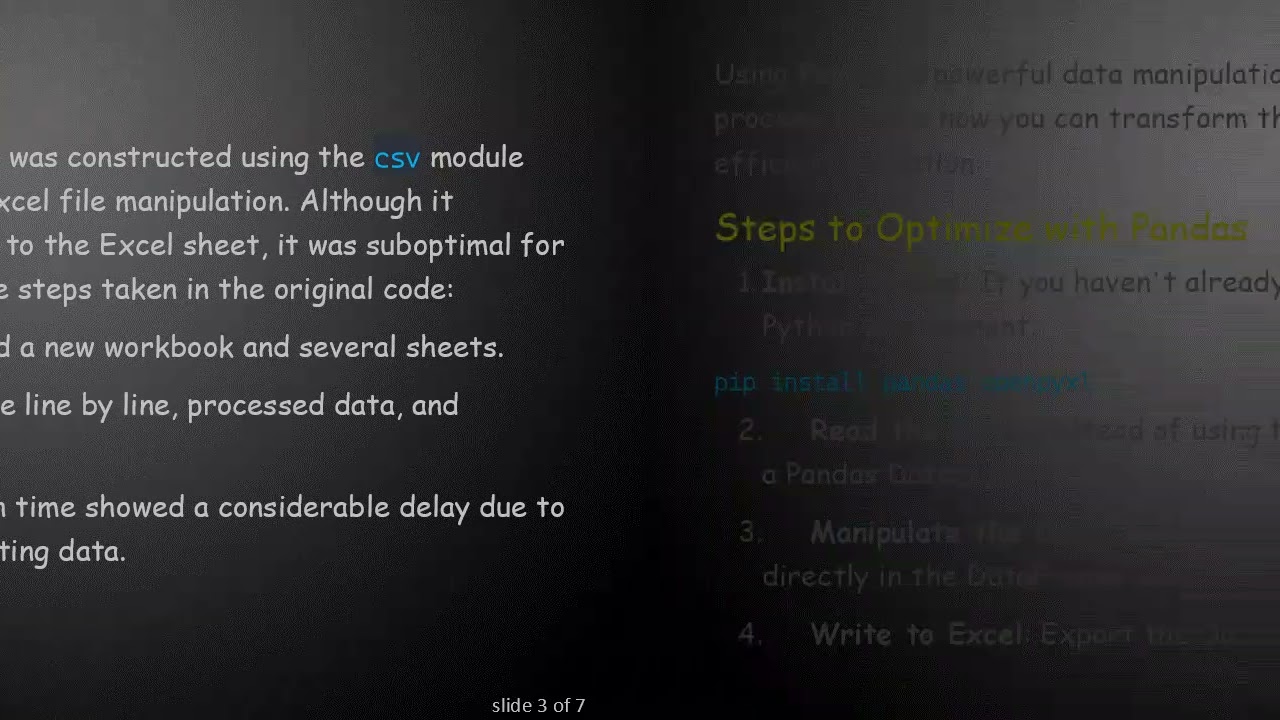
The initial code used to perform the task was constructed using the csv module combined with the openpyxl library for Excel file manipulation. Although it successfully read the text file and wrote to the Excel sheet, it was suboptimal for larger datasets. Here’s a brief look at the steps taken in the original code:
Workbook Creation: The code created a new workbook and several sheets.
Data Reading: It read a large text file line by line, processed data, and appended it to the new Excel sheet.
Execution Delay: Measuring execution time showed a considerable delay due to the methods used for reading and writing data.
The Solution
Using Pandas, a powerful data manipulation library, can significantly optimize the process. Here's how you can transform the task into a straightforward and efficient operation:
Steps to Optimize with Pandas
Install Pandas: If you haven't already, ensure that Pandas is installed in your Python environment.
[[See Video to Reveal this Text or Code Snippet]]
Read the Data: Instead of using the csv reader, load your data directly into a Pandas DataFrame.
Manipulate the Data: Add any necessary columns or perform calculations directly in the DataFrame.
Write to Excel: Export the DataFrame to an Excel file in one go.
Example Code
Here's how to efficiently read from your text file and write to an Excel sheet using Pandas:
[[See Video to Reveal this Text or Code Snippet]]
Advantages of Using Pandas
Speed: The use of Pandas allows for faster file operations due to its optimized code.
Ease of Use: It simplifies data manipulation, making it easier to add columns and perform arithmetic operations.
Better Memory Management: Pandas manages larger datasets more efficiently than traditional looping constructs.
Conclusion
By switching to the Pandas library, the task of reading from a delimited text file and writing to an Excel sheet becomes significantly more efficient. This change not only reduces execution time but also enhances code readability and maintainability. Whether you are dealing with small or large datasets, adopting this method will streamline your processes and ultimately save you precious time.
Embrace the power of Pandas to transform the way you process your data in Python! If you have any questions or need further clarification on using Pandas, don't hesitate to ask. Happy coding!
Доступные форматы для скачивания:
Скачать видео mp4
-
Информация по загрузке:



![Ultimate Data Analyst Bootcamp [24 Hours!] for FREE | SQL, Excel, Tableau, Power BI, Python, Azure](https://image.4k-video.ru/id-video/wQQR60KtnFY)


![Python - Полный Курс по Python [15 ЧАСОВ]](https://image.4k-video.ru/id-video/cfJrtx-k96U)


