Adding an LSTM Layer After TensorFlow Hub Pretrained Model
Автор: vlogize
Загружено: 2025-10-11
Просмотров: 0
Learn how to seamlessly integrate an `LSTM layer` into your Keras model after loading a TensorFlow Hub pretrained model for text classification.
---
This video is based on the question https://stackoverflow.com/q/68612469/ asked by the user 'Mus' ( https://stackoverflow.com/u/10896385/ ) and on the answer https://stackoverflow.com/a/68614222/ provided by the user 'Frightera' ( https://stackoverflow.com/u/13726668/ ) at 'Stack Overflow' website. Thanks to these great users and Stackexchange community for their contributions.
Visit these links for original content and any more details, such as alternate solutions, latest updates/developments on topic, comments, revision history etc. For example, the original title of the Question was: Add LSTM layers after tensorflow-hub pretrained model
Also, Content (except music) licensed under CC BY-SA https://meta.stackexchange.com/help/l...
The original Question post is licensed under the 'CC BY-SA 4.0' ( https://creativecommons.org/licenses/... ) license, and the original Answer post is licensed under the 'CC BY-SA 4.0' ( https://creativecommons.org/licenses/... ) license.
If anything seems off to you, please feel free to write me at vlogize [AT] gmail [DOT] com.
---
Adding an LSTM Layer After TensorFlow Hub Pretrained Model: A Step-by-Step Guide
When working with neural networks for text classification, particularly in natural language processing (NLP), developers often leverage pretrained models to benefit from existing language knowledge. Using TensorFlow Hub, you can load pretrained models like Word2vec, but you might face challenges when trying to add layers such as LSTM. This guide will address a common issue where an LSTM layer cannot process the output shape from the TensorFlow Hub model and will guide you on how to resolve it.
The Problem: Layer Shape Compatibility
While building a Keras model for text classification, you may initialize it with a TensorFlow Hub pretrained model as follows:
[[See Video to Reveal this Text or Code Snippet]]
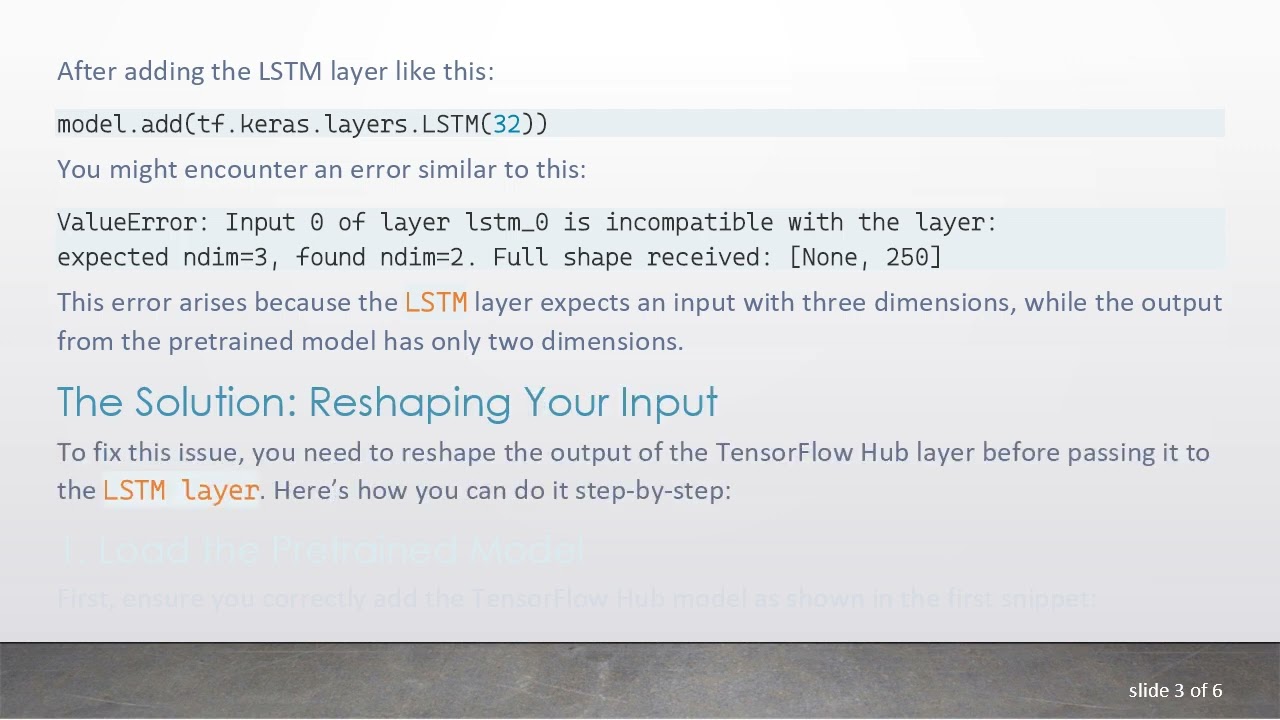
After adding the LSTM layer like this:
[[See Video to Reveal this Text or Code Snippet]]
You might encounter an error similar to this:
[[See Video to Reveal this Text or Code Snippet]]
This error arises because the LSTM layer expects an input with three dimensions, while the output from the pretrained model has only two dimensions.
The Solution: Reshaping Your Input
To fix this issue, you need to reshape the output of the TensorFlow Hub layer before passing it to the LSTM layer. Here’s how you can do it step-by-step:
1. Load the Pretrained Model
First, ensure you correctly add the TensorFlow Hub model as shown in the first snippet:
[[See Video to Reveal this Text or Code Snippet]]
2. Reshape the Output
Next, insert a Reshape layer immediately after the KerasLayer. The Reshape layer will convert the output from a two-dimensional shape (None, 250) to a three-dimensional shape (None, 250, 1) which is compatible with the LSTM layer:
[[See Video to Reveal this Text or Code Snippet]]
3. Add the LSTM Layer
Finally, add your LSTM layer as intended:
[[See Video to Reveal this Text or Code Snippet]]
Complete Model Code
Combining all of these elements, your complete model definition will look like this:
[[See Video to Reveal this Text or Code Snippet]]
Summary
By incorporating the Reshape layer, you ensure that the output from the TensorFlow Hub model aligns with the requirements of the LSTM layer. The model summary will now show that the output shape from the Reshape layer is (None, 250, 1), which is compatible for LSTM processing.
Key Takeaways:
Understanding Layer Requirements: Each layer in your neural network model has different requirements regarding the shape of input data.
Using Reshape: Reshape layers are a handy tool for adjusting the shape of outputs to fit the requirements of subsequent layers.
Debugging Shape Issues: When facing shape errors, reviewing the expected shapes of each layer and modifying where necessary is crucial.
Following these steps will ensure that you can successfully integrate an LSTM layer into your text classification model using Tensorflow Hub. Happy coding!
Доступные форматы для скачивания:
Скачать видео mp4
-
Информация по загрузке: