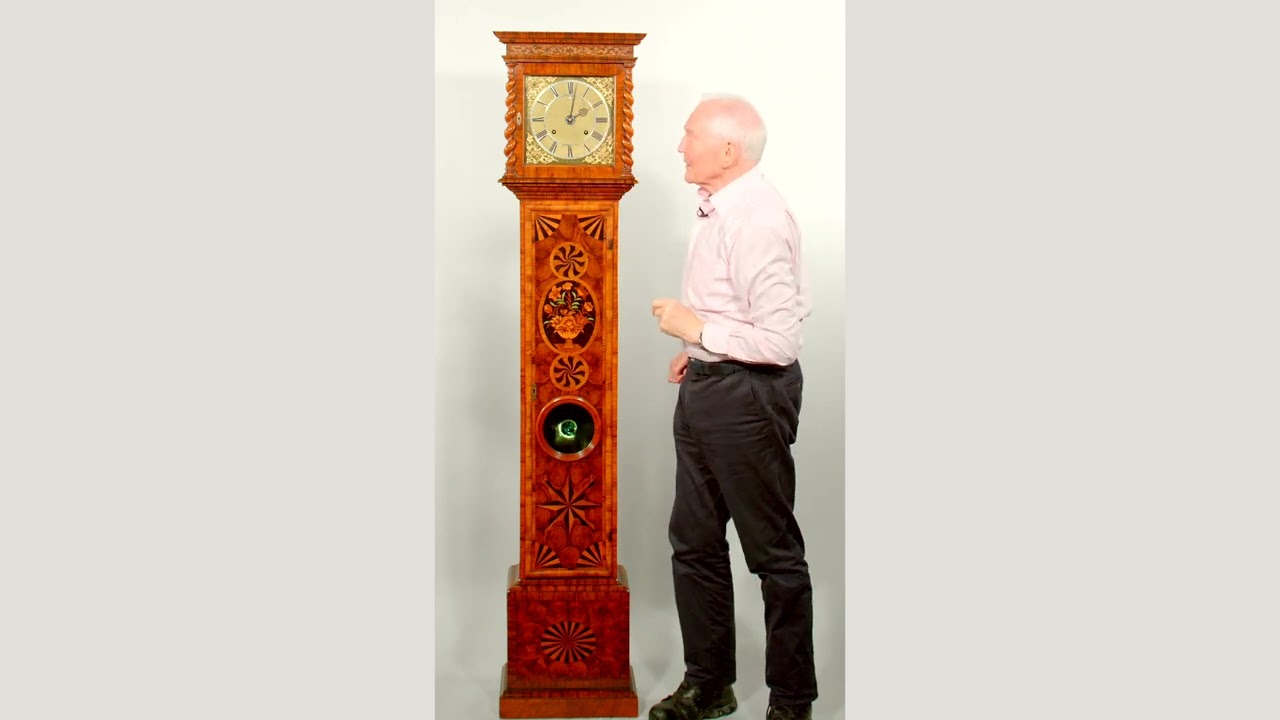
A rare walnut oyster, parquetry and marquetry panelled, month-going longcase clock Knibb, Circa 1685
Автор: Dr John C Taylor
Загружено: 2022-05-31
Просмотров: 2603
Joseph Knibb, London
Circa 1685
A rare walnut oyster, parquetry and marquetry panelled, month-going longcase clock with skeletonised chapter ring, previously in the Wetherfield collection
Height
6 feet 4¾ inches (1950 mm)
Case
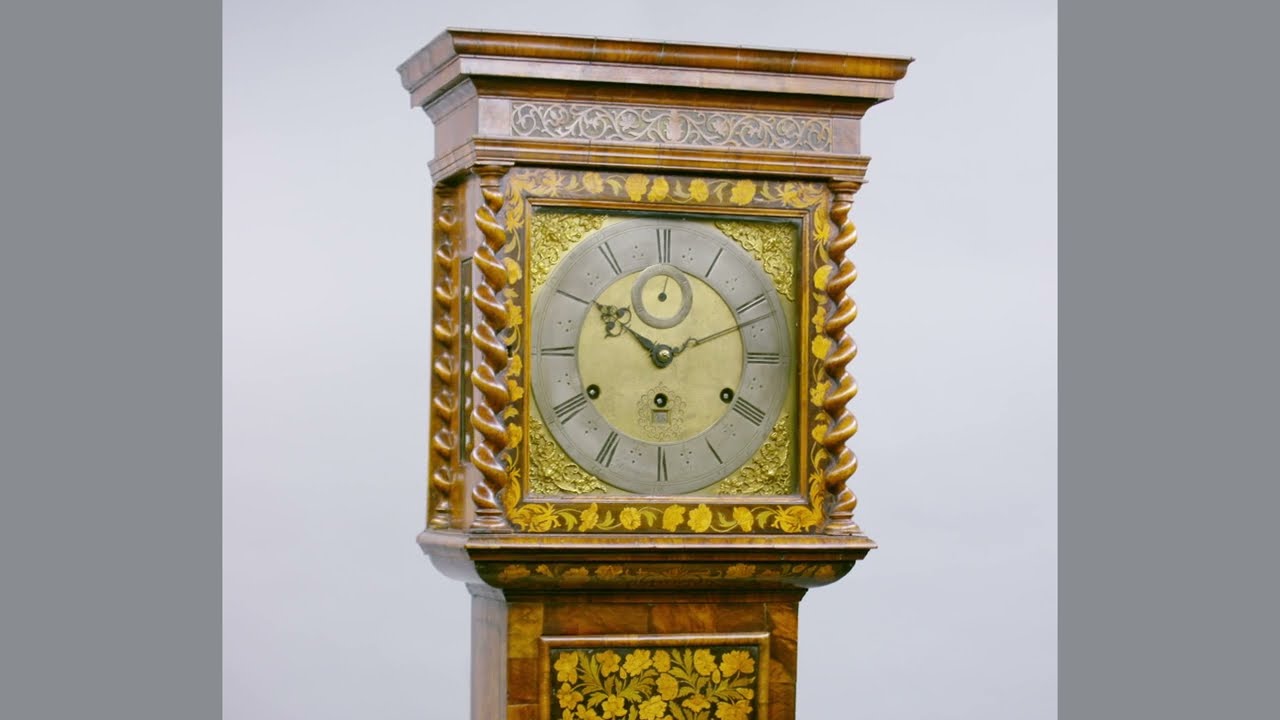
The case veneered in walnut oysters with parquetry and a floral marquetry panel on an oak carcass. Cross-grain walnut main mouldings to the hood, the frieze with pierced walnut fret to the front, above the walnut Solomonic reflective columns, with integral turned capitals and bases, flanking the dial aperture and with quarter columns behind. The trunk with convex throat mouldings, above the trunk door framed by D-end cross-grain mouldings and inset with fan parquetry corners of ebony and boxwood above two conforming wavy edge roundels and an oval marquetry panel of a bird in an urn of flowers with green stained foliage, with a further parquetry star and corners below the large circular glazed pendulum lenticle, all set within a walnut oyster ground. The conforming walnut base with a parquetry roundel, the skirting later. Wetherfield Collection 1928 label pasted inside the trunk door.
Dial
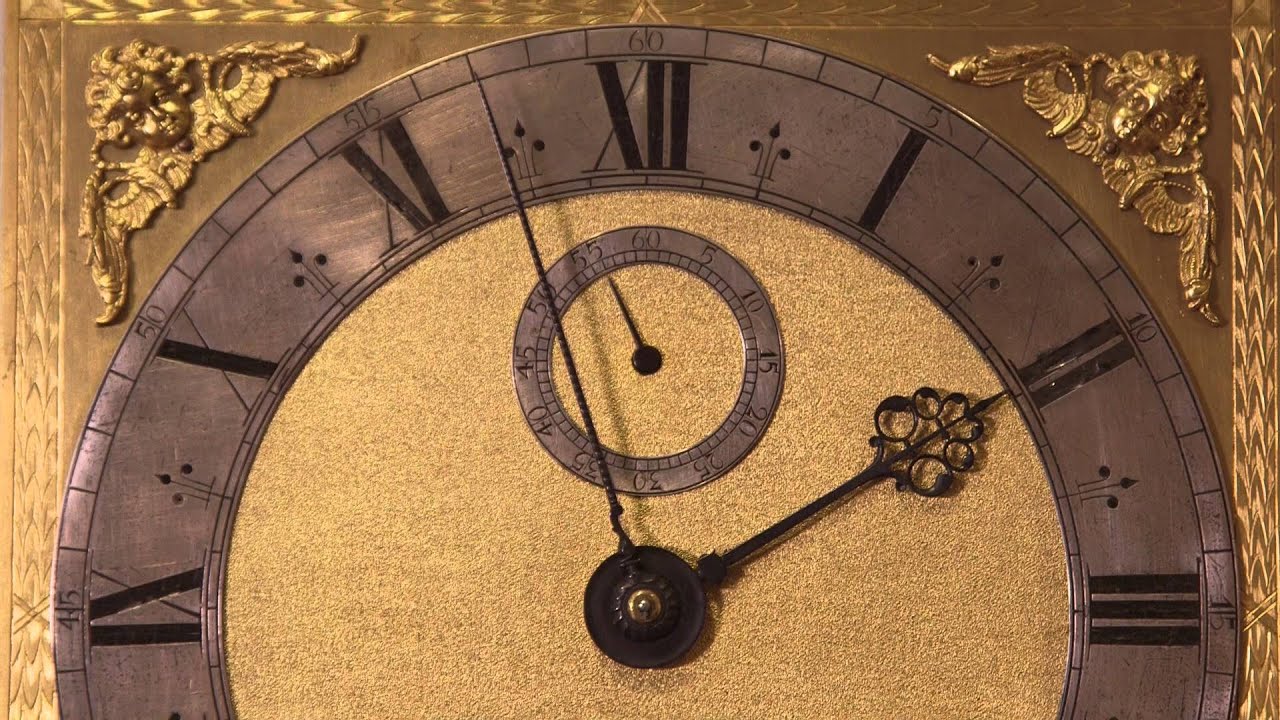
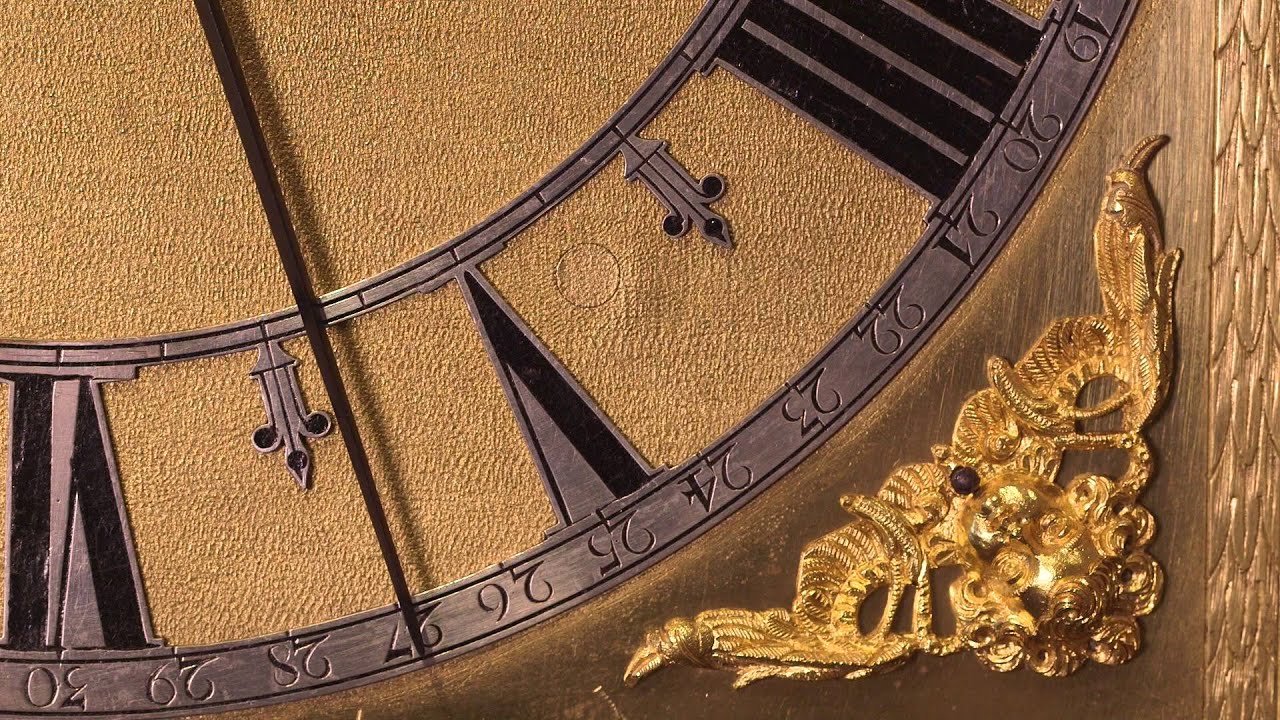
The 10 inch square gilt-brass dial, winged cherub and scroll corner spandrels with engraved foliage between and signed along the lower edge Joseph Knibb, London, the silvered brass skeletonized chapter ring with every Arabic minute numbered outside the Roman chapter with simple dot half-hour marks, the finely matted centre inset with a square date aperture below XII, with well pierced and sculpted blued steel hands, the dial fixed with four latched dial feet.
Duration
One month
Movement
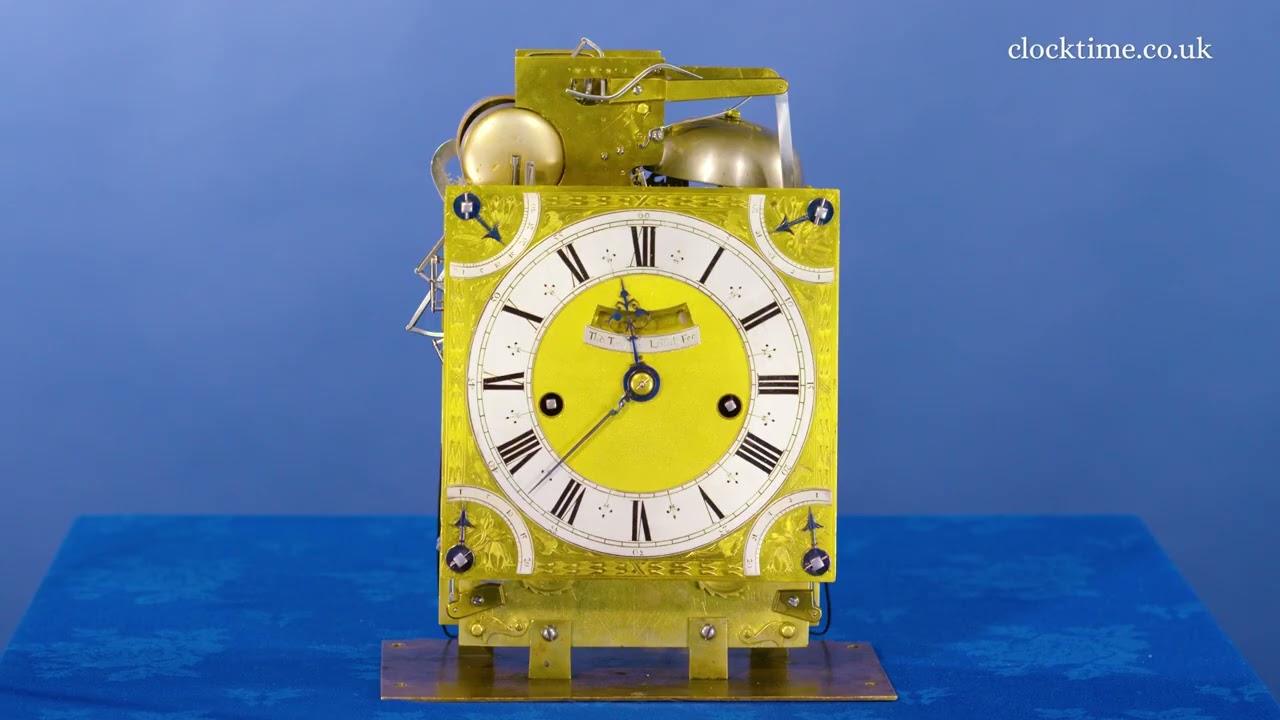
The typical Knibb movement with six fine knopped pillars, latched to the frontplate. The going train with anchor escapement and pallet cut-out in the backplate, the pallet-arbor cocked and the pendulum suspension with fine adjustment butterfly-nut above, the strike train with an outside countwheel governing the hour strike. Both trains with five wheels, and reverse wound, for month duration.
Escapement
Anchor with one-second pendulum
Strike Type
Countwheel hour
Provenance
The Wetherfield Collection no.31, sale catalogue no.189;
1928, purchased by H. Pendleton Rogers;
Bonhams, 14 December 2011, lot 115, sold for £143,400;
The John C Taylor Collection, inventory no.143
Exhibited
2018, London, Innovation & Collaboration, exhibit no.76
Literature
Cescinsky, English Furniture of the 18th Century, 1911, Vol.1, fig.272;
Britten’s, Old Clocks and Watches, 1956. 5th Edition, p.507 illus.;
WE Hurcomb, The Wetherfield collection of 222 clocks, 1928, p.45 illus.;
Bruton, The Wetherfield Collection of Clocks, 1981, plate 82
Garnier & Hollis, Innovation & Collaboration, 2018, p.275
Comparative Literature RA Lee, The Knibb Family Clockmakers, 1964, Plates 20 and 23;
Dawson, Drover and Parkes, Early English Clocks, 1982, plate 340
This well known clock has been recorded, published and illustrated in various books for over 100 years. Very aesthetically pleasing, skeletonised chapter rings and the requirement for close-edged dial matting was both difficult and time consuming, as a result it was reserved for the best productions of a clockmaker’s output. Although subject to some restoration over the years, this fine and undoubtedly expensive oyster, marquetry and parquetry case complements both the dial and its long duration, confirming this clock was priced at the top end of Knibb’s output.
https://www.johnctaylor.com/
Доступные форматы для скачивания:
Скачать видео mp4
-
Информация по загрузке: