Lionel Rogg (pedal harpsichord) Buxtehude, preludes and fugues
Автор: Harpsichord Vinyl Gallery
Загружено: 2016-10-18
Просмотров: 37216
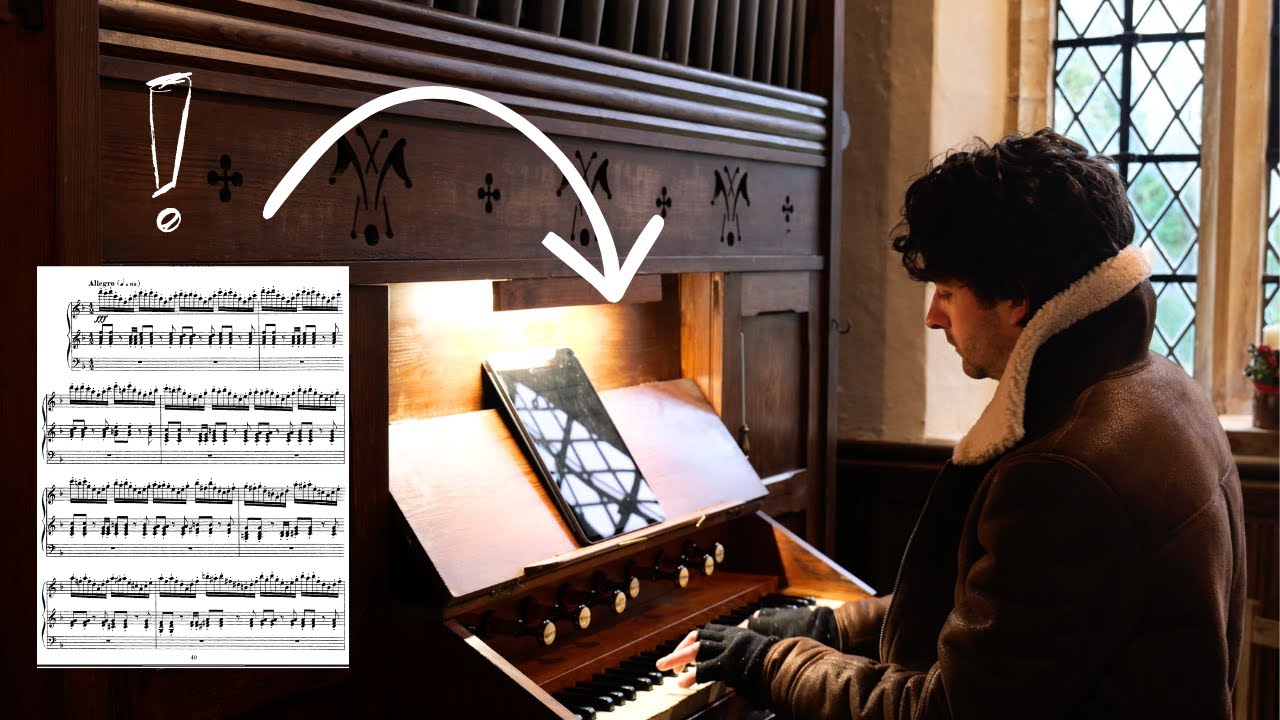
Recorded in Lionel Rogg's home, Geneva, by Oryx Sound Studios, May 1967. Recording Engineer: Harry Mudd. Producer: Michael Meacock. Photograph on front of cover: Lionel Rogg playing his Wittmayer Pedal-harpsichord (used in this recording) in his Geneva home. Pressing: Orlake. Cover printed by Senol Ltd. Printing Company. Cover design: Lawrence Perry.
ORYX RECORDINGS 1732, Walton on Thames
Side A
00:00 I Prelude & Fugue in a minor BuxWV 153
05:54 2 Passacaglia in d minor (Dorian) BuxWV 161
11:30 3 Prelude, Fugue & Chaconne in C Major BuxWV 137
Side B
16:20 1 Prelude & Fugue in g minor BuxWV 149
23:07 2 Ciacona in e minor BuxWV 160
28:10 3 Prelude & Fugue in F sharp minor BuxWV 146
DIDERIK BUXTEHUDE (1637-1707)
Of all the various musical influences that affected Bach, perhaps
the most important as well as the most direct is that of Diderik
Buxtehude, to hear whom Bach as a youth walked from Arnstadt
to Liibeck, a distance of two hundred miles. Buxtehude's father,
although a Danish subject, was of German origin; his mother was
Danish. And although the younger Buxtehude was a Dane by birth
(whether born at Helsinor-Shakespeare's Elsinore-or Helsingborg,
across the water, in Sweden), he was a North German by
adoption. He ~robably studied witlt his father, who was organist
at the Olai Church in Elsinore for thirty-two years. One of the
conditions of Buxtehude's appointment to the Marienkirche at
Liibeck was that he should marry the daughter of his predecessor,
Franz Tunder. This he did on 3rd August, 1668, less than four
months after taking up his duties at the age of thirty. More than
thirty years later, when Buxtehude himself thought of retiring,
marriage with his own unmarried daughter was a condition imposed
on his wou,d-be successor. The 1 8-year old Handel was not
attracted to the idea in 170 3-(that the fate of music in England
f~r the next two centuries was decided by the looks of the
daughter of a Liibeck organist is a chastening thought)-nor was
the 20-year old Bach in 170~ .
If Johann Sebastian successfully withstood the blandishments of
the lady, he no less successfully learnt from her father, for in
many of Bach's organ works stylistic features derived from
Buxtehude are apparent. Buxtehude was a famous man in his day,
but his delayed posthumous fame was long based on his position as
the greatest of Bach's immediate precursors. Today, his music is
valued for its intrinsic worth and not only for its historical
importance. Scholars like Spitta, Pirro, Seiffert and, in more
recent years, Josef Hedar, have helped it take its rightful place.
Buxtehude's work, combining as it does the austere and the
flamboyant, the monumental and passionate, the static and the
urgent, is the musical counterpart of Gothic architecture.
In his organ music, Buxtehude often succeeds in imposing a unity
on the various sections of a piece by subtle variations of the
thematic material in its various sections. This is a feature of the
Prelude and Fugue in a minor, the first of three in that key in
the Hedar Edition (Spitta, Vol I, No. 9). The Prelude develops
in canonic imitations from the jagged, to-and-fro semiquaver
pattern in common-time heard at the outset, winding over a sixbar
dominant pedal-point to a tonic major chol'd. Out of this
there springs the first fugue-subject with its even pattern of
descending repeated notes. Buxtehude inverts this in the course
of the Fugue, which ends in the major after a short cadential
flourish . Out of this tonic major chord there now springs the
subject of the second fugue, a chromatic variant of the first
fugue-subject and in six-four instead of common-time. A toccatalike
coda, back in common-time and ending with a long tonic
pedal-point concludes the work.
Buxtehude's Passacaglia probably owes its survival to Bach, for
its only known source is the so-called Andreas Bach-Buch, a
manuscript in the hand of Bernhard Bach, the brother of Andreas
and also a nephew of Johann Sebastian from whom he received
his musical education. The origin of the passacaalia was a dance in
triple-time, but by Bach's time the term had come to be applied
to an elaborate series of variations on a theme (in triple-time) which was repeated in each variation-usually, but not always, in the
bass part, and in the same key. This definition applies to Bach's own Passacaglia, perhaps his organ masterpiece, but not to
Buxtehude's where the ostinto theme is invariably in the bass and changes key. The structure of Buxtehude's Passacaglia is solid
and symmetrical. Its four-bar theme gives rise to a movement in four sections of equal length. In each of these the theme is
heard seven times. The first and last sections, in d minor, enclose a middle pair in F major and a minor. The sections are linked by
brief modulations.
Felix Aprahamian

Доступные форматы для скачивания:
Скачать видео mp4
-
Информация по загрузке: