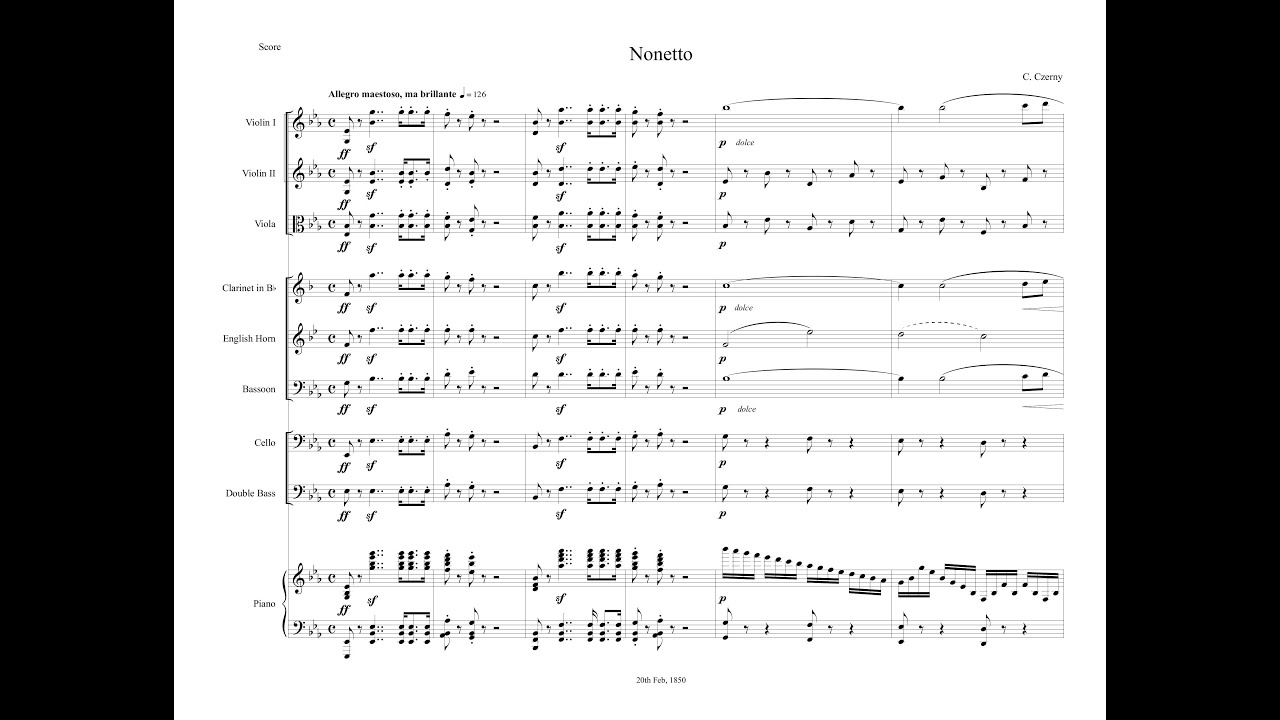
Carl Czerny – Nonet (clarinet, English horn, bassoon, string quintet & piano)
Автор: ContrebasseClassique
Загружено: 2026-01-17
Просмотров: 58
Carl Czerny (1791-1857) – Nonet in E-flat major for piano, clarinet, English horn, bassoon, 2 violins, viola, cello and double bass (1850)
#czerny #carlczerny #nonet
Brooklyn Theatre Salon Ensemble
Recording:
I. • Nonet: I. Allegro maestoso
II. • Nonet: II. Andante
III. • Nonet: III. Scherzo
IV. • Nonet: IV. Finale
Score available here: https://imslp.org/wiki/Category:Czern...
Looking for new chamber music repertoire? Go take a look at the ContrebasseClassique website: https://www.contrebasseclassique.com/
Details by Edition Silvertrust: https://www.editionsilvertrust.com/cz...
Czerny's Nonet in E flat Major was not published during his lifetime. The manuscript lay moldering in the Vienna City Library (Wien bibliothek im Rathaus) for more than 150 years before it received its first publication. On the title page to the manuscript, Czerny wrote, "Am 20. Februar 1850 begonnen und fur Graf Fay in Ungam komponiert" (Begun the 20th of February 1850 and composed for Count Fay in Hungary). Count Istvan Fay for whom the music was composed, owned a large estate near the Hungarian town of Sopron and was a well-known music collector. It seems highly unlikely that Czerny ever delivered a copy of the manuscript to the count.
The instrumentation of the Nonet seems to have been influenced by Schubert's Octet for winds and strings, although Czerny substituted an English Hom for the Oboe and, of course, added a piano part. The opening movement, Allegro maestoso, ma brillante, begins with a couple of resounding chords. The main theme is dominated by its rhythm and to some extent lends the music a symphonic aura. The English Horn is entrusted to present the song-like main subject of the second movement, Andante. A dialog between the winds and piano continues for some time before the strings finally are allowed to join in. Next comes a dramatic, hard driving Scherzo with a nicely contrasting and lyrical trio section, in which the first violin takes the lead. Here, the music is reminiscent of Schubert. The finale, Introduzione andante-Allegro vivace, begins rather like the second movement but the Andante does not last long and is brought to an end with a clarinet cadenza which leads to the main section, an exciting energetic Allegro.
Carl Czerny (1791-1857) is remembered as one of the most famous piano teachers of all time. He was a child prodigy. When Beethoven heard Czerny play, he invited the boy to study with him, which Czerny did for three years. He also studied with Muzio Clementi and Johann Nepomuk Hummel. Besides being Liszt's only real teacher, Czerny taught a host of other famous pianists. Today, the only music of Czerny's which is ever played are his pedagogical works for pianists such as his etudes and his famous Art of Finger Dexterity and his School of Velocity. But Czerny composed over 1000 works in virtually every genre although most were for the piano. The bulk of his oeuvre---potpourris based on various opera arias and such which made his publishers rich, was composed at the their request. These salon pieces were incredibly popular throughout the 19th century but for this very reason Czerny was attacked by most critics as nothing more than a hack. Very few of his other works received more than a premiere and it is highly doubtful that his critics every heard his symphonies, lieder or chamber music. Had they done so, their opinion about Czerny and his music would certainly have been very different because Czerny was not only a master craftsman but also a composer with a gift for melody. This Nonet is an excellent example of his extraordinary talent.
Доступные форматы для скачивания:
Скачать видео mp4
-
Информация по загрузке:




![[manuscript score] Luigi Boccherini: String Quintet with double bass Op.39 No.3, G.339](https://image.4k-video.ru/id-video/grOaF2xXFEY)


![[Score] Ravel - Le Tombeau de Couperin (arr. for wind quintet by Mason Jones)](https://image.4k-video.ru/id-video/jrbW1u667fE)