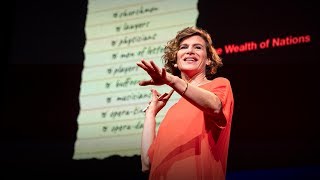
Secrets of Economic Growth | Ricardo Hausmann
Автор: World Economic Forum
Загружено: 2015-03-10
Просмотров: 163807
http://www.weforum.org/
Economic Complexity is like a game of Scrabble, says Ricardo Hausmann. The more letters you have, the more words you can make; the more capabilities a country has, the more diverse products it can generate. In this video for the World Economic Forum Hausmann, from the Harvard Kennedy School of Government, uses metaphors and metrics to explain the gap between rich and poor countries.
Click on the video for an in depth analysis, or read key quotes below
On the growing gap between rich and poor
“The secrets of economic growth is the question that Alan Smith started economics with: what's the origin of the wealth of nations and why are some countries rich and other countries poor? The only thing is that when he wrote “The Wealth of Nations”, the richest country in the world was probably the Netherlands, and was about four times richer than the poorest country of the world."
“Today, the richest countries in the world are about 250 times richer than the poorest countries in the world. You might say well, what’s problem of the difference incomes between countries? It’s not only between countries. Within the same country - with the same exchange rates, same interest rates, same tax regimes et cetera - you have differences in productivity per worker of about a factor of 10. That's a truly puzzling result.”
On growth and productivity
“If you think about technology as the explanation for these humongous difference is in productivity, you have to ask yourself why technology doesn’t diffuse. The problem is that in order to implement technology there is a crucial ingredient that at some stage in the production you will need: “know-how”. You need the ability of the brain to do things, something that the brain must be trained to do it and that takes a long time. The diffusion of that is complicated.”
“In order to get our minds around “know-how”, I'm going to make a stylised comparison between a traditional Inuit - and here is the Inuit engaged in food production, here in housing construction, and here engaged in transportation - to this guy sitting by a computer wearing glasses. Who has more know-how? Well, the guy uses glasses and doesn't have a clue as to how to make glasses. He has a headset and a computer and doesn't know how to make those things either.”
“If I put this guy in the Arctic he will either freeze or starve to death, so there is no practical way that you can say that he has more know-how than the Inuit. But it is possible to say that the society to which this guy belongs knows how to do more things than the society that the Inuit belongs to - not because this society is a bunch of geniuses, but because in this society there are some people who know how to make glasses, know how to make headsets or know how to make other things.”
“It's the diffusion of that know-how in society that underpins the capacity to know how to do more things and more complicated things. That doesn't mean the secret of progress is to have large companies. This is a very big chicken company. But it’s not a very complex company, as if you move workers around not much will happen to the production process. But you cannot do that in an orchestra. Here each worker is contributing a different bit of know-how to the whole. So, as you need the whole set of instruments to make the symphony, it's not what you know, it's the network of know-how to which you are connected.”
On Scrabble and connecting capabilities
So it's being connected to that network, all these other inputs, that allows someone to mobilise all that know-how and to generate productivity. I am going to redescribe this as the game of Scrabble. In Scrabble you have to make words. You are given letters, so think of words as products, words are services. Think of letters as bits of “Know-how.” In order to make something you have to string the bits of know-how together - the same way that you need the different instruments to make a symphony.
"If you only have one kind of letter, you're mostly going to make one kind of word. But if I give you more letters, you get an increasing number of words diversification of what you do and longer words, more complex products. For example the most diverse country in the world is Germany, and there are very few other countries that are able to do the things that Germany is able to do. While the poorest countries in the world make few things and they make things that everybody knows how to make. They make shorter words. So the more letters you have, the more complex words."

Доступные форматы для скачивания:
Скачать видео mp4
-
Информация по загрузке: