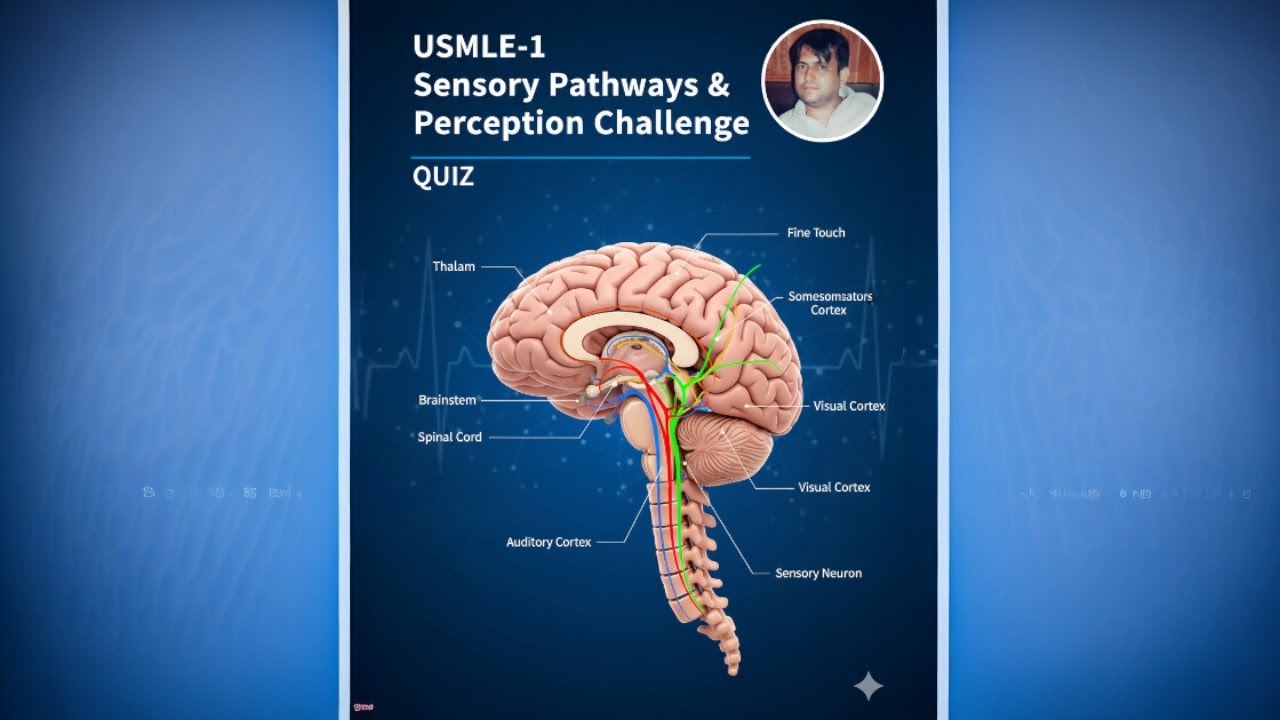
Sensory Pathways & Perception Challenge base video-5
Автор: Dr Sheen Medical lectures
Загружено: 2026-01-13
Просмотров: 6
The Dorsal Column–Medial Lemniscal (DCML) system is the brain’s high-speed, high-precision data highway. It is designed to tell the mind exactly where and how intense a touch or movement is.
1. Precision through Lateral Inhibition
When you touch a single point on your skin, the signal spreads out like a wave. To prevent this from feeling "blurry," the brain uses lateral (surround) inhibition.
The Mechanism: The most excited neurons in the center send "stop" signals to their neighbors.
The Result: This blocks the lateral spread of the signal, creating a sharp "peak" of excitation. This is why you can distinguish two needles just 1–2 mm apart on your fingertips (Two-Point Discrimination).
2. Sensory Intensity: The Weber-Fechner Principle
The nervous system can handle a massive range of intensities (from a whisper to an explosion).
The Rule: We detect the ratio of change, not the absolute amount.
Example: If you are holding 30g, you notice a 1g addition. If you are holding 300g, you won't notice that 1g; you need 10g to feel the difference. This ensures the system isn't "swamped" by strong background stimuli.
3. Position Senses (Proprioception)
This system tells you where your limbs are without you looking at them.
Static Position: Conscious perception of body part orientation.
Dynamic (Kinesthesia): Perception of the rate of movement.
The Hardware: Muscle spindles are the primary receptors for mid-range joint angles. At the extremes of joint movement, Ruffini endings and Pacinian corpuscles take over.
4. The Anterolateral Pathway: The "Crude" Alternative
While the DCML is fast and precise, the Anterolateral System is slower and less specific.
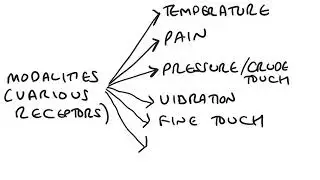
Function: It carries "survival" sensations like pain, temperature, tickle, itch, and sexual sensations.
Difference: It has poorer localization and fewer gradations of intensity (10–20 levels vs. 100 in the DCML).
5. Corticofugal Signals
The brain doesn't just receive; it talks back. Corticofugal signals travel from the cortex down to the relay stations. These signals are almost entirely inhibitory, acting as a "volume knob" to sharpen focus or decrease sensitivity when the input is overwhelming.
Would you like me to create a summary table comparing the specific sensory modalities of the DCML versus the Anterolateral system?
Доступные форматы для скачивания:
Скачать видео mp4
-
Информация по загрузке: