Transition Metals | Ultimate Guide | Full Topic | A Level Chemistry
Автор: The Chemistry Tutor
Загружено: 2025-04-01
Просмотров: 51704
Transition Metals | Ultimate Guide | Full Topic | A Level Chemistry
Transition metals are some of the most versatile elements in the periodic table, forming complex ions, exhibiting variable oxidation states, and acting as catalysts in key industrial processes. In this A Level Chemistry masterclass, we break down everything you need to know about transition metals in one comprehensive video. Whether you're revising for exams or looking to deepen your understanding, this video is designed for all exam boards.
🔹 What You'll Learn:
✔️ Electron configurations & properties of transition metals
✔️ Complex ions, ligands, and isomerism
✔️ Why transition metals are coloured & how to use a colorimeter
✔️ Redox reactions, electrode potentials & redox titrations
✔️ Catalysis – homogeneous, heterogeneous & autocatalysis
📌 Timestamps
00:05 Introduction
00:20 What are transition metals?
01:24 Electron configuration of transition metals
05:22 General properties of transition metals
06:34 Complexes
09:19 Monodentate ligands
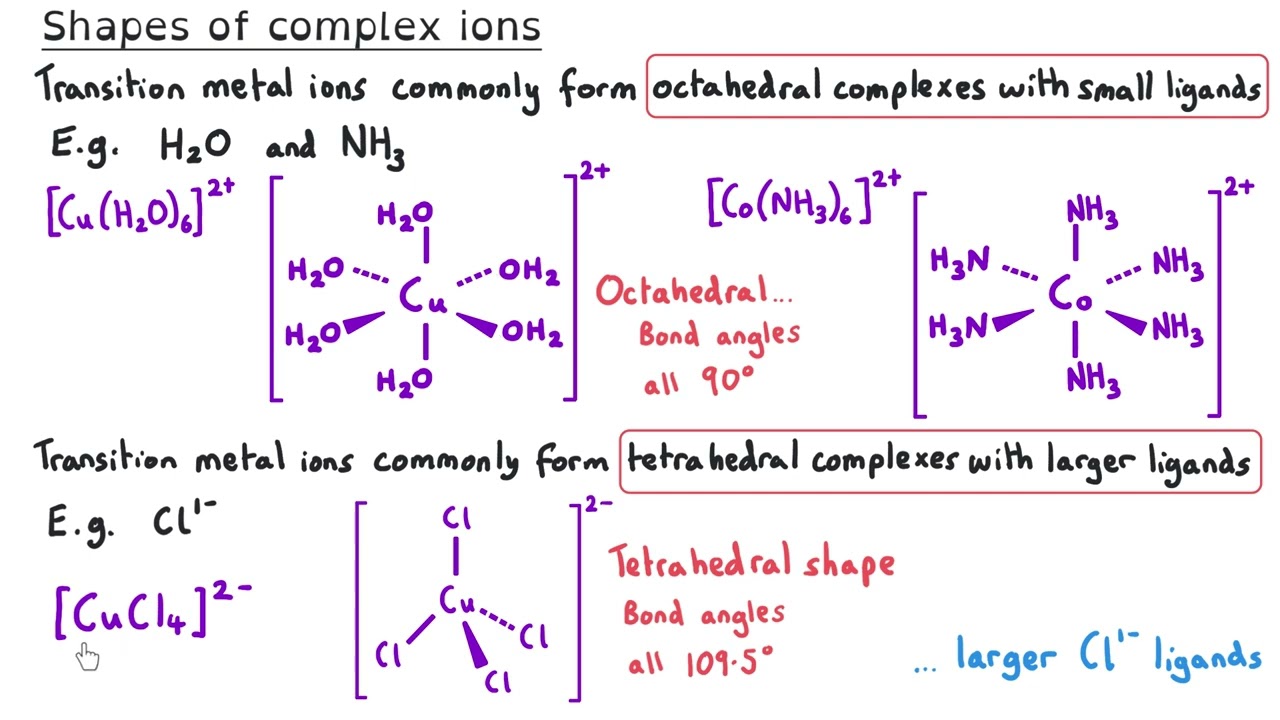
10:29 Shapes of complex ions
12:04 Bidentate ligands
14:55 Multidentate ligands
16:46 Drawing the shape and working out oxidation states
18:23 Tollens reagent
20:16 Geometric Isomerism | Cis-/trans-
21:39 Cisplatin
22:57 Optical Isomerism in complexes
25:12 Ligand substitution reactions
26:33 Substitution involving the chloride ligand
28:17 The chelate effect
31:41 Haem
33:46 How cisplatin works
35:43 Absorbing, transmitting, and reflecting light
37:10 Energy difference and the d sub-shell
40:37 Why are colours different?
43:23 Using a colorimeter
45:50 Calibration curves | Determining an unknown concentration
47:53 Variable oxidation states and electrode potentials
49:59 Redox potentials
52:03 Vanadium and Zinc
54:52 Redox titrations | Iron & Potassium Manganate (VII)
58:23 Redox titrations | Ethanedioate & Potassium Manganate (VII)
1:02:03 Redox titrations | Hydrogen Peroxide & Potassium Manganate (VII)
1:05:13 What are catalysts and how do they work?
1:06:53 Heterogeneous catalysts
1:08:15 How heterogeneous catalysts work
1:09:38 Catalyst efficiency and poisoning
1:11:23 The Contact Process and vanadium (V) oxide
1:13:33 Homogeneous catalysts
1:15:45 Iron (II) catalyst | Iodide ions and peroxodisulfate ions
1:18:51 Redox potentials and catalysis
1:20:47 Autocatalysis | Potassium manganate (VII) and ethanedioic acid
1:24:56 Investigating autocatalysis
This A Level Chemistry masterclass gives you exam-ready explanations and real-world applications, perfect for AQA, OCR, Edexcel, and all exam boards!
🔗 Explore More:
🔹Inorganic Chemistry Year 1 Explanation videos Playlist: • Periodicity | Full Topic | A level Chemistry
🔹 Inorganic Chemistry Year 2 Explanation videos Playlist: • Composition & Evolution of the Atmosphere ...
🔹 Inorganic Chemistry Exam Question Walkthrough Playlist: • Period 3 Oxides | Exam Question Walkthrough
🔹Inorganic Chemistry Multiple Choice Walkthrough Playlist: • Periodicity | A level Chemistry | Multiple...
📢 Connect with Us:
📷 Instagram: @chemistrytutor123
🎵 TikTok: @chemistrytutor123
📩 Email: thechemistrytutor123@gmail.com
📌 Hashtags:
#alevelchemistry #transitionmetals #chemistryrevision #redoxreactions #complexions #catalysts #Colorimetry #chemistryexplained #exampreparation #chemistrymasterclass
Correction:
02:15 I read the Ar for scandium instead of titanium. Titanium’s atomic number is 22.
04:53 The electron configurations for Sc³⁺ and Zn²⁺ should be [Ar] 3s².
Доступные форматы для скачивания:
Скачать видео mp4
-
Информация по загрузке: