How to Use unittest.mock.patch for Multiple Returns in Python Testing
Автор: vlogize
Загружено: 2025-09-16
Просмотров: 0
Learn how to efficiently use `unittest.mock.patch` in Python to return different values for a function call made multiple times within your tests.
---
This video is based on the question https://stackoverflow.com/q/62778757/ asked by the user 'Jérémie RPK' ( https://stackoverflow.com/u/9636734/ ) and on the answer https://stackoverflow.com/a/62795527/ provided by the user 'Jérémie RPK' ( https://stackoverflow.com/u/9636734/ ) at 'Stack Overflow' website. Thanks to these great users and Stackexchange community for their contributions.
Visit these links for original content and any more details, such as alternate solutions, latest updates/developments on topic, comments, revision history etc. For example, the original title of the Question was: unittest mock.patch only once
Also, Content (except music) licensed under CC BY-SA https://meta.stackexchange.com/help/l...
The original Question post is licensed under the 'CC BY-SA 4.0' ( https://creativecommons.org/licenses/... ) license, and the original Answer post is licensed under the 'CC BY-SA 4.0' ( https://creativecommons.org/licenses/... ) license.
If anything seems off to you, please feel free to write me at vlogize [AT] gmail [DOT] com.
---
How to Use unittest.mock.patch for Multiple Returns in Python Testing
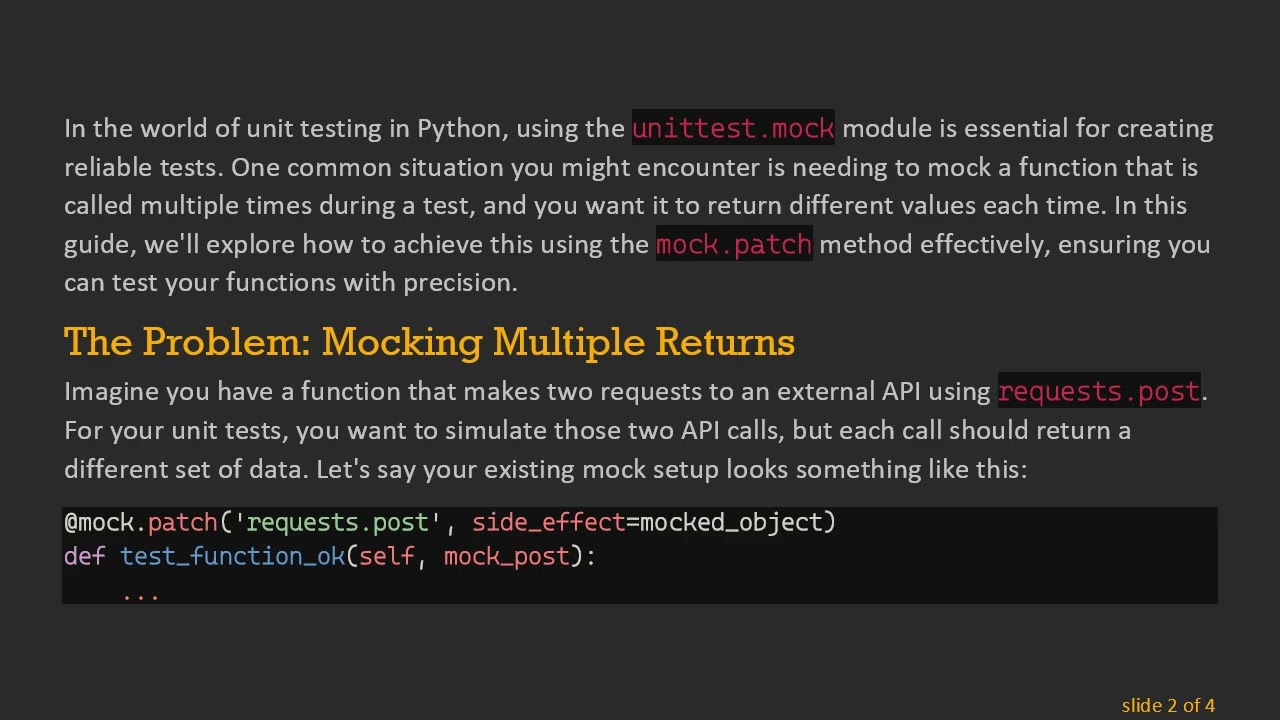
In the world of unit testing in Python, using the unittest.mock module is essential for creating reliable tests. One common situation you might encounter is needing to mock a function that is called multiple times during a test, and you want it to return different values each time. In this guide, we'll explore how to achieve this using the mock.patch method effectively, ensuring you can test your functions with precision.
The Problem: Mocking Multiple Returns
Imagine you have a function that makes two requests to an external API using requests.post. For your unit tests, you want to simulate those two API calls, but each call should return a different set of data. Let's say your existing mock setup looks something like this:
[[See Video to Reveal this Text or Code Snippet]]
Here, you are using a single mock object, which means your function will behave the same way on both calls. This is not what we want. Instead, we want the first call to return mocked_1 and the second call to return mocked_2. But how can we do that without overcomplicating our code?
The Solution: Using side_effect
You can use the side_effect argument to provide a list of values that your mocked function should return on subsequent calls. Here’s how you can implement this:
[[See Video to Reveal this Text or Code Snippet]]
Breaking It Down
Understanding side_effect: The side_effect property can accept a function that is called when the mock is called, or it can accept an iterable (like a list). When using an iterable, each call to the mock will return the next item in the provided list.
Mocking API Calls:
In the example, mocked_1() is called for the first request, and mocked_2() for the second. This ensures that different responses are returned on each call to requests.post.
Advantages:
This method is straightforward and keeps your code clean. It makes it easy to simulate various responses from external services without excessive complexity.
Conclusion
By leveraging unittest.mock.patch with the side_effect parameter, you can seamlessly return different values for successive calls to a mocked function. This approach enhances your testing process by allowing you to simulate real-world interactions more closely, which is critical for validating the behavior of your functions accurately.
Now that you've learned how to implement this technique, you can enhance your unit tests to handle multiple calls and responses more effectively. Happy testing!
Доступные форматы для скачивания:
Скачать видео mp4
-
Информация по загрузке: