Waves Lecture 5 Power, Intensity & Energy in Waves Class 11 Physics CBSE & JEE
Автор: CBSE & JEE Physics | Dr Kedar Pathak
Загружено: 2026-01-09
Просмотров: 3
In this Waves Lecture 5 (Class 11 Physics, CBSE & JEE), we focus on how a travelling sinusoidal wave carries energy along a string, and how to calculate its power and intensity.
We start with a right‑moving sinusoidal wave:
y(x,t) = A sin ω(t − x/v)
and derive the instantaneous and average power crossing a point on the string. Using the tension T and linear mass density μ, we obtain the standard result:
P_av = ½ μ ω² A² v = 2π² μ v A² f²
so the power carried by the wave is proportional to A² and f².
We then define the intensity:
I = P_av / area = ½ ρ ω² A² v
and show how similar expressions appear later in sound waves and even in Thermodynamics / Gas Dynamics (energy flux in compressions and rarefactions).
Numerical examples include:
• Finding power for given μ, T, A, f using P = ½ μ ω² A² v.
• Finding intensity ratio from y–t graphs using I ∝ f² A².
• Finding the highest frequency allowed by a given maximum power.
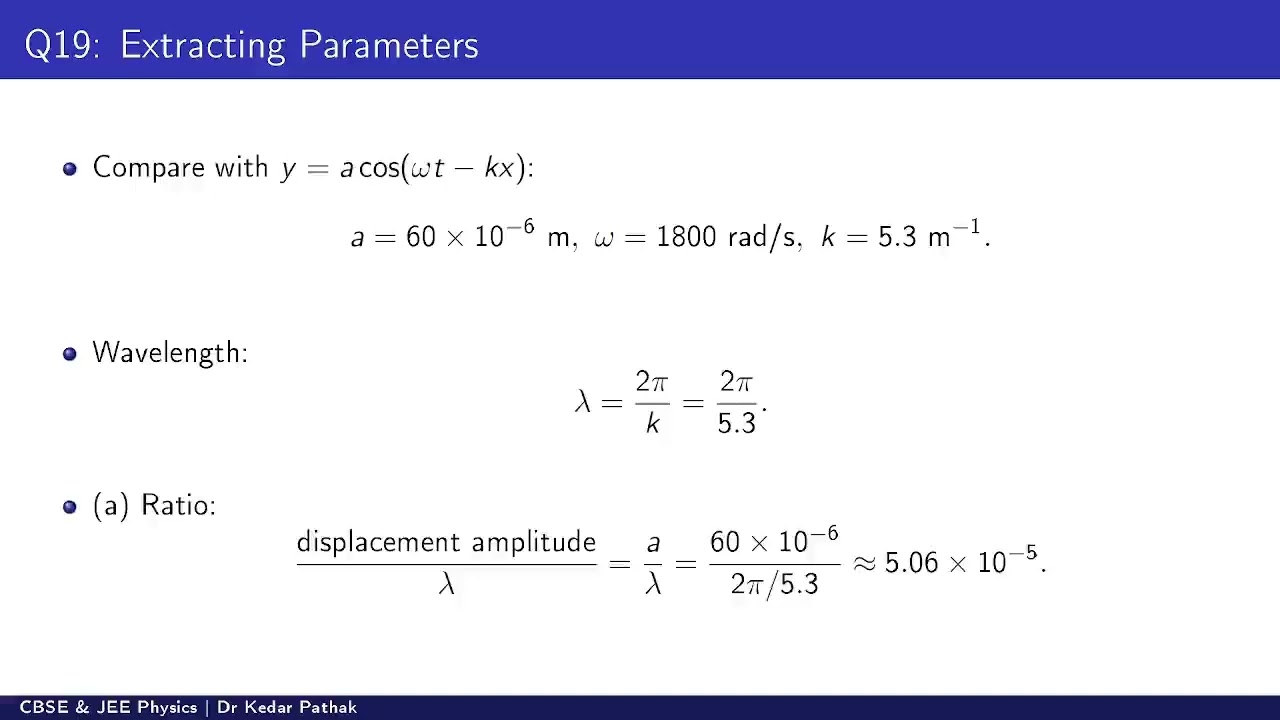
• Reading k, ω, A from a given wave function and computing P.
• Calculating elastic potential energy and kinetic energy of a small string element (showing PE and KE are equal on time average).
• How power and amplitude change when tension is changed, and average energy stored in a length of string.
Finally, we interpret dy/dx:
• In longitudinal waves, dy/dx represents local volume strain (ΔV/V).
• In transverse waves, dy/dx is simply the geometric slope of the string.
These ideas are the bridge from simple string waves to sound waves and energy transport in Thermodynamics and Gas Dynamics.
Channel: CBSE & JEE Physics | Dr Kedar Pathak
Clean, exam‑tight Hinglish lectures with full derivations and graphs, no hype.

Доступные форматы для скачивания:
Скачать видео mp4
-
Информация по загрузке: