Resolving the ValueError in Keras with Multi-Output Neural Networks
Автор: vlogize
Загружено: 2025-10-05
Просмотров: 0
Learn how to fix the `ValueError` when building a Keras neural network with multiple outputs, optimizing your model architecture for better performance.
---
This video is based on the question https://stackoverflow.com/q/63923215/ asked by the user 'Seldi' ( https://stackoverflow.com/u/9277626/ ) and on the answer https://stackoverflow.com/a/63940086/ provided by the user 'Seldi' ( https://stackoverflow.com/u/9277626/ ) at 'Stack Overflow' website. Thanks to these great users and Stackexchange community for their contributions.
Visit these links for original content and any more details, such as alternate solutions, latest updates/developments on topic, comments, revision history etc. For example, the original title of the Question was: ValueError building a neural network with 2 outputs in Keras
Also, Content (except music) licensed under CC BY-SA https://meta.stackexchange.com/help/l...
The original Question post is licensed under the 'CC BY-SA 4.0' ( https://creativecommons.org/licenses/... ) license, and the original Answer post is licensed under the 'CC BY-SA 4.0' ( https://creativecommons.org/licenses/... ) license.
If anything seems off to you, please feel free to write me at vlogize [AT] gmail [DOT] com.
---
Understanding the ValueError in Keras for Multi-Output Models
When working with neural networks in Keras, one of the common challenges developers encounter—especially when implementing complex models with multiple outputs—is the dreaded ValueError. This can be particularly frustrating when you feel confident about your architecture. In this guide, we will delve into a specific scenario of a Keras model designed to have two outputs—one for classification and the other for regression—and outline a solution that might just save the day.
The Problem: Shape Mismatch Error
The error arises when attempting to fit a model with a specific input and output configuration, resulting in the following message:
[[See Video to Reveal this Text or Code Snippet]]
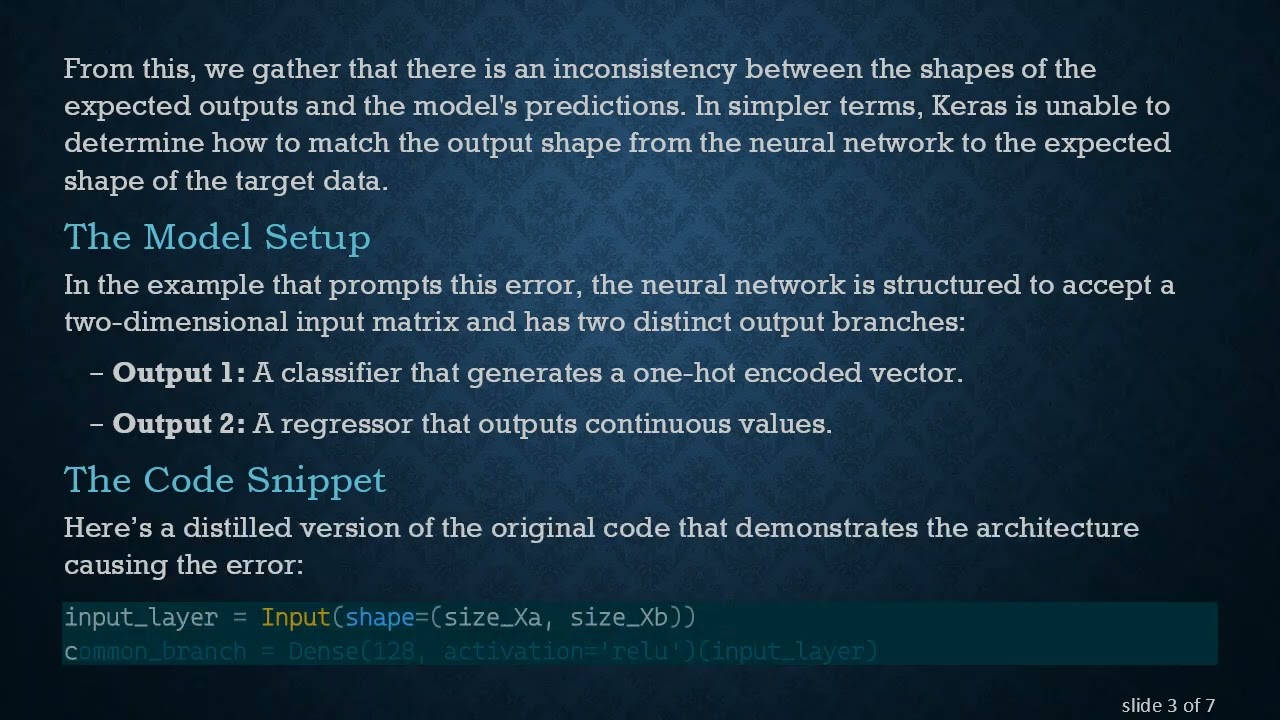
From this, we gather that there is an inconsistency between the shapes of the expected outputs and the model's predictions. In simpler terms, Keras is unable to determine how to match the output shape from the neural network to the expected shape of the target data.
The Model Setup
In the example that prompts this error, the neural network is structured to accept a two-dimensional input matrix and has two distinct output branches:
Output 1: A classifier that generates a one-hot encoded vector.
Output 2: A regressor that outputs continuous values.
The Code Snippet
Here’s a distilled version of the original code that demonstrates the architecture causing the error:
[[See Video to Reveal this Text or Code Snippet]]
In this setup, sizes for Xa, Xb, Y1, and Y2 influence how data flows through the model and affects the expected output shape.
The Solution: Flattening the Output
As mentioned, the error can be resolved by flattening the output of the common branch before splitting it into separate branches. This adjustment ensures that the dimensions of the outputs are aligned correctly with what Keras anticipates.
Implementing the Flatten Layer
Here's how to modify the code to incorporate this solution:
[[See Video to Reveal this Text or Code Snippet]]
By adding the Flatten layer, the model compresses the output shape, removing the mismatch error. This makes it easier for Keras to handle outputs because each output can now be treated as a 1D array.
Adjusted Model Code
Here is how the full revised model generation function might look:
[[See Video to Reveal this Text or Code Snippet]]
Conclusion: Avoiding Common Pitfalls
When architecting a neural network in Keras, especially one with multiple outputs, it's crucial to ensure that the shapes of your inputs and outputs are compatible. Common solutions, like the Flatten layer, can often solve these shape mismatches effectively.
If you encounter similar issues, remember to:
Check the shapes of your training data.
Inspect the outputs of each layer in your model.
Ensure that you're appropriately flattening or reshaping data when necessary.
Understanding and correcting these shapes not only enhances performance but also elevates your skill in deep learning practices. Happy coding!
Доступные форматы для скачивания:
Скачать видео mp4
-
Информация по загрузке:





![[4K FULL HD] Relaxing Water Background | 1 HOUR | Calm Water Wallpaper (No Sound)](https://image.4k-video.ru/id-video/y9PTNTSpGJs)