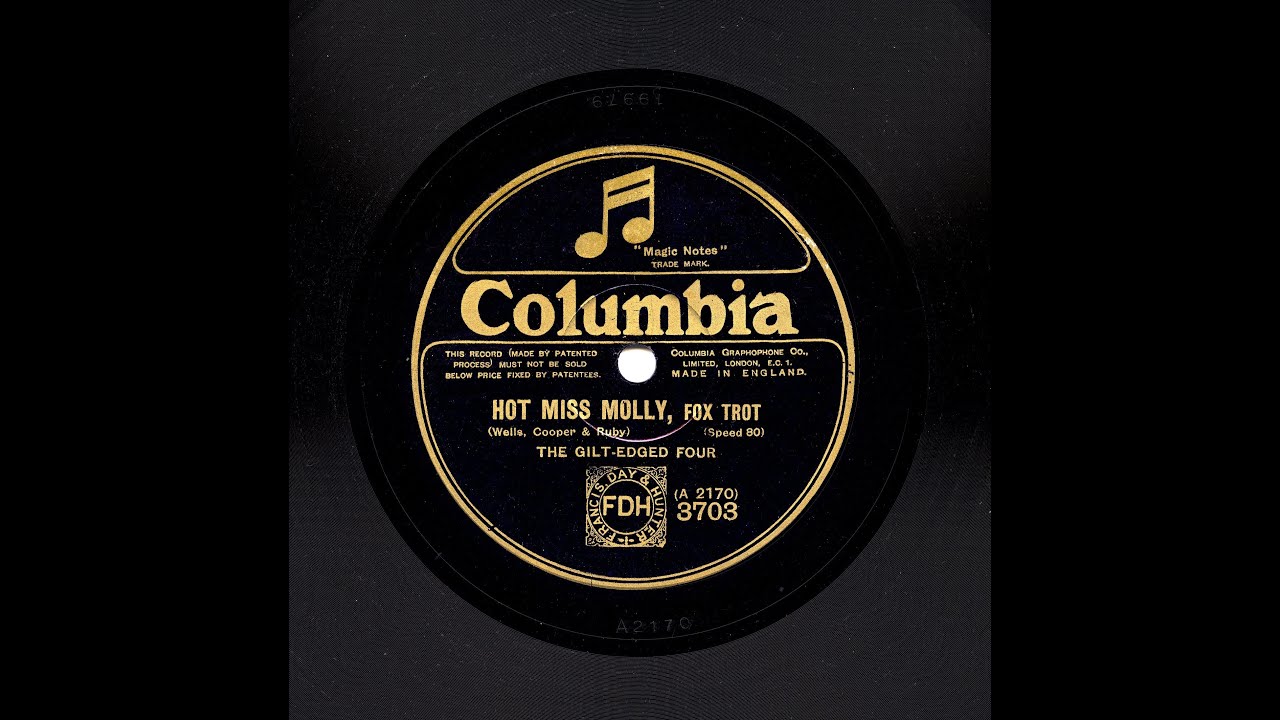
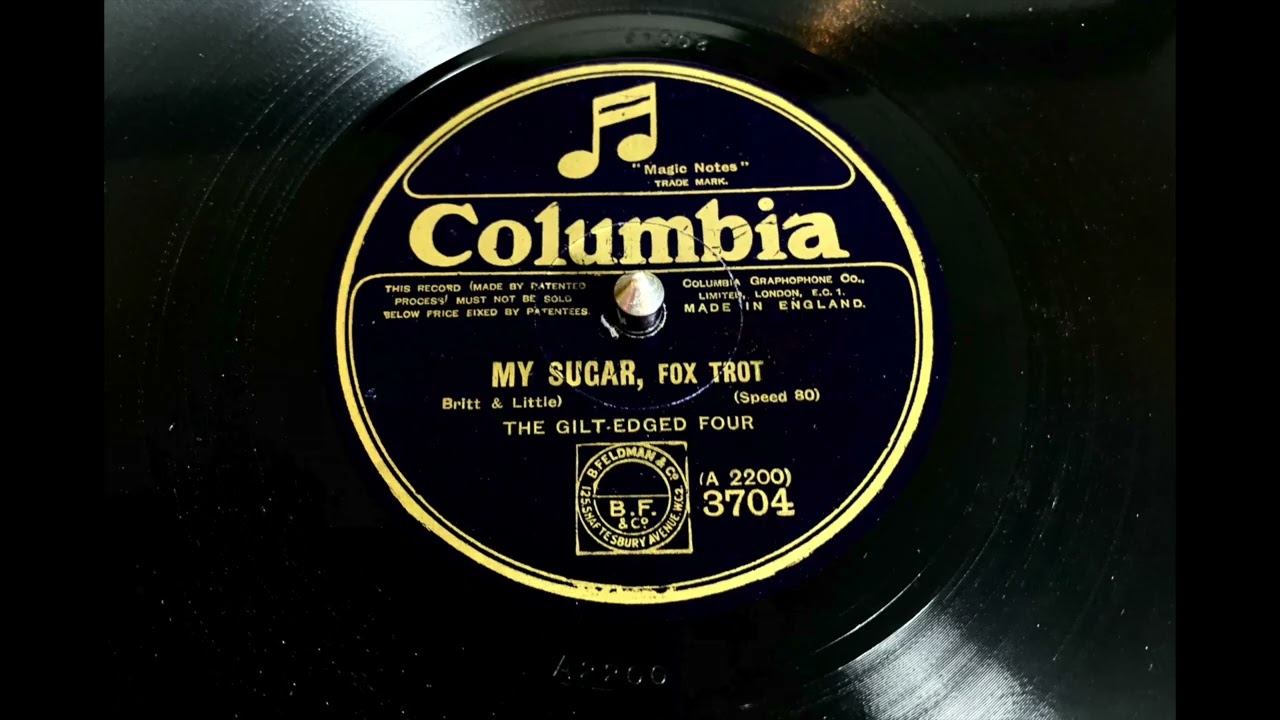
"My Sugar" The Gilt-Edged Four (English Columbia, 1925) Hot!
Автор: Desdemona202
Загружено: 2025-03-01
Просмотров: 238
prob. Mike Mosiello, t / Al Starita, as / Sid Bright, p / prob. Eddie Lang or poss. Len Fillis, bj
Columbia Gramophone Co. Studios
London, UK ca. June 1925
A-2200 “My Sugar” (Addy Britt–Little Jack Little) Columbia 3704
Transferred with 3.0ML lateral stylus in Audiotechnica VMN70SP cartridge via Audiotechnica AT-LP120 Turntable. Declicked and EQ’d by Colin Hancock. Discographical Info and Research from Brian Rust’s “Jazz Records” and “American Dance Bands,” DAHR, The Berkin Family, Javier Soria Laso, Michael Malisoff, Mark Berresford, Nick Dellow, Andrew J. Sammut, and Colin Hancock. Thanks to Jonathan David Holmes for the copy of this wonderful disc.
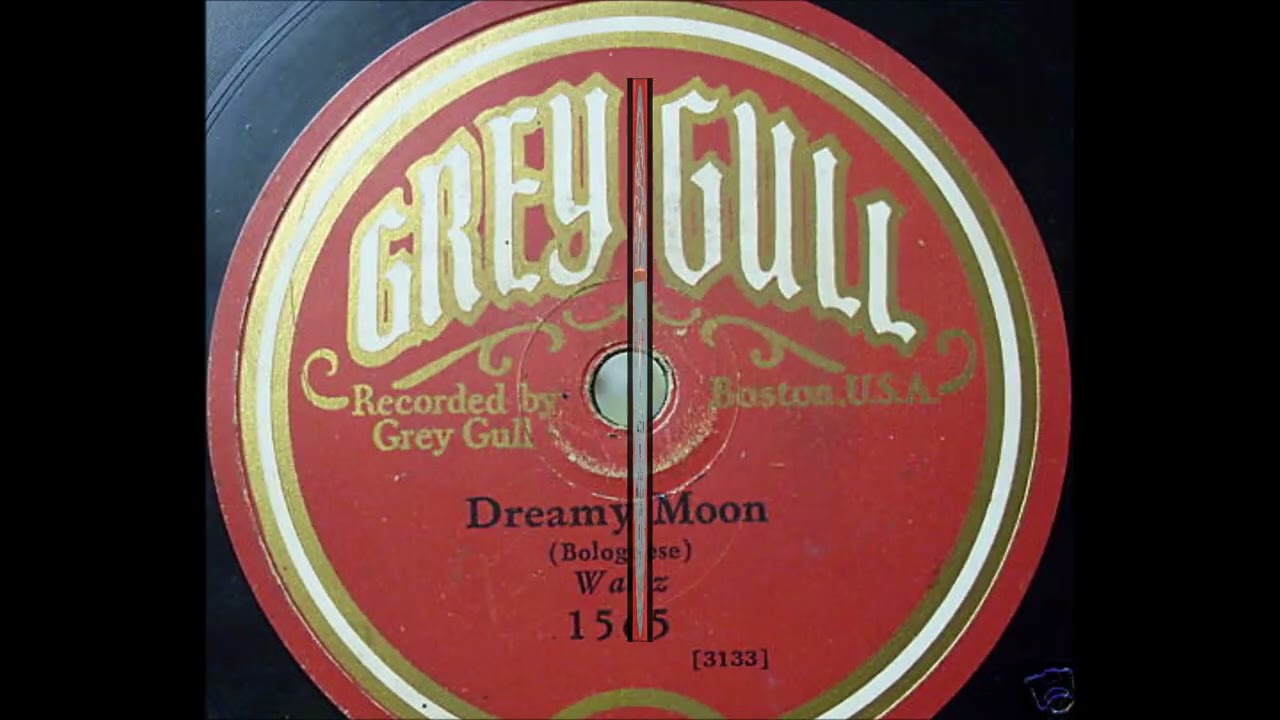
There have been a lot of misconceptions about the first few sessions by the Gilt-Edged four, so this is an attempt to correct them. Misconception 1 is that they began in 1925 for the English Columbia Gramophone Co., which is not so. Rather, they began in 1921 thanks to the same Al Starita, but recording for the Grey Gull label which operated a studio at 81 Wareham Street in Boston, where Starita and his brothers’ orchestra was located at the time. When Starita relocated to the UK, he began organizing smaller hot combo sessions under the same name for Columbia.
Misconception number 2 is that the banjo player on this record must be Len Fillis. Though Fillis did record on banjo with the band, there is no banjo present on the side where Lang guests, “Best Black.” Lang himself was a capable banjo player and recorded many sides with the instrument on Charlie Kerr Orchestra dates for Edison in 1923. His style completely matches up with the player on the sides adjacent to “Best Black.” This is substantiated by Max Goldberg remembering “Eddie Lang was the first one” in regards to string players in the Gilt-Edged Four.
Misconception 3, is that Julius Berkin is the trumpet player on these sides. After interviewing the Berkin family, not only did they have no recollection of him traveling to the UK until his time with Ambrose in 1927, but he is nowhere to be seen in the ship records, and was not playing with any band known to have travelled to the UK. In fact, the only reason his presence was thought to be on the record was the misremembering of Eddie Gross Bart that it was Berkin, not Dave Klein, with Ted Lewis who was at the Kit Kat Club in London in June and July. However, the ship records do survive for the entire Lewis band and both trumpet players Walter Kahn and David Klein are mentioned. So who could it be? The most likely candidate is Mike Mosiello.
Why Mosiello? For one he was in the United Kingdom at the same time as the Mound City Blue Blowers (whom Lang was touring with), as a member of Vincent Lopez’s Orchestra. Indeed, he’d recorded with Lopez a few weeks earlier in New York on “Sing Loo” (where he plays a fine muted obbligato) and “Why Do I Love You?” Additionally, it really just sounds like him. Listen to any Grey Gull house band or Nathan Glantz-led side cut between 1924 and 1927 and chances are you’ll hear Mosiello (“Always Got the Blues,” “Goodbye Ain’t Always Gone,” “I’m Wild,” “Jimmy Jones,” “Woogey Woo,” etc.) Julius Berkin has often been suggested due to incorrect analysis of aural evidence that he was involved in Grey Gull recordings. Mosiello’s work in many contexts has been attributed to Berkin, despite Berkin’s sound being quite different. One listen to any Red Hotters recording–which Berkin not only played in but also co-led–will immediately show that this is not the same player. The Berkin family did remember a mention of Harry Raderman in my interviews with them as well, also substantiating his presence on the Red Hotters sessions. Incidentally, “Woogey Woo” was one of many which Grey Gull re-recorded in the electric era, but it was doneso under a different name–“You're the Kind of Girl I Can Love” by the Metropolitan Dance Players. Mosiello participated in both attempts, contributing his spitfire trumpet work on both. Other titles Mosiello appears to have re-recorded for Grey Gull include “I’m Music Mad” (redone as “Sweet Little Sis”) and “I’m Wild,” under the same name. While not featuring Mosiello, another Grey Gull re-record was Porter Grainger’s “In Harlem’s Araby,” initially recorded by Leroy Smith’s Detroit-based dance band, and then rerecorded by Grainger’s own unit. Finally, Mosiello is also pictured with Nathan Glantz’s Orchestra in a 1922 flyer, as well as with Sam Lanin’s Orchestra in a 1924 image of the Roseland band–both versions of those respective bands where Berkin has been misidentified.
With this information we must reassess the personnel of these sides. A lot of evidence points in the direction of the above listed personnel. And, how about this wonderful performance? A bouncy and joyously lilting take on the Britt–Little collaboration that crosses the line between hot and sweet. I especially enjoy the charleston rhythms in the last chorus, and the band’s creative devices to enrich the arrangement.
Доступные форматы для скачивания:
Скачать видео mp4
-
Информация по загрузке: