Sorting Photos by Camera and Date: A Faster Approach Using R
Автор: vlogize
Загружено: 2025-10-11
Просмотров: 1
Discover an efficient method to bin photos by camera and date in R. Learn how to optimize your data.table operations for better performance and faster execution.
---
This video is based on the question https://stackoverflow.com/q/68625858/ asked by the user 'Jordan' ( https://stackoverflow.com/u/15605956/ ) and on the answer https://stackoverflow.com/a/68645195/ provided by the user 'dcarlson' ( https://stackoverflow.com/u/1580645/ ) at 'Stack Overflow' website. Thanks to these great users and Stackexchange community for their contributions.
Visit these links for original content and any more details, such as alternate solutions, latest updates/developments on topic, comments, revision history etc. For example, the original title of the Question was: Sorting times into bins
Also, Content (except music) licensed under CC BY-SA https://meta.stackexchange.com/help/l...
The original Question post is licensed under the 'CC BY-SA 4.0' ( https://creativecommons.org/licenses/... ) license, and the original Answer post is licensed under the 'CC BY-SA 4.0' ( https://creativecommons.org/licenses/... ) license.
If anything seems off to you, please feel free to write me at vlogize [AT] gmail [DOT] com.
---
Sorting Photos by Camera and Date: A Faster Approach Using R
When dealing with large datasets, efficiency becomes paramount. In this guide, we will discuss a common challenge: sorting photos taken by wildlife cameras into bins based on the camera and the date of photographs. This task can become cumbersome, particularly when dealing with thousands of rows in your dataset. Let's explore a way to optimize the R code you've been using, making sorting faster and more manageable.
The Challenge
You're working with a dataset that includes over 120,000 photos taken by various cameras, and your current script takes about 20 minutes to run. The goal is to categorize these photos into bins based on the installation and service times of the cameras. You want to ensure that you can easily adjust your time bins as needed for research purposes.
Here's how your current approach works:
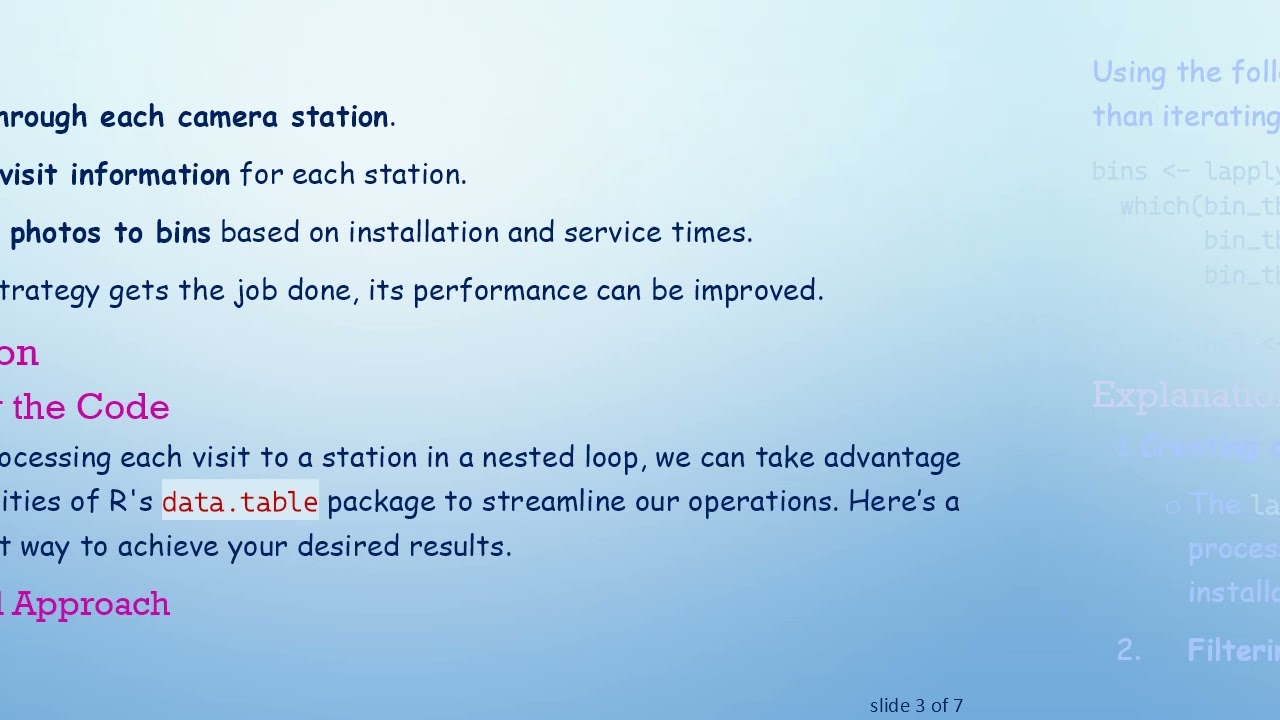
Iterate through each camera station.
Filter visit information for each station.
Assign photos to bins based on installation and service times.
Though this strategy gets the job done, its performance can be improved.
The Solution
Optimizing the Code
Instead of processing each visit to a station in a nested loop, we can take advantage of the capabilities of R's data.table package to streamline our operations. Here’s a more efficient way to achieve your desired results.
Redesigned Approach
Using the following code snippet will allow you to create bins in a single pass rather than iterating through each photo for every visit.
[[See Video to Reveal this Text or Code Snippet]]
Explanation of the Code
Creating a List of Bins:
The lapply function goes through each row of bin_tbl. This is equivalent to processing through each bin you've defined for your photo bins based on the installation and service dates.
Filtering the Photos:
The which function assesses if the photo_tbl rows belong in the defined bin for each station. It checks two main conditions:
Year Unit Station Match: bin_tbl$year_unit_station[i] == photo_tbl$year_unit_station
Date Range Inclusion: The photo's Creation_Datetime is within the bin_start and bin_end.
Assigning Bin Names:
The names() function assigns the bin_ID from the bin_tbl to the list of bins, making it easier to reference later on.
Benefits of the Optimized Code
Single Pass Processing: Instead of checking every photo against each visit, the optimized code makes one pass through the photos for each bin, significantly reducing computation time.
Scalability: As your dataset grows, the optimized solution can handle the increase without a drastic increase in processing time.
Flexibility: You can adjust time bins easily for your research needs without rewriting large parts of your code.
Conclusion
By utilizing efficient coding techniques in R, you’re not just improving the performance of your script; you’re also making your data analysis process more robust and scalable. Adopting strategies like avoiding nested loops and leveraging data.table capabilities can lead to substantial time savings.
Now that we’ve tackled the problem of sorting photos into bins, you can spend more time on analysis and less on waiting for scripts to run. If you have other questions about optimizing your R scripts, feel free to reach out!
Доступные форматы для скачивания:
Скачать видео mp4
-
Информация по загрузке: