Johann Strauss II: Carnevals-Specktakel (謝肉祭の光景) Quadrille Op. 152 - (1) Piano (2) Orchestra
Автор: Dr. Taka Otagawa
Загружено: 2025-11-30
Просмотров: 165
**Johann Strauβ BICENTENNIAL CELEBRATION (1825-2025) 祝ワルツ王生誕200年**
Johann Strauss II (1825-1899): Carnevals-Specktakel (Carnival Spectacle 謝肉祭の光景) Quadrille Op. 152 - (1) Piano (2) 5:41 Orchestra
1st Performance: Tuesday February 21, 1854 – STRAUSS Benefit Ball [Dance Instructor: Franz Rabensteiner (1810-1859) ] – Flora-Saal (a gigantic ballroom) at the SCHWENDER’s Establishment in Rudolfsheim https://en.wikipedia.org/wiki/Rudolfs... - performed by the Strauβkapelle conducted by Johann Strauss II
Sources: 1st edition Piano Score published by Carl Haslinger, Wien Plate no. C. H. 11,683 (11.15.1854) Set of Orchestral Parts published by Carl Haslinger, Wien Plate no. C. H. 11,685 (11.15.1854) https://imslp.org/wiki/Carnevals-Spec...)
The Piano: Performed by Dr. Taka S. [STRAUSS] Otagawa Ph.D. in Physical Chemistry (Texas A&M), US Citizen 小田川 隆朗 理工学博士 (= The Pianist) https://drive.google.com/file/d/1Ua5y...
Recorded LIVE (12.3.1977) at Herr Karasawa (唐澤俊三)* Residence, Yokohama, JAPAN
[* Founder/Director of the Tokyo Johann Strauβ Ensemble] Equipment: Top-of-the-line Yamaha Upright Piano, TEAC Reel-to-Reel Tape Recorder, Professional Recording Microphone
ANALYSIS of “The HISTORICAL PIANO RECORDINGS” by Herr Karasawa https://drive.google.com/file/d/1JEPK...
The Orchestral Performance (Restored / Edited by The Pianist): Courtesy of Otto Schulz-Biedermeier Orchestra (1950s)
From the original Marco Polo CD NOTEs about Carnevals-Specktakel-Quadrille (Carnival's Hubbub Quadrille) op. 152 [written in 1991 by Herr PETER KEMP, Honorary Life President of The Johann Strauss Society of Great Britain]:
The hubbub of Vienna's annual carnival festivities can well be imagined when one considers not only the number of her dance establishments but also the sheer capacity which some of them boasted: the largest of all, the short-lived Odeon-Saal, could accommodate no less than 8,000 people in its vast ball-arena. As public demand continued to grow, new dance halls were built, especially in the outlying suburbs.
In 1833 a German, Karl Schwender (1806-66), travelled from Karlsruhe to Vienna where he settled, working first as a waiter and then as a billiard-marker at the Paradiesgartl in the Volksgarten. In 1835 he converted an old cowshed on ground adjoining the country house of Baroness Pereira-Arnstein in the suburb of Braunhirschengrund into a coffee-house and, moreover, enterprisingly organised regular transport for his customers between the city centre and the area in front of the Mariahilferlinie (one of the outer wall fortifications of the old inner city of Vienna which had been constructed on the orders of Prince Eugen at the beginning of the 18th century), in the vicinity of his premises. From such modest beginnings, and through a process of continual rebuilding work, arose Schwender's massive and grandiose entertainment establishment, the 'Colosseum', which opened in 1865.
In 1854, however, Schwender's establishment was still comparatively small – though the Viennese press described it as "excellent" and "splendid" – and each event was guaranteed massive public patronage. Accordingly, on Tuesday 21 February, there was a large attendance for Johann Strauss's benefit ball in the dance salon at Schwender's. The evening occasioned the première of a high-spirited quadrille, the seventh new work written by Johann for that year's carnival. The Wiener Neuigkeits-Blatt (23 February 1854) reported: "Alternating with his brother [Josef] the popular beneficiary conducted the ball music and, besides his recently composed waltzes, amongst which the charming 'Schneeglöckchen' is to be mentioned, performed a new 'Karnevals-Specktakel-Quadrille' which, composed with extreme originality, enjoyed the greatest applause and had to be played six times. In the casino room the able military band [Prince Schwarzenberg Infantry Regiment] of Herr Tischler performed chiefly compositions by the beneficiary".
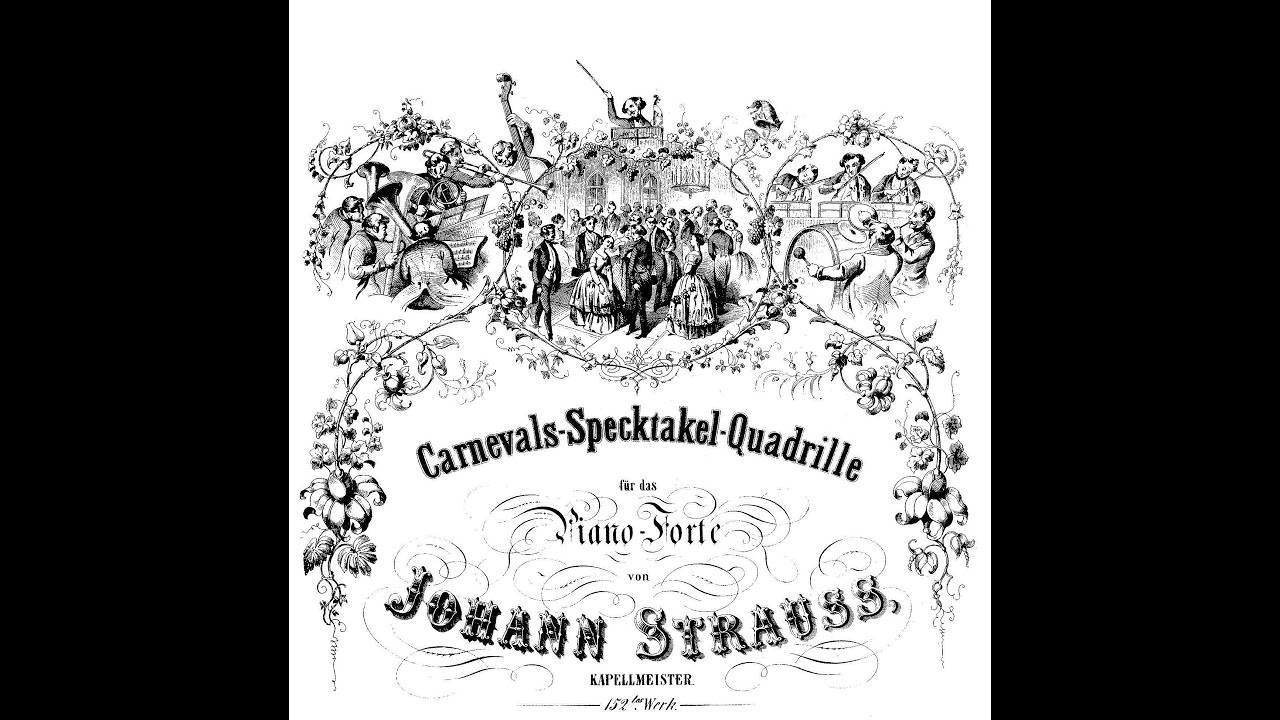
The din of carnival is entertainingly captured on the title page illustration for the first piano edition of the Carnevals-Specktakel-Quadrille: a central vignette shows groups of carnival-goers chatting animatedly, while either side members of the orchestra play their instruments with great gusto, as Johann Strauss himself wields his baton over all.
Доступные форматы для скачивания:
Скачать видео mp4
-
Информация по загрузке: