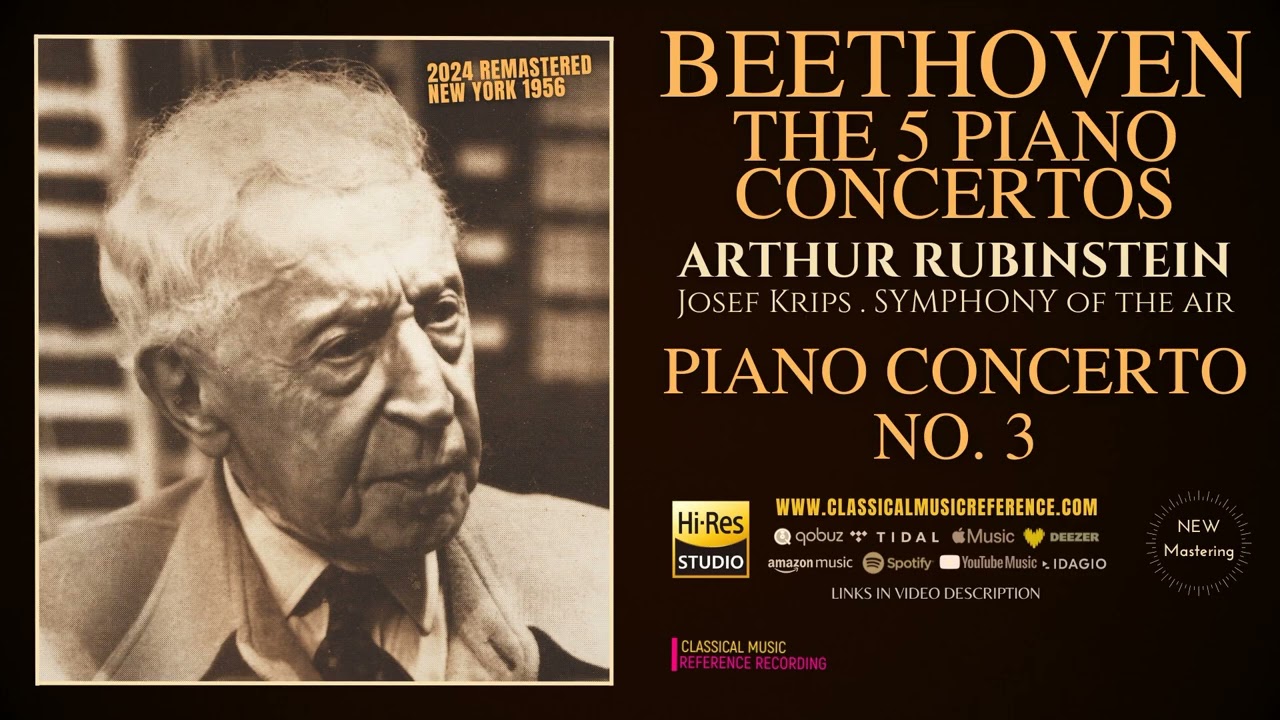
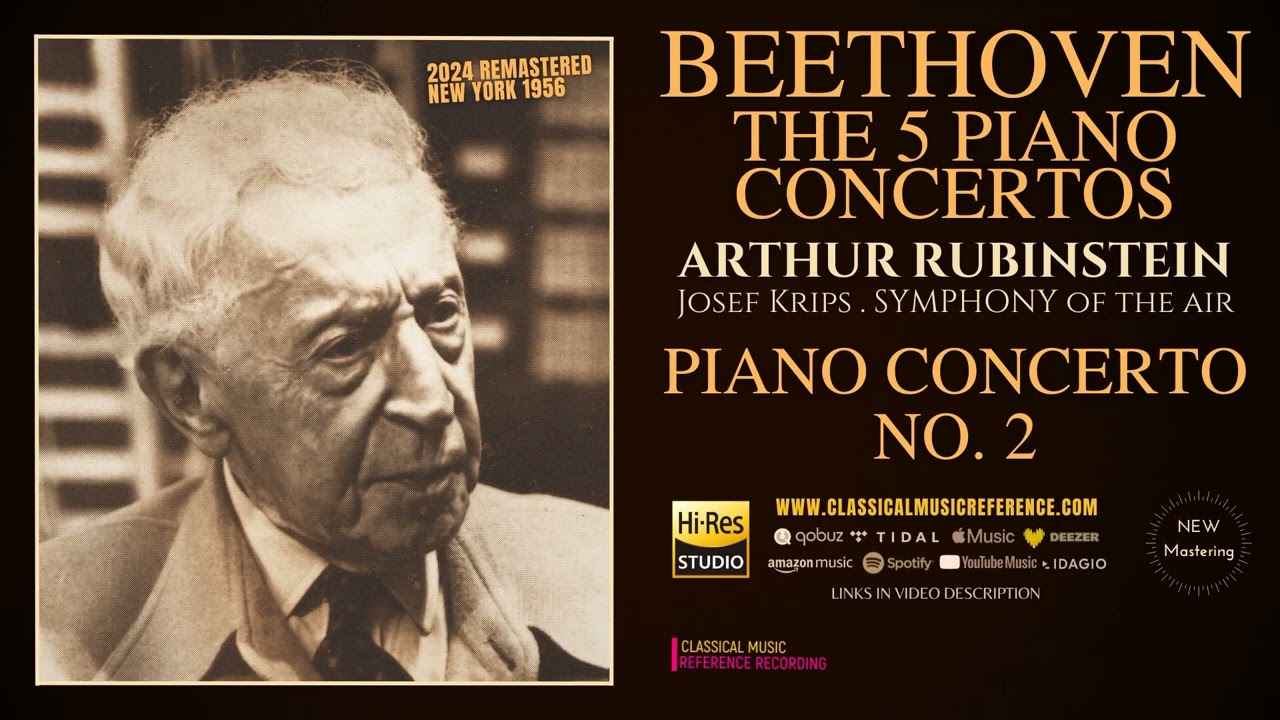
Beethoven: Piano Concerto No. 2, Op. 19 / Remastered (reference recording: Arthur Rubinstein)
Автор: Classical Music/ /Reference Recording
Загружено: 2024-08-14
Просмотров: 14053
🔥🎧 Full Album available // Beethoven: The 5 Piano Concertos by Arthur Rubinstein
🔥🎧 Choose my streaming platform: https://lnk.to/beethovenconcertosrubi...
🎧 Qobuz (Hi-Res/flac) https://cutt.ly/QevujKCF Tidal (Hi-Res/flac) https://cutt.ly/WevuklTK
🎧 Deezer (Hi-Fi) https://cutt.ly/XevukY9G Spotify (mp3) https://cutt.ly/9evuzguD
🎧 Amazon Music (Hi-Res/flac) https://cutt.ly/pevukX9B Idagio (Hi-Fi) https://cutt.ly/LevuxNbI
🎧 Apple Music (off) Youtube Music (mp4) https://cutt.ly/ZevulWUI
🔊 **Download the album (Hi-Res MASTER - WAV uncompressed)** https://cutt.ly/Classical-Music-Refer...
Ludwig van Beethoven (1770-1827) Piano Concerto No. 2 in B-flat Major, Op. 19
00:00 I. Allegro con brio (2024 Remastered, New York 1956)
13:40 II. Adagio (2024 Remastered, New York 1956)
23:12 III. Rondo. Molto allegro (2024 Remastered, New York 1956)
Piano: Arthur Runbinstein
Symphony of the Air
Conductor: Josef Krips
Recorded in 1956, at New York
New mastering in 2024 by AB for https://classicalmusicreference.com/
🔊 Join us with your phone on our WhatsApp fanpage (our latest album preview): https://cutt.ly/5eathESK
🔊 Find our entire catalog on Qobuz: https://cutt.ly/geathMhL
🔊 Discover our playlists on Spotify: https://cutt.ly/ceatjtlB
❤️ Support us on Patreon https://cutt.ly/ZezaldhI
In fact, this was Beethoven's first piano concerto, as it was completed in 1795, and the composer performed it that same year during its premiere in Vienna. His friend Wegeler recounted that, two days before the concert, only the last two movements were ready. Beethoven, bedridden with a severe cold and fever, nevertheless composed the Rondo page by page, working tirelessly until it was finished, with the copyist struggling to keep up. In 1801, Beethoven wrote to Hofmeister: “I value the concerto [in B-flat] at only ten ducats. As I have already said, I do not claim that it is one of the best.” However, it seems that Beethoven had a preference for the Concerto in B-flat, as he played it at all the concerts he gave during his tours in Bohemia and Germany.
Notes by Martin Pearlman: With this sparkling concerto, the 24-year-old Beethoven made his debut as a pianist and composer before the Viennese public on March 29, 1795. According to the Wiener Zeitung, there was "unanimous applause," and the young musician had the honor of performing the concerto later that same year with the esteemed Haydn conducting.
Over the next several years, he continued to play the work as a show piece but revised it several times. On one memorable occasion, when Beethoven decided to write an entirely new third movement -- the one that he eventually published -- his friend Wegeler reported that "not until the afternoon of the second day before the concert did he write the rondo, and then while suffering from a pretty severe colic which frequently afflicted him... In the anteroom sat four copyists to whom he handed sheet after sheet as soon as it was finished." Then at the first rehearsal, Beethoven discovered that his piano was tuned a half step lower than the wind instruments, a crisis that required him to transpose his solo part up a half step for that rehearsal.
Although it is called Concerto No. 2, this is the earliest of Beethoven's five piano concertos. It was written in Bonn, before he moved to Vienna, but, by the time it was published in 1801, his publisher had already issued his next concerto and had called it his Concerto No. 1. This Bb concerto from his earlier years thus became No. 2 and was given a later opus number. By then, Beethoven's style was starting to evolve from the Mozartian character of this concerto toward something quite new. His revisions, even including writing a new third movement, could bring the work only so far toward his current style and his current level of experience. Thus he told his publisher, "I don't consider it one of my best works" and offered it to him for half the price of his first symphony.
But it is a charming and delightful work with a beautiful slow movement that must have shown off Beethoven's noted cantabile style of playing, as well as a light-hearted, comic finale. As a great improvisor, Beethoven would have made up his first-movement cadenza on the spot. The written-out cadenza that has come down to us is one that Beethoven created much later (1809). With it, he briefly inserts his more advanced style of piano writing into this early concerto.
Other Album available // Rachmaninoff by Rubinstein: Piano Concerto No.2, Rhapsody on a theme of Paganini
🎧 Qobuz https://cutt.ly/JevoXMJk Tidal https://cutt.ly/xevoXcMU
🎧 Deezer https://cutt.ly/aevoCsv9 Spotify https://cutt.ly/devoCLaC
🎧 Amazon Music https://cutt.ly/vevoVsdA Youtube Music https://cutt.ly/FevoVm3U
🎧 Soundcloud https://cutt.ly/yevoNNXG
Ludwig Van Beethoven PLAYLIST (reference recordings): • Ludwig Van Beethoven (1770-1827)
Доступные форматы для скачивания:
Скачать видео mp4
-
Информация по загрузке: