Two Types of Colorblindness?
Автор: Chromaphobe
Загружено: 2021-04-13
Просмотров: 3703
Do you have two types of colorblindness? Double CVD? A pair of paltry perception parameters? Erm... Anyway you say it, you almost certainly do not...
Explanation about Protanomaly/Deuteranomaly Combo:
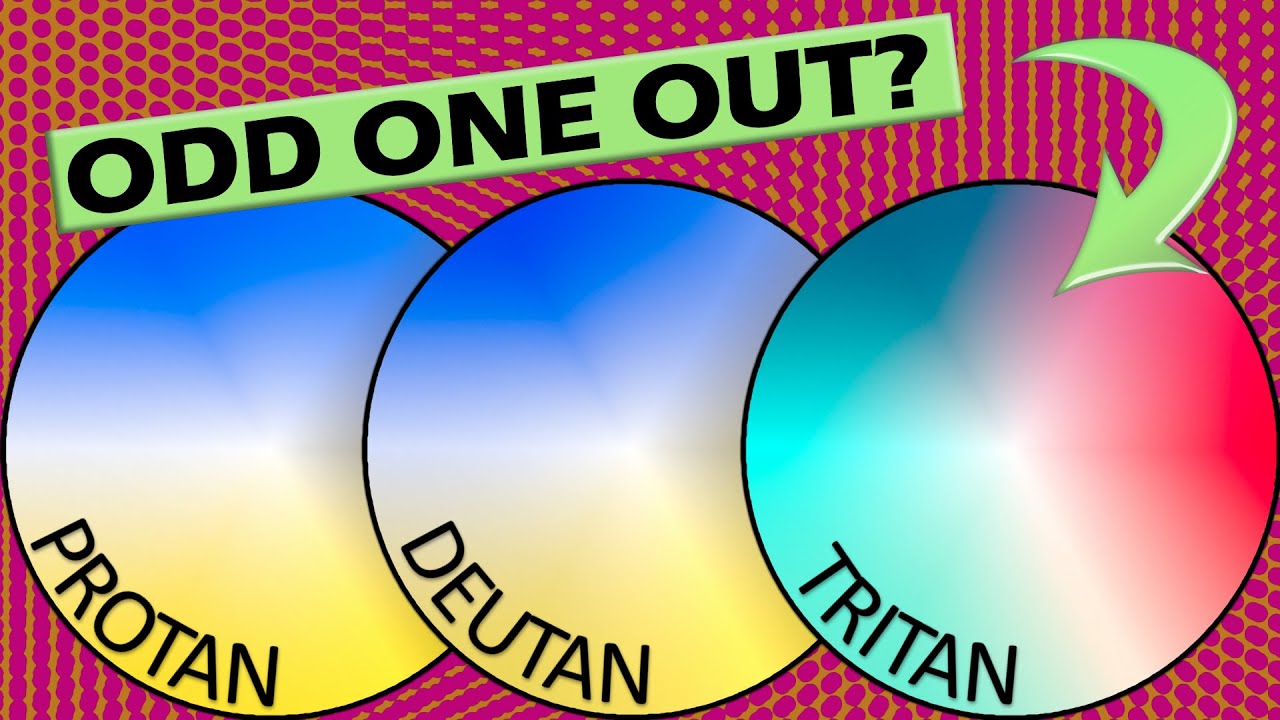
It is easy to consider that an L-opsin (normally at 560nm) and M-opsin (normally at 530nm) could each shift towards the other a portion of this 30nm separation and meet somewhere in the middle. If they meet directly in the middle, then the person should have a mixture of protan and deutan color vision. However, they cannot meet directly in the middle. The difference between an L-opsin and M-opsin is just 6 amino acids in a protein of over 300. Every anomalous opsin is in fact a hybrid between the L- and M-opsins. Of those 6 amino acids, it will have some like the typical L-opsin, tuning the anomalous opsin to higher wavelengths, and some like the typical M-opsin, tuning the opsin to lower wavelengths. However, just one of these amino acids is responsible for 20nm of that 30nm shift. This means that anomalous opsins can exist in the range of 530-540nm and 550-560nm, but not 540-550nm (rough numbers). There is therefore a large divide between what is considered protanomaly and what is considered deuteranomaly, and while there can be small variances, there will never be a case where a red-green anomalous trichromacy looks like an average of protanomaly and deuteranomaly.

Доступные форматы для скачивания:
Скачать видео mp4
-
Информация по загрузке: