Understanding Memory Allocation in C: Does malloc() Inside a Function Free Memory?
Автор: vlogize
Загружено: 2025-10-03
Просмотров: 2
Explore how `malloc()` works inside functions in C and learn how to manage memory allocation effectively with clear examples.
---
This video is based on the question https://stackoverflow.com/q/63445542/ asked by the user 'Kamel Fakih' ( https://stackoverflow.com/u/13569419/ ) and on the answer https://stackoverflow.com/a/63445626/ provided by the user 'Ôrel' ( https://stackoverflow.com/u/4605105/ ) at 'Stack Overflow' website. Thanks to these great users and Stackexchange community for their contributions.
Visit these links for original content and any more details, such as alternate solutions, latest updates/developments on topic, comments, revision history etc. For example, the original title of the Question was: does using malloc( ) inside a function free the allocated memory after its execution?
Also, Content (except music) licensed under CC BY-SA https://meta.stackexchange.com/help/l...
The original Question post is licensed under the 'CC BY-SA 4.0' ( https://creativecommons.org/licenses/... ) license, and the original Answer post is licensed under the 'CC BY-SA 4.0' ( https://creativecommons.org/licenses/... ) license.
If anything seems off to you, please feel free to write me at vlogize [AT] gmail [DOT] com.
---
Understanding Memory Allocation in C: Does malloc() Inside a Function Free Memory?
In the world of C programming, managing memory is a critical skill that can often lead to confusing situations, especially for beginners. One common question that arises is whether using malloc() inside a function automatically frees the allocated memory after exiting the function. This guide will dive into this question, providing clarity and solutions to common pitfalls regarding dynamic memory allocation in C.
The Problem
Imagine you're working on a program that requires dynamic memory allocation. You create a function that allocates memory for a structure using malloc(). However, upon returning to the main function, you find that accessing the allocated memory results in unreadable or random output. Why does this happen? The answer lies in how memory allocation and pointers interact in C.
Here’s a simplified code snippet demonstrating this problem:
[[See Video to Reveal this Text or Code Snippet]]
In this function, the allocated memory isn't retained in the calling function, leading to potential memory leaks and incorrect data access.
The Solution: Correct Memory Allocation Handling
To avoid memory management errors, such as the one illustrated above, we need to make specific adjustments to the pointer handling in our allocation function. Here's a step-by-step explanation of how to properly allocate memory and ensure it is accessible after the function has completed.
1. Use Double Pointers
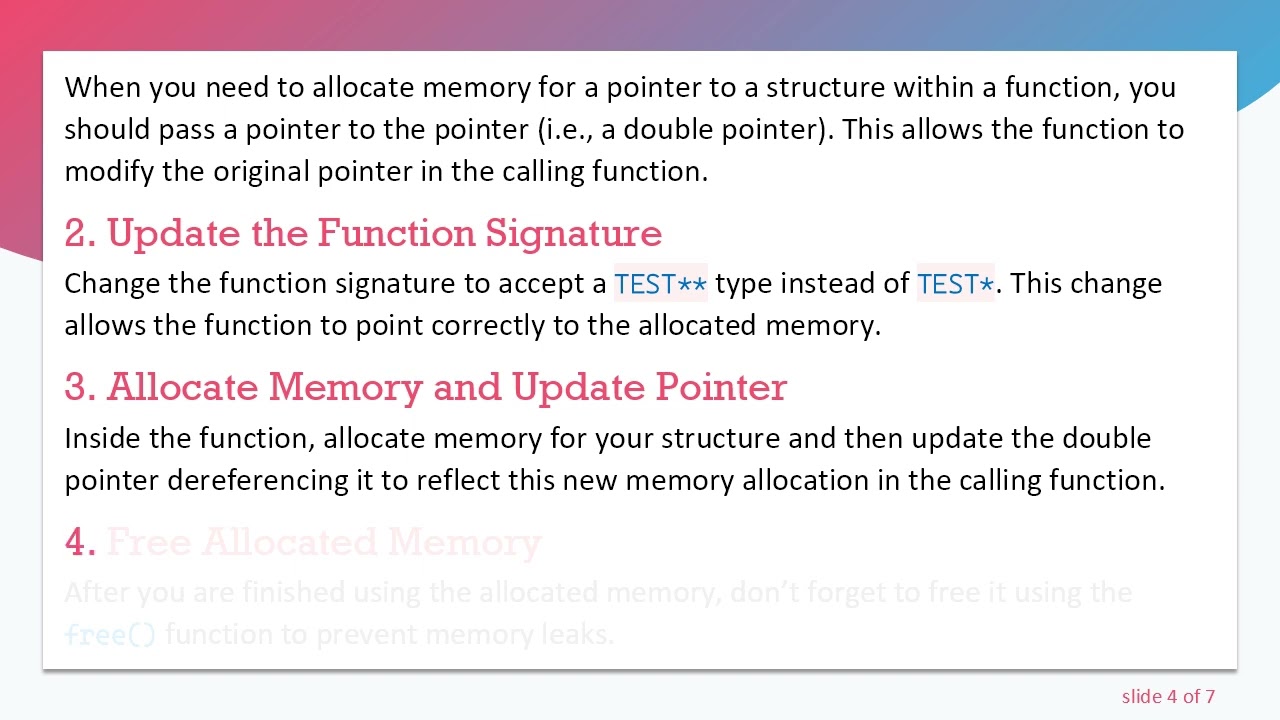
When you need to allocate memory for a pointer to a structure within a function, you should pass a pointer to the pointer (i.e., a double pointer). This allows the function to modify the original pointer in the calling function.
2. Update the Function Signature
Change the function signature to accept a TEST** type instead of TEST*. This change allows the function to point correctly to the allocated memory.
3. Allocate Memory and Update Pointer
Inside the function, allocate memory for your structure and then update the double pointer dereferencing it to reflect this new memory allocation in the calling function.
4. Free Allocated Memory
After you are finished using the allocated memory, don’t forget to free it using the free() function to prevent memory leaks.
Example Code
Here's a corrected version of the provided code:
[[See Video to Reveal this Text or Code Snippet]]
Key Takeaways
Always use double pointers when allocating memory in functions if you intend to modify the pointer.
Remember to free any dynamically allocated memory to prevent memory leaks in your applications.
Understanding pointer behavior in C is crucial for effective memory management, especially as your programs grow in complexity.
By grasping these concepts, you'll enhance your coding skills and prevent common memory-related issues in your C programs. Happy coding!
Доступные форматы для скачивания:
Скачать видео mp4
-
Информация по загрузке: