Is Vue Router Secure? Unpacking Authentication and Navigation Guards
Автор: vlogize
Загружено: 2025-10-01
Просмотров: 1
Discover how to ensure your `Vue Router` implementation is secure by properly configuring authentication checks. Learn best practices for navigation guards and route protection in your Vue.js applications!
---
This video is based on the question https://stackoverflow.com/q/63894024/ asked by the user 'Lucas' ( https://stackoverflow.com/u/14278350/ ) and on the answer https://stackoverflow.com/a/63894215/ provided by the user 'Phil' ( https://stackoverflow.com/u/283366/ ) at 'Stack Overflow' website. Thanks to these great users and Stackexchange community for their contributions.
Visit these links for original content and any more details, such as alternate solutions, latest updates/developments on topic, comments, revision history etc. For example, the original title of the Question was: Vue router is safe?
Also, Content (except music) licensed under CC BY-SA https://meta.stackexchange.com/help/l...
The original Question post is licensed under the 'CC BY-SA 4.0' ( https://creativecommons.org/licenses/... ) license, and the original Answer post is licensed under the 'CC BY-SA 4.0' ( https://creativecommons.org/licenses/... ) license.
If anything seems off to you, please feel free to write me at vlogize [AT] gmail [DOT] com.
---
Is Vue Router Secure? Unpacking Authentication and Navigation Guards
When developing web applications with Vue.js, one of the primary concerns is ensuring that routes are secure, especially those that require authentication. Recently, a developer realized an issue when testing route access through the console, raising a critical question: Is Vue Router secure? In this post, we'll explore the issue and provide solid solutions to ensure that unauthorized users cannot access protected routes.
Understanding the Problem
The core issue arises from the beforeEach navigation guard used in Vue Router. This guard is intended to check if a user is authenticated before allowing access to specific routes. However, the developer noticed that accessing a route via the console using the command:
[[See Video to Reveal this Text or Code Snippet]]
allowed navigation despite authentication requirements declared in the beforeEach guard.
What Went Wrong?
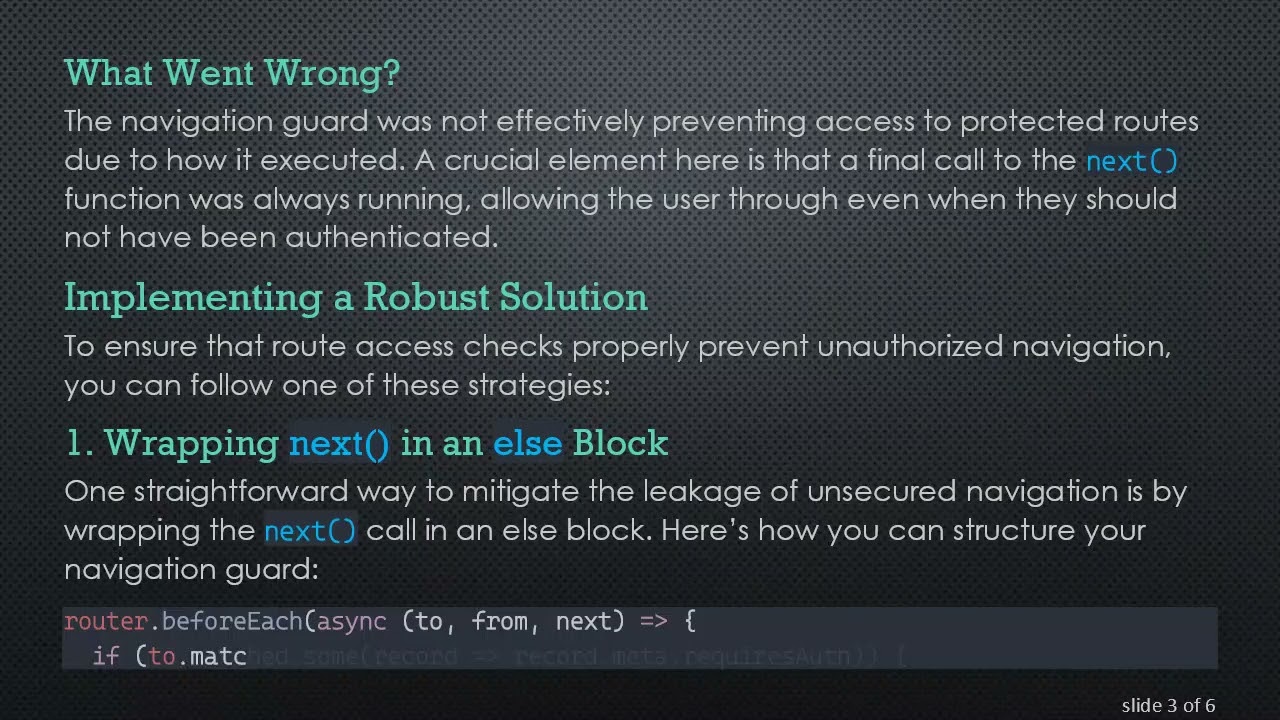
The navigation guard was not effectively preventing access to protected routes due to how it executed. A crucial element here is that a final call to the next() function was always running, allowing the user through even when they should not have been authenticated.
Implementing a Robust Solution
To ensure that route access checks properly prevent unauthorized navigation, you can follow one of these strategies:
1. Wrapping next() in an else Block
One straightforward way to mitigate the leakage of unsecured navigation is by wrapping the next() call in an else block. Here’s how you can structure your navigation guard:
[[See Video to Reveal this Text or Code Snippet]]
2. Using return to Control Flow
Another approach is to use the return statement effectively to exit from the guard when a decision has been made. This ensures that you don’t accidentally call next() again after having already resolved user authentication. Below is a revised version of the navigation guard with the proper use of return:
[[See Video to Reveal this Text or Code Snippet]]
Conclusion
Ensuring that your Vue Router implementation is secure requires careful attention to how authentication checks are handled in navigation guards. By adopting one of the above strategies—either wrapping next() in an else block or using returns to control flow—you can effectively prevent unauthorized access.
Remember, securing routes is a vital step in protecting user data and ensuring a safe web application. Implement these strategies today to bolster the security of your Vue.js projects!
Доступные форматы для скачивания:
Скачать видео mp4
-
Информация по загрузке:


