Postgres Query Optimization: Improving Your Order By Performance
Автор: vlogize
Загружено: 2025-09-21
Просмотров: 1
Discover how to enhance PostgreSQL query performance when adding order by criteria, including upcoming features and practical tips!
---
This video is based on the question https://stackoverflow.com/q/62832995/ asked by the user 'Chen Guevara' ( https://stackoverflow.com/u/6854670/ ) and on the answer https://stackoverflow.com/a/62837053/ provided by the user 'jjanes' ( https://stackoverflow.com/u/1721239/ ) at 'Stack Overflow' website. Thanks to these great users and Stackexchange community for their contributions.
Visit these links for original content and any more details, such as alternate solutions, latest updates/developments on topic, comments, revision history etc. For example, the original title of the Question was: Postgres query optimizer generates bad plan after adding another order by criterion
Also, Content (except music) licensed under CC BY-SA https://meta.stackexchange.com/help/l...
The original Question post is licensed under the 'CC BY-SA 4.0' ( https://creativecommons.org/licenses/... ) license, and the original Answer post is licensed under the 'CC BY-SA 4.0' ( https://creativecommons.org/licenses/... ) license.
If anything seems off to you, please feel free to write me at vlogize [AT] gmail [DOT] com.
---
Postgres Query Optimization: Improving Your Order By Performance
In the world of database management, query optimization is crucial for maintaining the performance and efficiency of your applications. If you're using PostgreSQL, you might have encountered a situation where adding an ORDER BY criterion results in a suboptimal execution plan. This guide explores this problem and provides valuable solutions.
The Problem Explained
Consider a scenario where you are using Django ORM to query data from a PostgreSQL database. After adding an additional ORDER BY clause to your query, you notice that the PostgreSQL query optimizer generates a bad plan. This can lead to slow performance, as the database does not execute the query in the most efficient manner.
Example of the Issue
The problematic query resembles the following:
[[See Video to Reveal this Text or Code Snippet]]
Upon execution, the query planner generates a costly execution plan:
[[See Video to Reveal this Text or Code Snippet]]
In this scenario, the execution plan performs a sort operation after fetching a large number of rows, followed by a filtering process, which is not ideal.
Understanding the Solution
In order to tackle the problem of a poor execution plan, we need to work with how the PostgreSQL optimizer approaches queries.
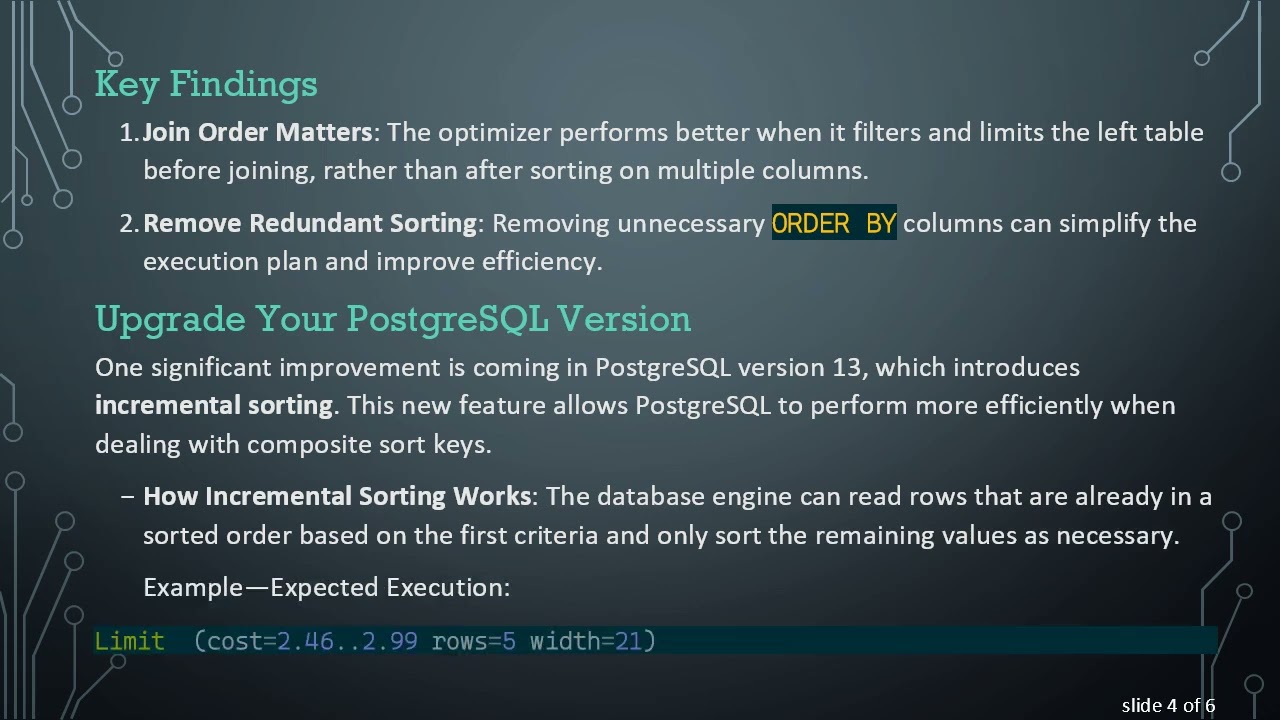
Key Findings
Join Order Matters: The optimizer performs better when it filters and limits the left table before joining, rather than after sorting on multiple columns.
Remove Redundant Sorting: Removing unnecessary ORDER BY columns can simplify the execution plan and improve efficiency.
Upgrade Your PostgreSQL Version
One significant improvement is coming in PostgreSQL version 13, which introduces incremental sorting. This new feature allows PostgreSQL to perform more efficiently when dealing with composite sort keys.
How Incremental Sorting Works: The database engine can read rows that are already in a sorted order based on the first criteria and only sort the remaining values as necessary.
Example—Expected Execution:
[[See Video to Reveal this Text or Code Snippet]]
Modifying Indexes
If you're unable to upgrade to version 13 immediately, another solution is to modify your indexes:
Index Adjustment: You can add the id column to your existing index or create a new composite index that includes both end_date and id. This will help the optimizer to execute the query more efficiently.
Conclusion
Optimization of queries in Postgres, especially when it involves ORDER BY, can significantly impact application performance. By understanding how the optimizer works and making informed adjustments to your queries and database indexes, you can achieve better performance.
Key Takeaways
Remove unnecessary ORDER BY terms when they don’t contribute to your result set.
Utilize PostgreSQL version 13 and its incremental sorting feature for greater efficiency.
Adjust your indexing strategy to optimize performance for specific queries.
By following these strategies, you can significantly improve the performance of your PostgreSQL queries, resulting in a smoother and faster application experience.
Доступные форматы для скачивания:
Скачать видео mp4
-
Информация по загрузке: