Bonus Day 3: Matrix Multiplication — The Engine Behind Model 3 Regression
Автор: TalkShopWithBen
Загружено: 2026-01-12
Просмотров: 16
This bonus lesson focuses on matrix multiplication — the single most important operation behind PNNL Model 3 optimal start math.
At first glance, matrix multiplication can feel intimidating, but in reality it’s just structured dot products. Every output value is created by multiplying a row by a column and summing the result. That’s it.
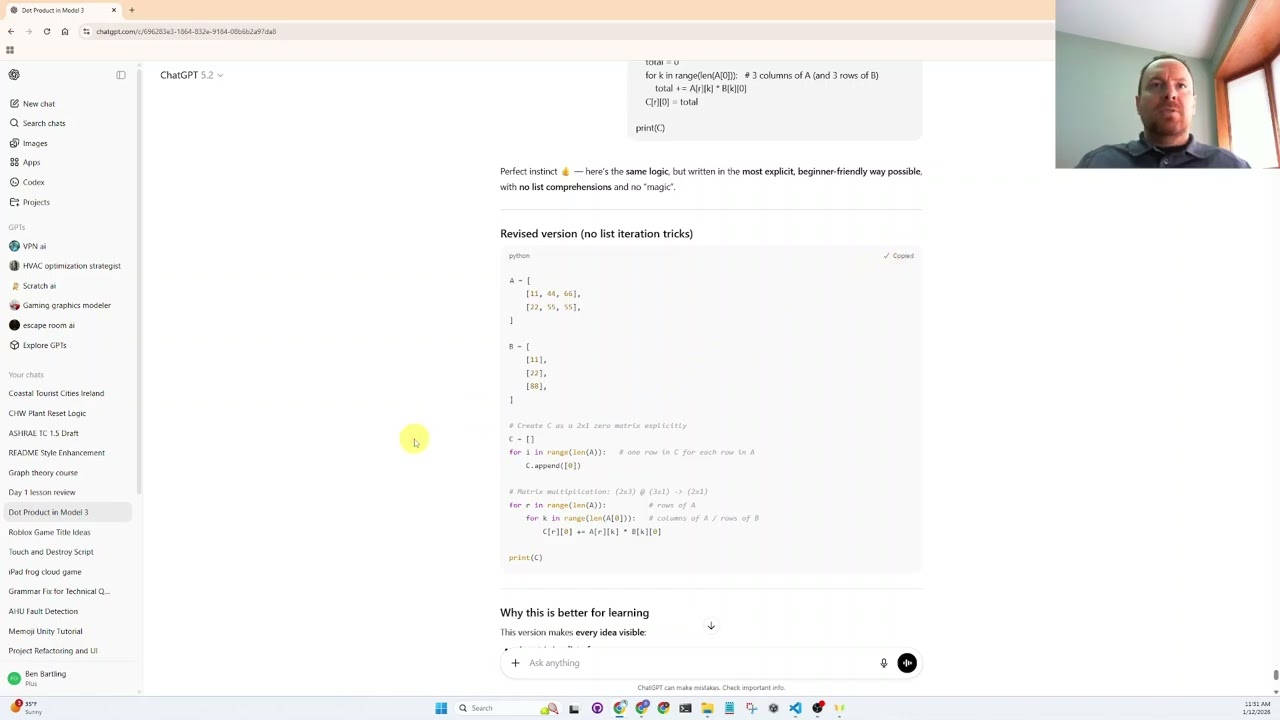
In this video, we strip away the abstraction and show how matrix multiplication works using loops only. No NumPy. No math libraries. Just plain logic — exactly what you need when working inside constrained BAS environments like Niagara Program Objects.
Why does this matter?
Because Model 3 requires two key operations:
XᵀX and Xᵀy
Both of these are nothing more than matrix multiplications. If you understand how to multiply matrices, you can implement regression in any language — Java, Python, C, or even embedded controllers.
This lesson covers:
• What matrix multiplication actually does
• Why dimensions must match
• How row-by-column dot products work
• How XᵀX and Xᵀy appear in Model 3
• How to write your own matrix multiply routine by hand
• Why this math is realistic even on resource-constrained BAS hardware
By the end of this lesson, matrix multiplication should feel mechanical instead of mysterious. Once this clicks, the rest of Model 3 regression math becomes approachable and implementable.
Lesson reference
https://github.com/bbartling/hvac-opt...
Vibe Coding (Niagara Program Objects)
https://github.com/bbartling/niagara4...
#HVAC
#OptimalStart
#BuildingAutomation
#NiagaraFramework
#SmartBuildings
#HVACMath
#MatrixMultiplication
#ControlSystems
#EngineeringEducation
#VibeCoding
Доступные форматы для скачивания:
Скачать видео mp4
-
Информация по загрузке:



![Как происходит модернизация остаточных соединений [mHC]](https://image.4k-video.ru/id-video/jYn_1PpRzxI)