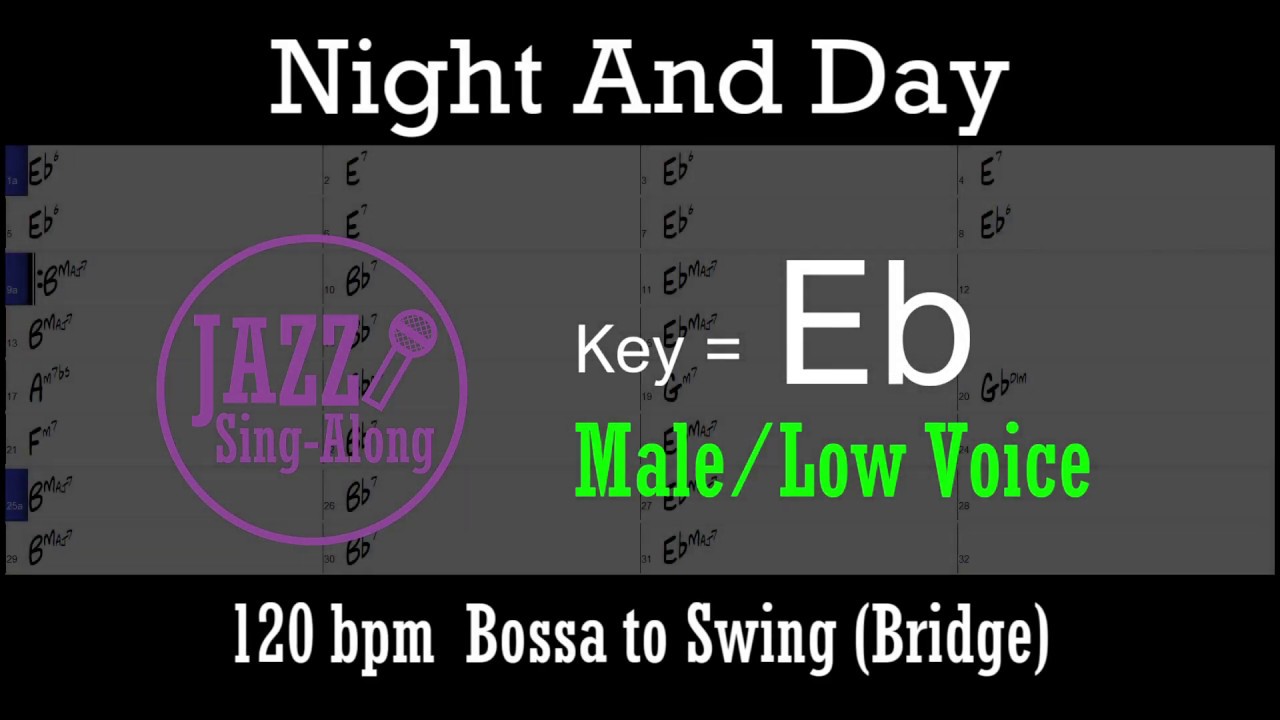
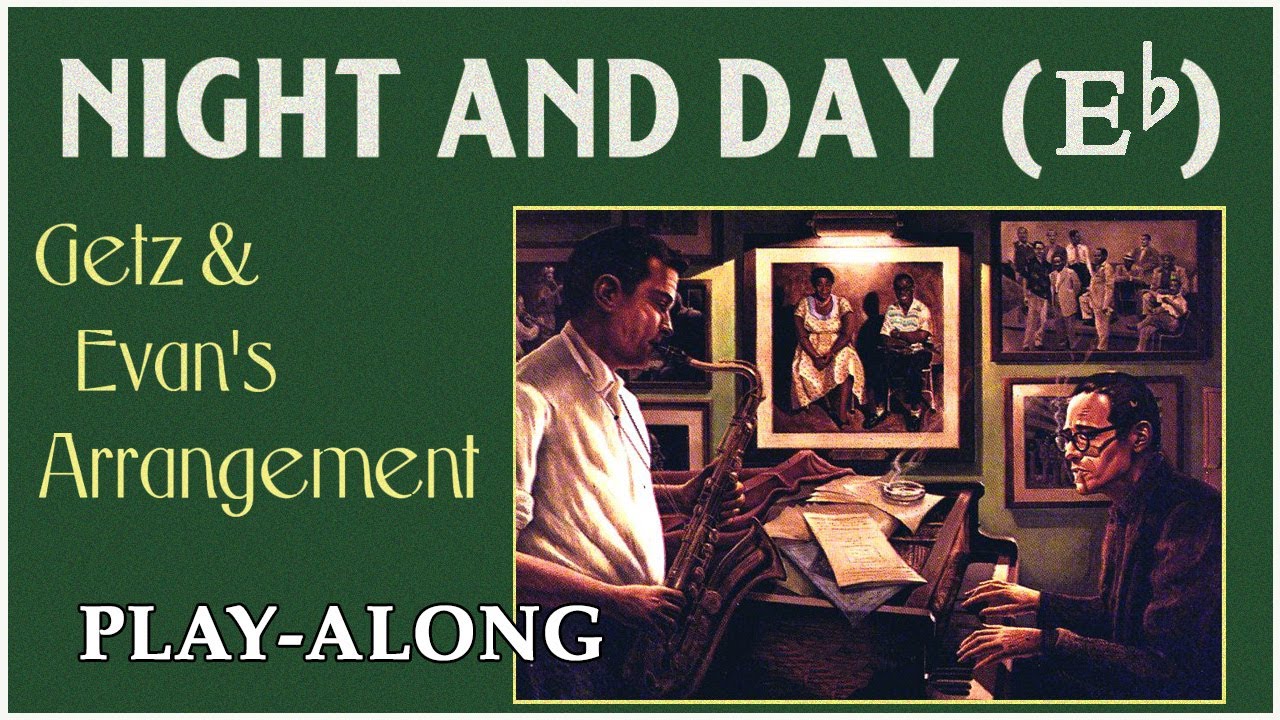
Night and Day (Eb) - GETZ & EVANS ARRANGEMENT || BACKING TRACK
Автор: JGC Play-Alongs
Загружено: 2021-01-18
Просмотров: 5514
8 Bar Drum Intro, Head In, Solo w/ Breaks x1, Solo x4, Head Out, Outro
Straight/Swing Up Tempo 215 BPM
Inspired by the Stan Getz and Bill Evans recording!
Download a free chord chart for this tune here:
https://www.jazzguitarcomprehensive.c...
Check out my page for hundreds more of the best Play-Alongs and Loops in the world!
Join me on Patreon for Backing Tracks and Lead Sheets each week, as well as much more:
► / jazzguitarcomprehensive
Some notes about the composition as found on
https://www.jazzguitarcomprehensive.com/
Composer: Cole Porter
Year: 1932
Origin: Introduced in the Broadway Musical Gay Divorce.
Style: Usually played either straight or swung, or a combination of the two.
Form: A-B-A-B-C-B (48 Bars) [8-8-8-8-8-8]
It is very common to change feels for different sections. For instance, on Joe Henderson’s rendition from the album Inner Urge, the band plays the entire tune swung with only the C section straight. On the album Stan Getz & Bill Evans, the band alternates between straight and swing feels every 8 bars.
Verse: A-B (16 Bars) [8-8]
Not usually included, the original recording from Leo Reisman with Fred Astaire features it.
Key: Fred Astaire originally performed this composition in Eb Major. This has become a common key, although it often takes many varying keys.
Harmony/Overview: This harmony in this composition is mainly functional, although rather unconventional for a popular song from early 1930's. The harmony in the A sections from the original recording use a bVIMaj7 – V7 turnaround. While these changes are commonly used, many musicians oftentimes opt for a minor II - V instead. The B section consists of # IVmi7b5 - IVmi - IIImi7 - bIIIdim7 before a final II - V returns to the tonic. The C section begins on bIIIMaj7 before returning to IMaj7, and this happens twice. The parallel Maj7 chards moving repeatedly in minor 3rd's was a very unconventional sound at the time and it helps give the piece a particularly unique character.
Recordings: This song has been recorded over 720 times to date and is one of the top ten ASCAP-revenue producing songs of all time. The first recording comes from Leo Reisman with Fred Astaire in 1932. It was first introduced in the 1932 musical The Gay Divorce which was later adapted to film in 1934. It is a very versatile tune that has taken a wide variety of treatments throughout a nearly a centuries worth of performances, and it has been recorded by virtually every prominent jazz musician.
JGC Top Picks:
Stan Getz & Bill Evans, 1964
Joe Henderson, Inner Urge, 1964
Kenny Garrett, Trilogy, 1995
Please consider supporting this channel through a donation, https://www.paypal.com/paypalme/jazzg...
Be sure to subscribe to my main channel:
/ @jazzguitarcomprehensive
As well as JGC History to trace the lineage of some of the most important compositions in jazz:
/ @jgchistory
The World's Premier Site for Jazz Guitar Education and Beyond https://www.jazzguitarcomprehensive.com/
#NightandDay #StanGetz #BillEvans
Доступные форматы для скачивания:
Скачать видео mp4
-
Информация по загрузке: