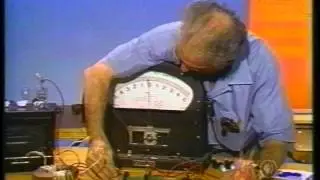
Julius Sumner Miller: Lesson 29 - The Physics of Toys - Acoustic - Thermal
Автор: Matthew Bryant
Загружено: 2013-07-31
Просмотров: 8845
This video is incomplete. Other copies exist on the internet--search for them if necessary.
A. We explored in another LESSON - on MECHANICAL TOYS -
the behavior of the TOY GUN which projects a pingpong ball.
Another question arises in this toy: When the ball is "fired" we
hear a "pop". A "poop". Where does THIS arise? Where does
the sound come from? So we see that this toy is not merely mechanical but gives rise to a question in ACOUSTICS. And the pitch of the "poop" can be altered by squeezing tightly or less so. . .suggest¬ing that it is the expanding air that emerges which gives rise to the sound. Much more can be said about this.
B. A disc - like a small saucer - has holes m rt. Another like it
is fitted to the first at their faces. We spin these on a string. We
are storing elastic twist energy in the wound-up string. On unwinding the "musical" system emits a pleasant array of sounds. . . .
the result of air rushing into and out of the holes. AND - what
do we see on the string? We see some standing waves set up. If
we examine this standing-wave mechanism closely we can relate
the wavelength on the string to the pitch of the note emitted. Beautiful thing.
C. Another musical device like that in B is made up of two hemispheres
face to face - with holes in each. The pitch emitted is different
the rotational speed different - the mechanical properties of a disk different from the mechanical properties of a sphere.
D. An airplane on a string is swung round and round - the other end
of the string fitted to the shaft of a stick held in the hand. And we
hear strange things! The string on the shaft is grabbed and let go -
grabbed and let go - like a violin bow grabbing the string on the
fiddle and letting go — relaxation oscillations - we call this.
Thus it is that the nose of the airplane is pulled out and relaxed -
pulled out and relaxed - and since it is flexible the air around
it has pulses delivered to it.
E. Another device of like nature: A winged insect. But here the
creature has a hollow chamber. And so what can we do? We first
listen to the note emitted with the chamber open then we close the
chamber with a cork stopper. And the note is changed because
open pipes and closed pipes emit different pitches.
F. The Bird Whistle: A chamber has a sliding piston. Its length can
thereby be changed. The pitch can thus be changed. Now too we
can heat the chamber whereupon the pitch changes. Thus we see
how length of pipe and temperature affect the pitch emitted. So
in orchestras: The temperature goes up - the stringed instruments
get lower - the winds get higher. Watch for this when next you
listen to an orchestra.
G. The Xylophone: An array of metal strips is fixed to "runners". The
metal strips are fastened at unique points - nodes. The strip is
struck with a tiny hammer. Each emits a note governed by its length
its size - its thickness - its stuff.
H. Two Frogs: A metal frog has a highly elastic flexible metal strip fixed to his body underneath. We flex the metal strip. What we hear is governed by the geometry and mechanical properties of the strip. The heavier the strip the greater the inertia and - in general
the lower the sound emitted.
I. A spinning wheel has a low-melting point metal fixed to it. The
mechanical energy delivered by the hand turns the wheel which scrapes the metal which heats it to incandescence which gives light. So we have the conversion of several kinds of ENERGY. . . mechanical - thermal - optical.
J. A Pop Gun: A long cylindrical chamber has a stopper closing one end. We drive a piston into the cylinder. Out pops the stopper and we hear a "poop". The longer the chamber the lower the pitch.
K. We show several other ACOUSTIC TOYS thus revealing the beauty and drama in things which are essentially for child's play but in which reside really rough and troublesome PHYSICS PRINCIPLES.

Доступные форматы для скачивания:
Скачать видео mp4
-
Информация по загрузке: