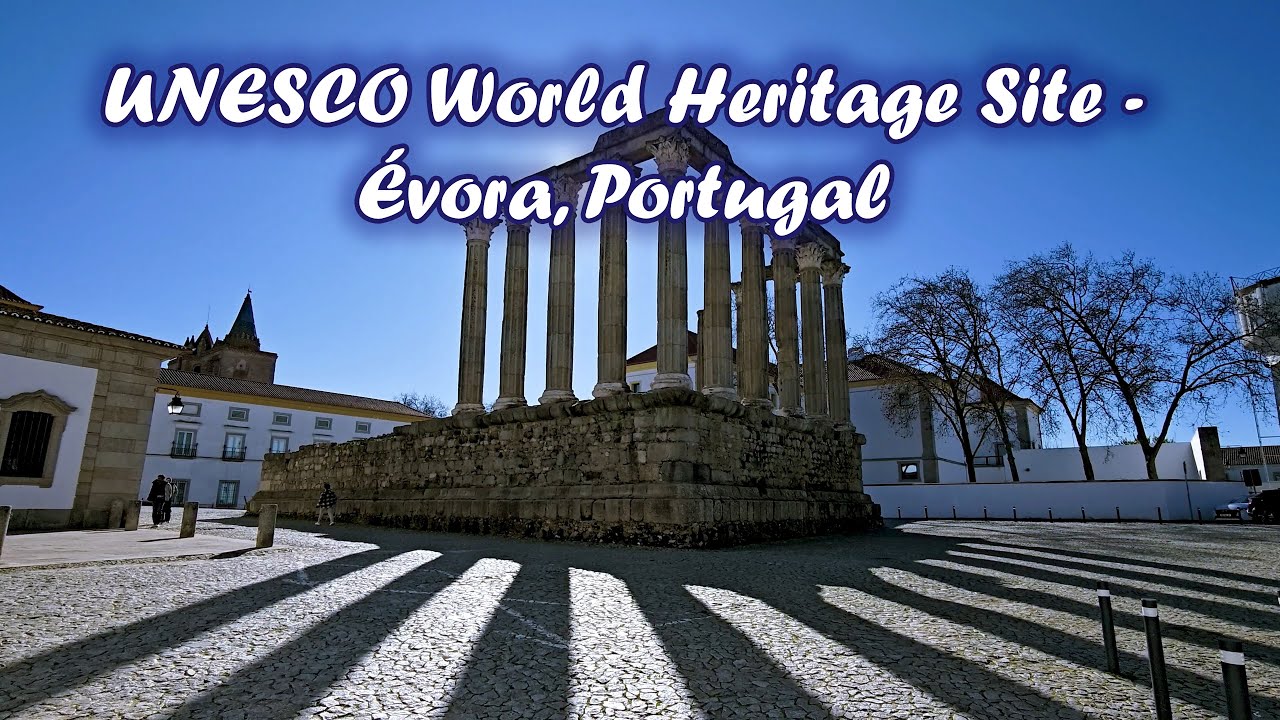
UNESCO World Heritage Site - Évora, Portugal
Автор: simplethrills
Загружено: 2026-01-07
Просмотров: 5
Évora’s historic centre in Portugal is a compact “museum city” whose streets, monuments and urban layout were inscribed as a UNESCO World Heritage Site in 1986. It offers an unusually complete picture of how a medium‑sized Iberian city evolved over more than two millennia, preserving the physical traces of successive civilizations layered within a still‑lived‑in urban fabric.
The city stands in the Alentejo region in south central Portugal, inland from Lisbon, in a landscape of rolling plains that historically supported agriculture and trade. This position away from the Atlantic coast helped Évora avoid some of the destructive forces that reshaped other Portuguese cities, such as the 1755 Lisbon earthquake, which in turn contributed to the survival of its older urban fabric.
Évora’s origins go back to pre‑Roman settlements that took advantage of a defensible hill and nearby water sources. Under Roman rule it became an important municipium, leaving behind substantial remains, the most emblematic being the so‑called Roman Temple whose granite podium and marble Corinthian columns still dominate a central square. Later, during the Islamic period, the city was reshaped with new defensive works and a more intricate street network before Christian reconquest in the 12th century reoriented its institutions and monumental building programs.
The city reached a political and cultural peak in the 15th and 16th centuries when Portuguese kings frequently resided there and major religious orders established powerful bases. This royal and ecclesiastical presence fostered the construction of noble houses, convents, colleges and civic spaces that still structure the historic centre today. Évora’s university, founded in the 16th century under Jesuit direction, turned the city into a regional intellectual hub, especially in theology and philosophy, further deepening its cultural profile.
Architecturally, Évora is renowned for the coherence of its traditional townscape. Whitewashed houses are punctuated by stonework portals, wrought iron balconies and interiors decorated with azulejo tiles, largely from the 16th to 18th centuries, which together create a distinctive visual rhythm. This ensemble is not a frozen museum but a living pattern of streets and dwellings that influenced the design of colonial towns, particularly in Brazil, where similar combinations of plastered walls, tiled decoration and church‑dominated skylines became characteristic.
Among its most important religious buildings, the Cathedral of Évora stands out as one of Portugal’s largest and most significant Gothic churches, begun at the end of the 12th century and completed over the following two centuries. Its massive granite bulk, Romanesque‑Gothic portal and later additions such as the Manueline elements illustrate how changing artistic styles were layered onto a single sacred structure without erasing earlier phases. Inside and around the cathedral, cloisters, chapels and treasures testify to the long role of Évora as an episcopal and later archiepiscopal seat.
Other monuments deepen the city’s historical narrative. The Chapel of Bones in the Church of São Francisco, lined with human bones and skulls, reflects early modern attitudes toward death and the transience of life as well as the Franciscan tradition of stark spiritual reminders. The medieval and early modern defensive walls, partly rebuilt in a style influenced by Vauban‑type bastioned fortifications, encircle much of the historic core and define the boundary of the World Heritage property. Public spaces such as Praça do Giraldo concentrate civic life, recalling periods when the square was a stage for markets, processions and political events.
UNESCO values Évora as an exceptional example of a city that preserves the structure and appearance of Portugal’s early modern “golden age,” when exploration, trade and religious authority were reshaping the kingdom. The survival of so many interlocking elements, from street patterns and domestic architecture to major religious and civic monuments, allows visitors and scholars to read changes in power, belief and aesthetics directly in the stones of the city. This continuity makes Évora a crucial place for understanding how Portuguese urbanism developed locally and how it projected its models abroad in the wider Lusophone world.
#WorldHeritage #OldTown #Romantemple
Доступные форматы для скачивания:
Скачать видео mp4
-
Информация по загрузке:




![[4K]🇺🇸Зимняя прогулка по Нью-Йорку | Верхний Вест-Сайд Манхэттена | Ужин в Song’e Napule🍕 (2026)](https://image.4k-video.ru/id-video/PS4hdPPioQw)


![25 ЛУЧШИХ МЕСТ ГЕРМАНИИ [РЕЙТИНГ] - Германия 2025 - Не только Берлин и Мюнхен](https://image.4k-video.ru/id-video/Lfk15cA2EOc)