From Black Sea to Atlantic, Russian oil tankers taken down one by one
Автор: RFU News — Strategic Geopolitics
Загружено: 2026-01-17
Просмотров: 81840
🔴 Our interactive news map: https://www.rfunews.com/map
🔴 Subscribe to unlock full access to the map + exclusive strategic insights: https://www.rfunews.com/pricing
Today, the biggest news comes from the Russian shadow fleet.
Here, events unfolding far beyond Ukraine’s coastline point to a shift in how pressure is being applied against Russia’s war economy. Within days, actions in two distant seas lined up in timing and effect, closing off routes Moscow has relied on to keep oil moving.
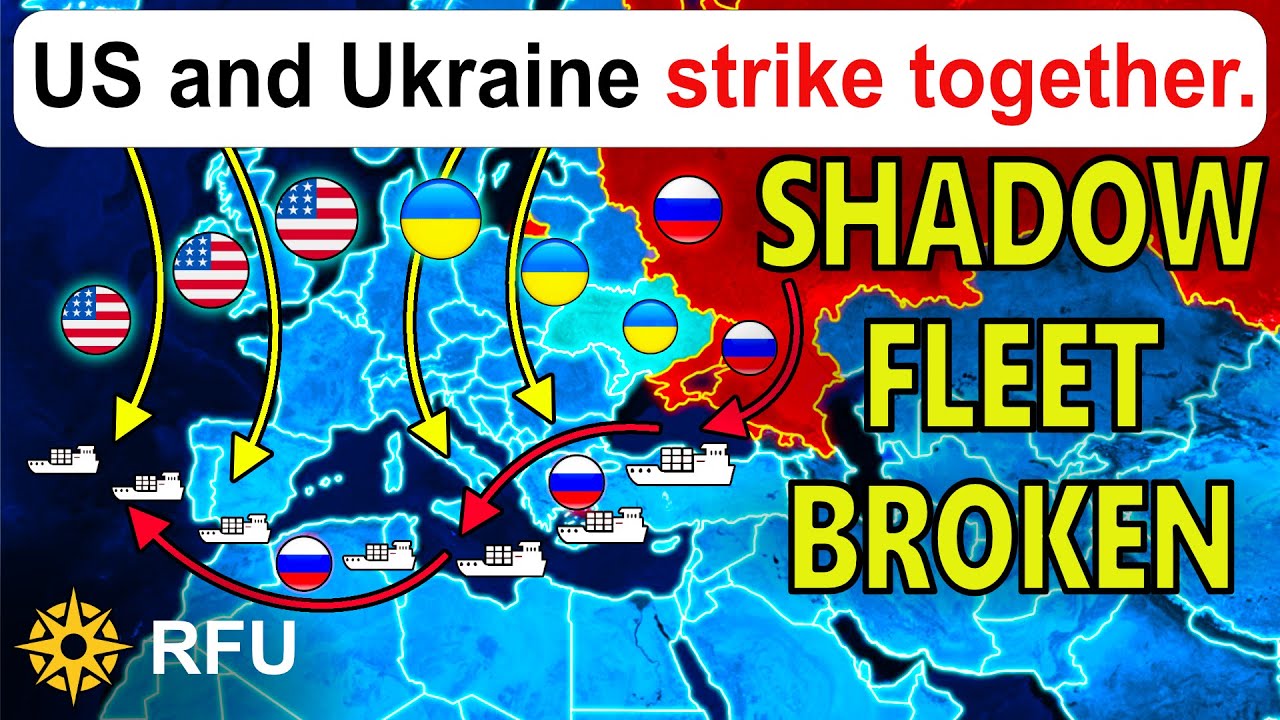
Over the same short window, the United States and Ukraine struck Russian maritime logistics in different theaters. In the Caribbean, US forces moved to seize the tanker Olina, a stateless shadow-fleet vessel operating under a false flag and listed on multiple sanctions regimes, removing it from service while still at sea. At the same time, a Russia-bound tanker in the Black Sea was hit by a drone near Turkey’s northern coast, damaged badly enough to force it to stop, seek assistance, and submit to inspection instead of continuing toward the port of Novorossiysk. These were interventions that took ships out of circulation, not statements or warnings.
On the American side, the operation centered on the seizure of Olina, a shadow-fleet tanker previously sanctioned under an earlier name for transporting Russian oil and now operating without a valid flag. US Coast Guard cutters moved to board the vessel in Caribbean waters under international law, marking the third Russian-linked tanker to come under US control in just two days. This seizure fits into a broader enforcement campaign targeting shadow-fleet tankers carrying Venezuelan and Russian-linked crude, which quietly removes vessels from circulation before they can complete their routes. At the other end of the route, Ukraine’s strike targeted a tanker transiting the Black Sea on its way to load Russian crude. The drone attack caused visible damage on deck and in the engine area, halted the ship’s progress, and triggered a request for assistance from the Turkish coast guard. As the ship was empty at the time, no oil was spilled, and no crew members were injured, but the voyage was completely. For a vessel operating on tight schedules and thin margins, that interruption mattered as much as destruction.
The alignment of these actions was deliberate, applying pressure to Russian maritime logistics from both ends at the same time. With seizures in the Atlantic and Caribbean and a strike in the Black Sea, Russia is now facing disruption across every major maritime route it relies on, rather than pressure concentrated in a single contested zone. This represents a new peak in operations against the shadow fleet, where enforcement is no longer absorbed locally but applied across multiple seas at once, leaving fewer fallback routes and clearing the assumption that tankers can simply divert around trouble. What changed this week is that the United States transitioned from sanctions and monitoring to direct enforcement at sea, aligning its actions with Ukrainian strikes in real-time. As a result, the central question for Russia is no longer where to reroute cargo, but whether a voyage can be completed at all without interruption.
The practical effect is that in addition to these, the Baltic is already increasingly monitored, and transits near Nato coastlines carry growing interception risk. To compensate, tankers are taking longer routes, detouring around controlled areas, loitering offshore to wait out patrols, and avoiding choke points whenever possible. Each of these choices adds distance, time, and cost, and a voyage that once followed the shortest commercial route now requires extended detours. Those added costs compound quickly, as longer voyages reduce the number of trips a tanker can complete each year, and even when tankers are not seized or struck, the effort to evade enforcement across multiple seas cuts directly into profitability and capacity. In effect, global enforcement turns every mile sailed into a liability, shrinking Russia’s usable shadow fleet not through destruction, but through cost and inefficiency.
Overall, these parallel actions show how coordinated pressure can reshape the maritime environment far beyond a single strike or seizure. The practical effects compound quickly. Each seized or disabled tanker removes carrying capacity immediately, disrupts loading schedules at hubs like Novorossiysk and Ust Luga, as well as signals to insurers and flag states that enforcement is active and unpredictable. By acting in different theaters within the same timeframe, the United States and Ukraine turned regional disruption into a global problem for Russian oil logistics. Secure maritime corridors are disappearing one by one as enforcement spreads across multiple seas. As those gaps widen, the revenue streams that sustain Russia’s war effort come under growing strain.
Доступные форматы для скачивания:
Скачать видео mp4
-
Информация по загрузке: