Finding the Right Output Folder for Artifacts in Azure DevOps Pipeline with DotNetCoreCLI
Автор: vlogize
Загружено: 2025-09-06
Просмотров: 3
Discover how to locate the output folder for your DotNetCoreCLI artifacts in Azure DevOps. Explore best practices and step-by-step solutions to ensure a smooth deployment process.
---
This video is based on the question https://stackoverflow.com/q/63191765/ asked by the user 'Yang You' ( https://stackoverflow.com/u/9531816/ ) and on the answer https://stackoverflow.com/a/63197709/ provided by the user 'Source Code' ( https://stackoverflow.com/u/4013975/ ) at 'Stack Overflow' website. Thanks to these great users and Stackexchange community for their contributions.
Visit these links for original content and any more details, such as alternate solutions, latest updates/developments on topic, comments, revision history etc. For example, the original title of the Question was: Azure pipeline task DotNetCoreCLI@ 2 - output folder of artifact
Also, Content (except music) licensed under CC BY-SA https://meta.stackexchange.com/help/l...
The original Question post is licensed under the 'CC BY-SA 4.0' ( https://creativecommons.org/licenses/... ) license, and the original Answer post is licensed under the 'CC BY-SA 4.0' ( https://creativecommons.org/licenses/... ) license.
If anything seems off to you, please feel free to write me at vlogize [AT] gmail [DOT] com.
---
Finding the Right Output Folder for Artifacts in Azure DevOps Pipeline with DotNetCoreCLI
When working on a .NET Web API project within an Azure DevOps pipeline, you might come across the challenge of determining where your published artifacts are located after the DotNetCoreCLI@ 2 task executes. This problem can be slightly perplexing, especially when the output folder isn't immediately clear from your build logs. Let's walk through the solution clearly and step-by-step.
Understanding the Problem
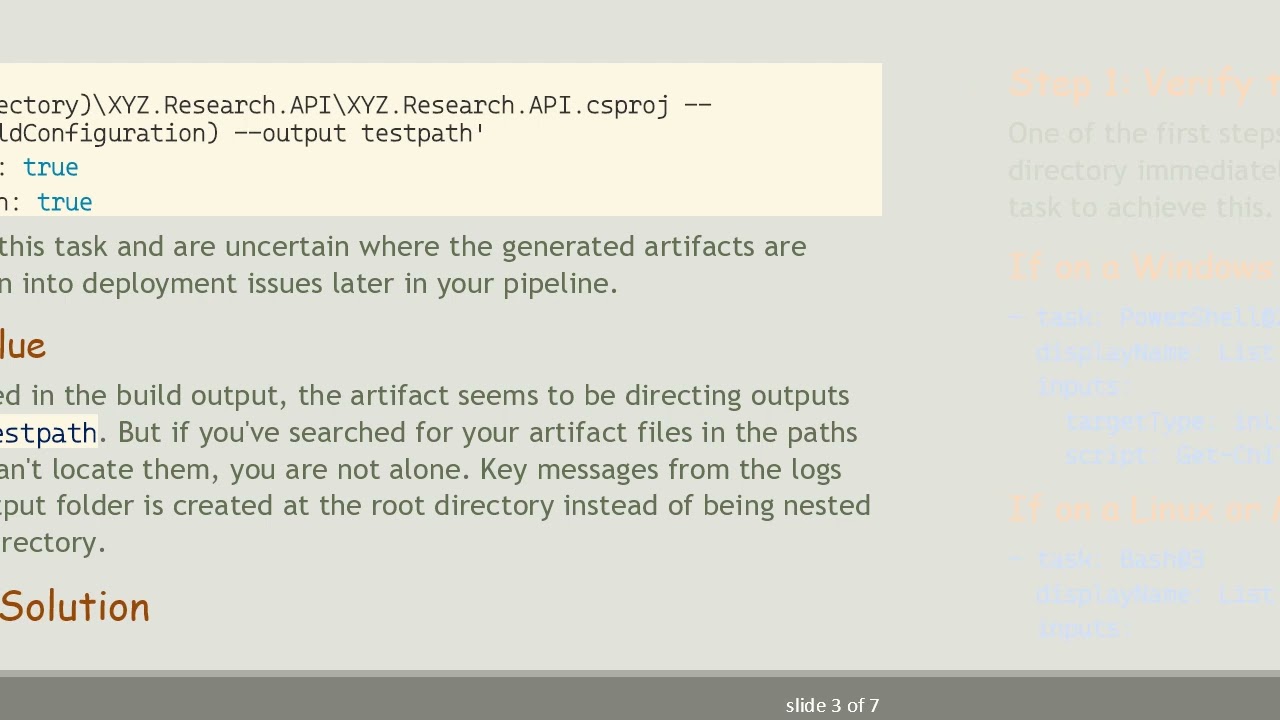
In a typical Azure DevOps pipeline, you might define a task to build and publish your .NET application, like so:
[[See Video to Reveal this Text or Code Snippet]]
However, if you run this task and are uncertain where the generated artifacts are stored, you might run into deployment issues later in your pipeline.
The Build Log Clue
From the log captured in the build output, the artifact seems to be directing outputs to a folder named testpath. But if you've searched for your artifact files in the paths suggested and still can't locate them, you are not alone. Key messages from the logs indicate that the output folder is created at the root directory instead of being nested within the project directory.
Step-by-Step Solution
Step 1: Verify the Artifacts Location
One of the first steps in locating your artifacts is to list the contents of the output directory immediately after the publish task. You can use either a PowerShell or Bash task to achieve this.
If on a Windows Agent:
[[See Video to Reveal this Text or Code Snippet]]
If on a Linux or Mac Agent:
[[See Video to Reveal this Text or Code Snippet]]
This will display all files in the working directory, allowing you to pinpoint where your published artifacts are stored.
Step 2: Use the Correct Parameters
Instead of passing the project file through the arguments parameter, it’s best to specify the project file using the projects parameter in your DotNetCoreCLI task. Additionally, aim to utilize the $(Build.ArtifactStagingDirectory) as your output directory. Here’s how you can adjust the task:
[[See Video to Reveal this Text or Code Snippet]]
Step 3: Ensure Directory Accuracy
If you change the output directory, remember that the working directory for your file listing task defaults to $(Build.SourcesDirectory). If you've changed locations, adjust the directory for your listing tasks accordingly to ensure you are viewing the correct location.
Conclusion
Locating the output folder for your artifacts generated by the DotNetCoreCLI@ 2 task in Azure DevOps can initially seem challenging. By following the outlined steps—verifying the output folder with a post-publish task, using proper parameters, and ensuring directory accuracy—you can ensure that the artifacts are readily available for subsequent steps in your pipeline. Engaging in these practices will lead to a smoother deployment experience.
By effectively managing your output paths, you can spend less time troubleshooting and more time developing your application. Happy coding!
Доступные форматы для скачивания:
Скачать видео mp4
-
Информация по загрузке:


