Converting JSON Arrays to POJO Integers in Java Using Jackson
Автор: vlogize
Загружено: 2025-10-06
Просмотров: 1
Learn how to map JSON date arrays to POJO integers using Jackson's ObjectMapper, including both constructor annotations and custom deserialization for flexibility.
---
This video is based on the question https://stackoverflow.com/q/64004700/ asked by the user 'tez' ( https://stackoverflow.com/u/3867630/ ) and on the answer https://stackoverflow.com/a/64006533/ provided by the user 'Kousik Mandal' ( https://stackoverflow.com/u/7880079/ ) at 'Stack Overflow' website. Thanks to these great users and Stackexchange community for their contributions.
Visit these links for original content and any more details, such as alternate solutions, latest updates/developments on topic, comments, revision history etc. For example, the original title of the Question was: Read date as an array integer from json and map with POJO as an integer
Also, Content (except music) licensed under CC BY-SA https://meta.stackexchange.com/help/l...
The original Question post is licensed under the 'CC BY-SA 4.0' ( https://creativecommons.org/licenses/... ) license, and the original Answer post is licensed under the 'CC BY-SA 4.0' ( https://creativecommons.org/licenses/... ) license.
If anything seems off to you, please feel free to write me at vlogize [AT] gmail [DOT] com.
---
Handling JSON Data with Jackson in Java
When working with REST APIs in Java, one common task is parsing JSON responses into Java objects, also known as POJOs (Plain Old Java Objects). One confusing aspect can arise when the JSON includes date fields as arrays of integers and you need these to fit into an integer data type in your POJO. In this post, we will explore how to effectively handle this scenario using Jackson's ObjectMapper.
The Problem
Imagine you receive a JSON response from an API that looks like this:
[[See Video to Reveal this Text or Code Snippet]]
You need to extract the startDate and endDate from the JSON array as integers (e.g., 2020922 for the start date). The challenge here is how to achieve this without altering your existing POJO structure significantly.
Solution Overview
To solve this problem, we can take one of two approaches:
Using a Constructor with @ JsonCreator Annotation: We can create a constructor in our POJO that accepts lists as parameters and processes them to create the desired integer format.
Implementing a Custom Deserializer: When modification of the POJO is not possible, we can create a custom deserializer to handle the conversion logic.
Approach 1: Using @ JsonCreator Annotation
Here is an example of how to use the @ JsonCreator annotation in your POJO:
POJO With Constructor
[[See Video to Reveal this Text or Code Snippet]]
Main Method Example
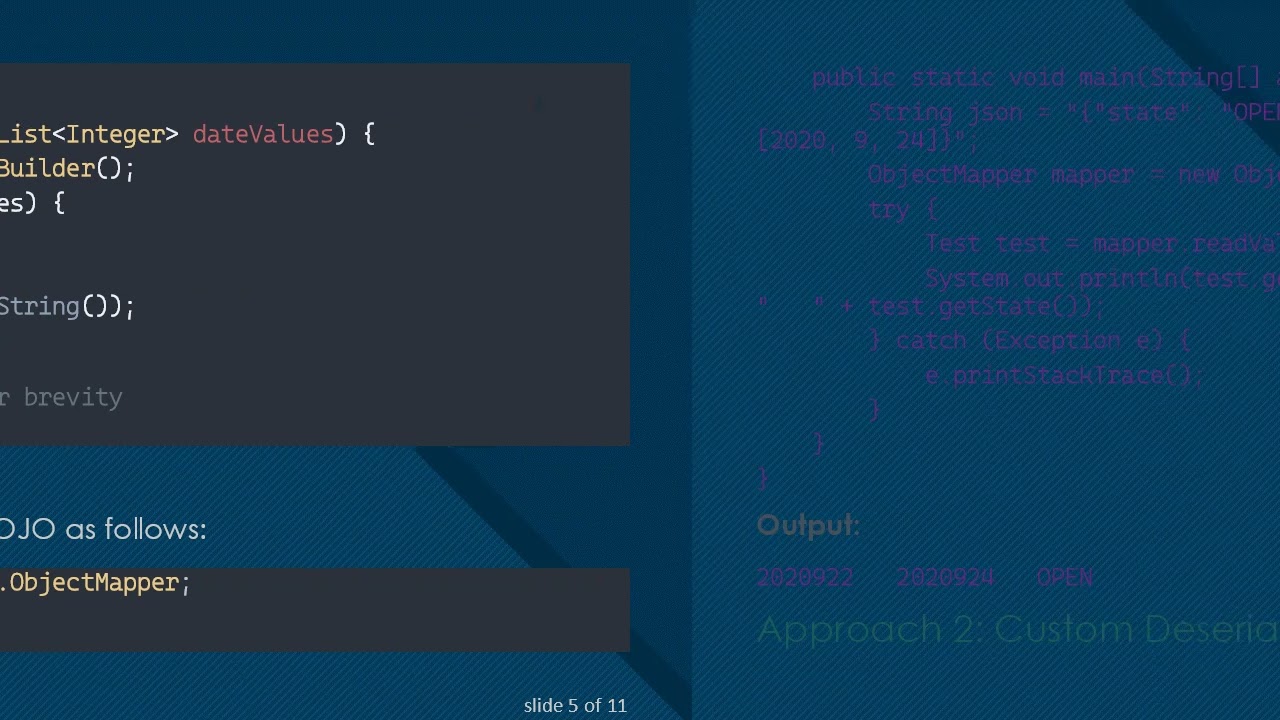
You can deserialize JSON into your POJO as follows:
[[See Video to Reveal this Text or Code Snippet]]
Output:
[[See Video to Reveal this Text or Code Snippet]]
Approach 2: Custom Deserialization
If you cannot modify the existing POJO, the alternative is to create a custom deserializer. Here’s how to do it:
Custom Test POJO
[[See Video to Reveal this Text or Code Snippet]]
Custom Deserializer
[[See Video to Reveal this Text or Code Snippet]]
Registering the Custom Deserializer
You need to register the custom deserializer like this:
[[See Video to Reveal this Text or Code Snippet]]
Output:
[[See Video to Reveal this Text or Code Snippet]]
Conclusion
In this guide, we've covered two approaches for mapping date arrays from JSON to integer fields in POJOs using Jackson. Depending on whether you can modify the existing POJO, you can choose the more straightforward constructor approach or opt for a custom deserializer if needed. Always remember to handle null values appropriately to avoid potential exceptions. Happy coding!
Доступные форматы для скачивания:
Скачать видео mp4
-
Информация по загрузке: