Addressing the Out of Memory Issue in Python Keras: A Comprehensive Solution
Автор: vlogize
Загружено: 2025-10-03
Просмотров: 3
Discover how to resolve the frustrating memory management issue in Keras and TensorFlow with our easy-to-follow guide. We'll help you optimize your code and understand memory usage better!
---
This video is based on the question https://stackoverflow.com/q/62917349/ asked by the user 'IVlad' ( https://stackoverflow.com/u/270287/ ) and on the answer https://stackoverflow.com/a/63042165/ provided by the user 'Martin Brisiak' ( https://stackoverflow.com/u/5123537/ ) at 'Stack Overflow' website. Thanks to these great users and Stackexchange community for their contributions.
Visit these links for original content and any more details, such as alternate solutions, latest updates/developments on topic, comments, revision history etc. For example, the original title of the Question was: Python Keras code out of memory for no apparent reason
Also, Content (except music) licensed under CC BY-SA https://meta.stackexchange.com/help/l...
The original Question post is licensed under the 'CC BY-SA 4.0' ( https://creativecommons.org/licenses/... ) license, and the original Answer post is licensed under the 'CC BY-SA 4.0' ( https://creativecommons.org/licenses/... ) license.
If anything seems off to you, please feel free to write me at vlogize [AT] gmail [DOT] com.
---
Tackling Python Keras Out of Memory Issues
Working with machine learning models can sometimes lead to unexpected errors, especially when it comes to memory management. One common issue that developers encounter is the out of memory (OOM) error while using Keras with TensorFlow. If you've experienced this frustrating problem, you're not alone! This guide will help you identify the cause of this memory issue and provide practical solutions to avoid it.
The Problem
In this scenario, a user implementing a Keras Sequential model on the CIFAR-10 dataset finds their Python code crashing with an exit code 137, indicating that the system is running out of memory. With 16 GB of RAM available, the user notices that memory consumption spikes significantly during execution, leading to eventual crashes after multiple iterations of their outer loop.
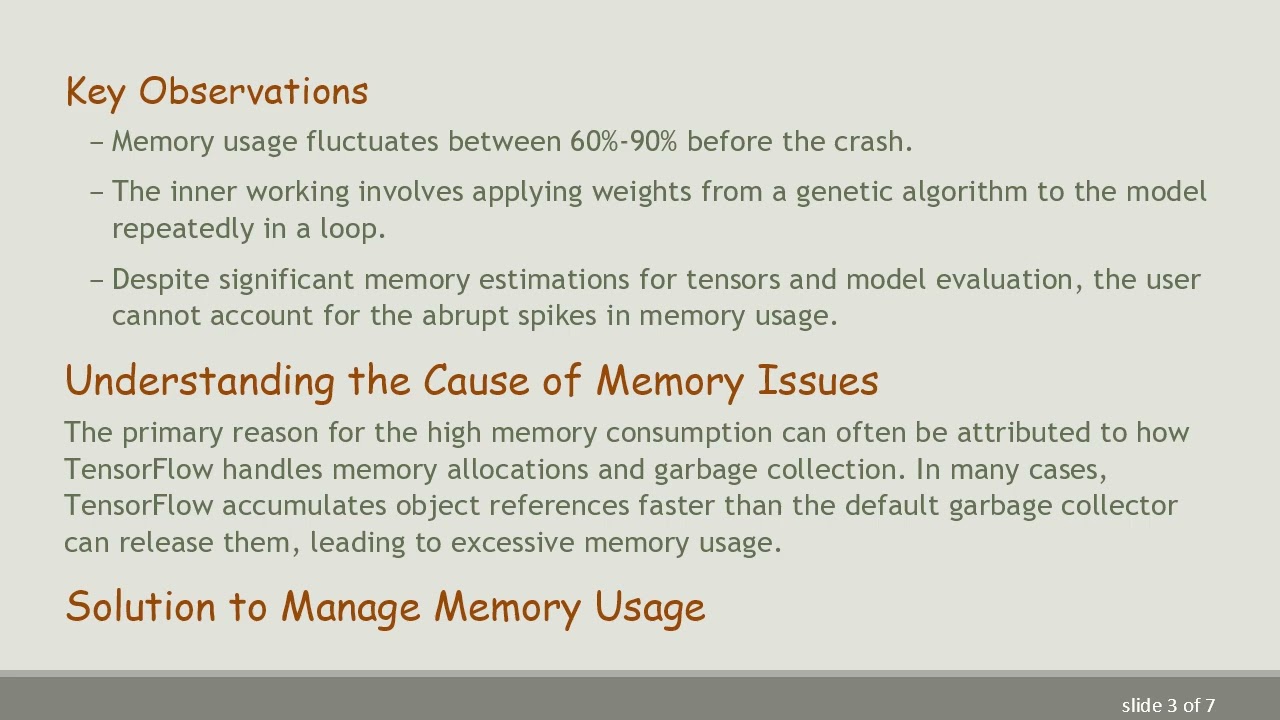
Key Observations
Memory usage fluctuates between 60%-90% before the crash.
The inner working involves applying weights from a genetic algorithm to the model repeatedly in a loop.
Despite significant memory estimations for tensors and model evaluation, the user cannot account for the abrupt spikes in memory usage.
Understanding the Cause of Memory Issues
The primary reason for the high memory consumption can often be attributed to how TensorFlow handles memory allocations and garbage collection. In many cases, TensorFlow accumulates object references faster than the default garbage collector can release them, leading to excessive memory usage.
Solution to Manage Memory Usage
After testing the original code, a simple yet effective way was discovered to alleviate the out-of-memory issue: manually invoking Python's garbage collector.
Implementation Steps
Import the required libraries:
Ensure you have the necessary imports at the beginning of your script.
[[See Video to Reveal this Text or Code Snippet]]
Load CIFAR-10 Data:
Shuffle and prepare your dataset as follows:
[[See Video to Reveal this Text or Code Snippet]]
Define Your Model:
Set up the Keras model with a straightforward architecture:
[[See Video to Reveal this Text or Code Snippet]]
Incorporate Garbage Collection:
Introduce gc.collect() within your loops to help manage memory effectively:
[[See Video to Reveal this Text or Code Snippet]]
Important Note
While manually invoking the garbage collector is not the optimal practice for production code, it can serve as a temporary fix in scenarios like this where excessive memory usage occurs.
Conclusion
Managing memory efficiently while training complex machine learning models can often be tricky. If you've encountered an out-of-memory error in your Python Keras projects, manually invoking the garbage collector could be the solution you need. Remember to analyze your code and optimize it as necessary, ensuring that you free up memory as you go. Should further complications arise, consider exploring other memory management techniques and tools available within Python and TensorFlow.
With these strategies, you're now better equipped to handle memory issues in Keras! Keep your code running smoothly and optimize your machine learning workflows. Happy coding!
Доступные форматы для скачивания:
Скачать видео mp4
-
Информация по загрузке: