Combining CNN and LSTM Networks for Enhanced Time Series Forecasting
Автор: vlogize
Загружено: 2025-09-22
Просмотров: 8
Discover how to effectively combine `CNN` and `LSTM` networks to leverage their strengths in time series forecasting using TensorFlow and Keras.
---
This video is based on the question https://stackoverflow.com/q/62912890/ asked by the user 'Max2603' ( https://stackoverflow.com/u/6215597/ ) and on the answer https://stackoverflow.com/a/62913443/ provided by the user 'Guillem' ( https://stackoverflow.com/u/7946792/ ) at 'Stack Overflow' website. Thanks to these great users and Stackexchange community for their contributions.
Visit these links for original content and any more details, such as alternate solutions, latest updates/developments on topic, comments, revision history etc. For example, the original title of the Question was: How to combine independent CNN and LSTM networks
Also, Content (except music) licensed under CC BY-SA https://meta.stackexchange.com/help/l...
The original Question post is licensed under the 'CC BY-SA 4.0' ( https://creativecommons.org/licenses/... ) license, and the original Answer post is licensed under the 'CC BY-SA 4.0' ( https://creativecommons.org/licenses/... ) license.
If anything seems off to you, please feel free to write me at vlogize [AT] gmail [DOT] com.
---
Combining CNN and LSTM Networks for Enhanced Time Series Forecasting
Time series forecasting is a complex task that requires understanding both past patterns and temporal dependencies in data. While Convolutional Neural Networks (CNNs) are excellent at capturing spatial features, Long Short-Term Memory (LSTM) networks shine in understanding sequences and temporal relationships. So, how do you harness the strengths of both to improve your forecasting models? This guide explores how to effectively combine independent CNN and LSTM networks using TensorFlow and Keras.
Understanding the Question
In the initial scenario, the user successfully developed a CNN that performs well on time series data and a basic LSTM that shows promise. However, they noticed that stacking the two networks does not yield the expected results. The user wants both networks to have access to the input data so the CNN can learn features while the LSTM focuses on temporal aspects. They also raise the question of whether concatenating the outputs of both networks is beneficial. Let's break this down step-by-step.
A Good Start: Choosing the Right Method
When working with TensorFlow and Keras, there are several approaches to combine CNN and LSTM networks effectively:
1. Use the Functional API
To create complex architectures in TensorFlow, it's highly recommended to use the functional API or subclass tf.keras.Model. This allows you to define multiple inputs and outputs easily, giving you flexibility in how data flows through your network.
2. Concatenate Outputs
Concatenating the outputs of both networks is akin to gathering insights from different perspectives. When both networks observe the same input data, the CNN can extract features while the LSTM manages the sequence-related attributes. This results in a more informed final prediction. Here's why concatenation is useful:
Diverse Insights: Different networks specialize in capturing various aspects of data, leading to more accurate predictions when their outputs are combined.
Enhanced Learning: Similar to having multiple experts analyze the same problem, combining their outputs can improve the overall model performance.
3. Explore Different Merge Methods
In addition to simple concatenation, consider trying other merge features approaches, such as:
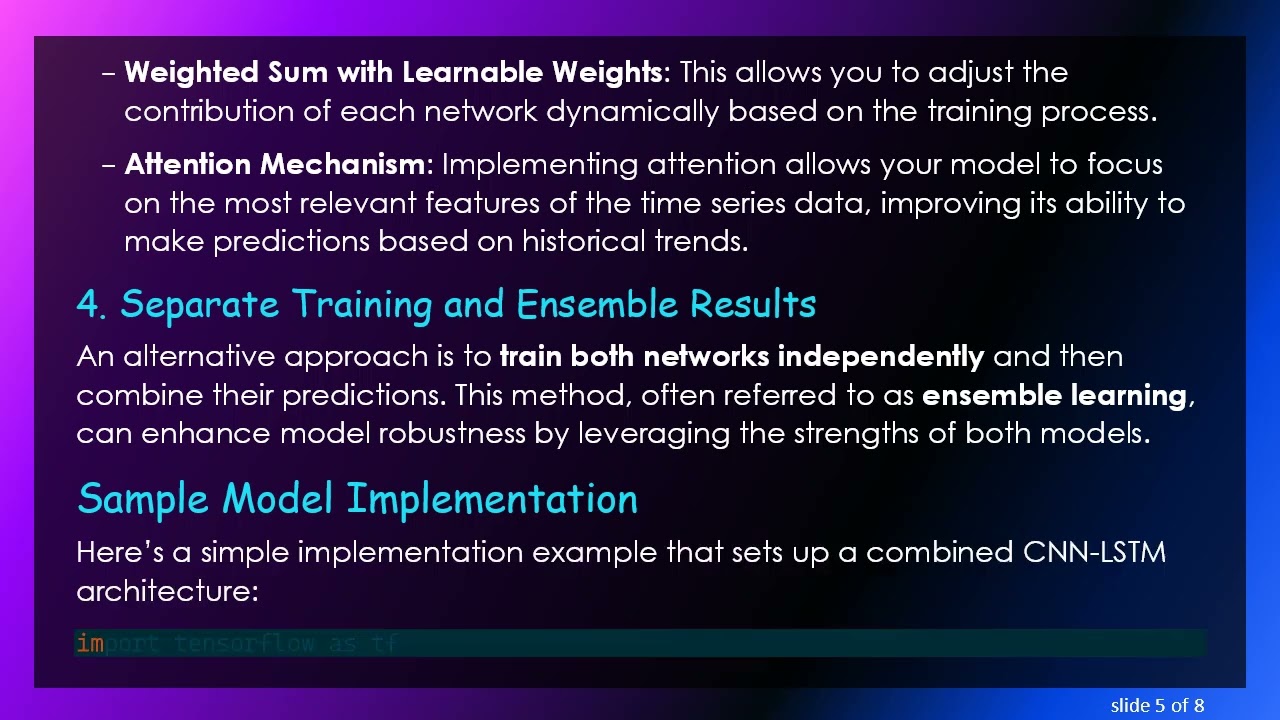
Weighted Sum with Learnable Weights: This allows you to adjust the contribution of each network dynamically based on the training process.
Attention Mechanism: Implementing attention allows your model to focus on the most relevant features of the time series data, improving its ability to make predictions based on historical trends.
4. Separate Training and Ensemble Results
An alternative approach is to train both networks independently and then combine their predictions. This method, often referred to as ensemble learning, can enhance model robustness by leveraging the strengths of both models.
Sample Model Implementation
Here’s a simple implementation example that sets up a combined CNN-LSTM architecture:
[[See Video to Reveal this Text or Code Snippet]]
Note on Modifications
The above example is saccharine in its simplicity. To make the model more effective, consider adding layers for Max Pooling, Dropouts, or enhancing architectures according to the specific dataset characteristics and forecasting task.
Conclusion
Combining CNN and LSTM networks can significantly enhance your time series forecasting performance. By utilizing the functional API, concatenating outputs, and exploring other merging methods, you can create a model that leverages the strengths of both architectures. Start implementing these strategies in your work, and you may find improved results in your forecasts. Happy coding!
Доступные форматы для скачивания:
Скачать видео mp4
-
Информация по загрузке:
![Как происходит модернизация остаточных соединений [mHC]](https://image.4k-video.ru/id-video/jYn_1PpRzxI)