Troubleshooting OpenCV Face Recognition Grayscale Conversion Errors in Python
Автор: vlogize
Загружено: 2025-09-21
Просмотров: 1
Discover how to solve the OpenCV grayscale conversion error while training your face recognition classifier in Python. This comprehensive guide will help you understand the issue and provide practical solutions for efficient coding.
---
This video is based on the question https://stackoverflow.com/q/62760771/ asked by the user 'Jason Abba' ( https://stackoverflow.com/u/12401771/ ) and on the answer https://stackoverflow.com/a/62761171/ provided by the user 'sehrob' ( https://stackoverflow.com/u/3370288/ ) at 'Stack Overflow' website. Thanks to these great users and Stackexchange community for their contributions.
Visit these links for original content and any more details, such as alternate solutions, latest updates/developments on topic, comments, revision history etc. For example, the original title of the Question was: OpenCV Face Recognition grayscale conversion error while training my classifier
Also, Content (except music) licensed under CC BY-SA https://meta.stackexchange.com/help/l...
The original Question post is licensed under the 'CC BY-SA 4.0' ( https://creativecommons.org/licenses/... ) license, and the original Answer post is licensed under the 'CC BY-SA 4.0' ( https://creativecommons.org/licenses/... ) license.
If anything seems off to you, please feel free to write me at vlogize [AT] gmail [DOT] com.
---
Troubleshooting OpenCV Face Recognition Grayscale Conversion Errors in Python
When it comes to developing a face recognition system using OpenCV in Python, it’s not uncommon to run into errors during the training phase of your classifier. One such error is related to converting images from color to grayscale, which can halt your progress before you've even started. In this guide, we’ll delve into a common issue faced by developers—namely the error encountered when attempting to convert images to grayscale.
The Problem: Image Conversion Error
While trying to train a classifier for face recognition, you may run into an error that looks like this:
[[See Video to Reveal this Text or Code Snippet]]
This error arises during the cvtColor function call in your code, suggesting that there's an issue with handling the input images from your dataset. Most likely, this is due to how you are iterating over your images.
Understanding the Error
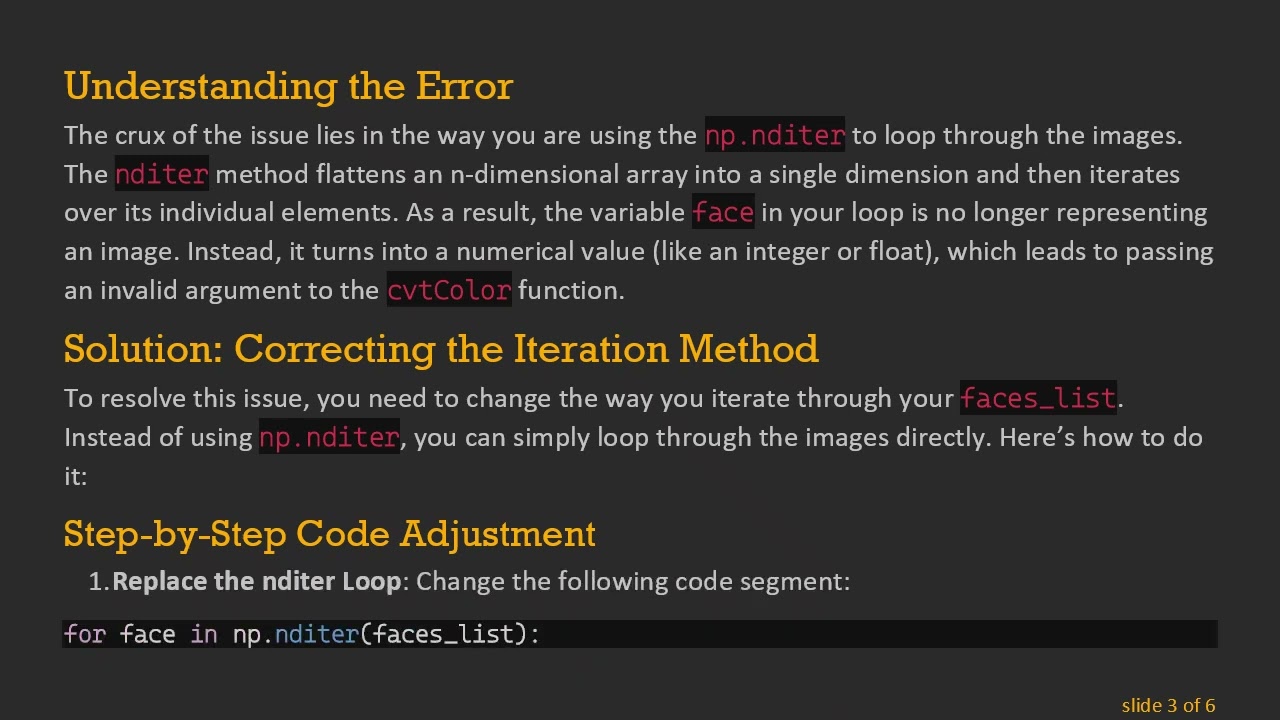
The crux of the issue lies in the way you are using the np.nditer to loop through the images. The nditer method flattens an n-dimensional array into a single dimension and then iterates over its individual elements. As a result, the variable face in your loop is no longer representing an image. Instead, it turns into a numerical value (like an integer or float), which leads to passing an invalid argument to the cvtColor function.
Solution: Correcting the Iteration Method
To resolve this issue, you need to change the way you iterate through your faces_list. Instead of using np.nditer, you can simply loop through the images directly. Here’s how to do it:
Step-by-Step Code Adjustment
Replace the nditer Loop: Change the following code segment:
[[See Video to Reveal this Text or Code Snippet]]
to a straightforward loop like this:
[[See Video to Reveal this Text or Code Snippet]]
Modify the Function: Here’s the adjusted function using the correct loop:
[[See Video to Reveal this Text or Code Snippet]]
Summary of Changes:
Replace np.nditer with a direct loop to access images properly.
Ensure you are passing valid images to the cv2.cvtColor function.
Conclusion
By making this simple adjustment to your code, you should be able to avoid the grayscale conversion error that arises during the training of your face recognition classifier. Remember that small changes in how you handle your data can have significant impacts on your application’s performance. Happy coding, and may your classifier achieve the recognition accuracy you strive for!
Доступные форматы для скачивания:
Скачать видео mp4
-
Информация по загрузке: