Flavonoid Containing Drug (Part 02) = Tea (Biological Source, Description, Chemical Const. & Uses)
Автор: Solution- Pharmacy
Загружено: 2020-02-09
Просмотров: 10407
Download "Solution Pharmacy" Mobile App to Get All Uploaded Notes, Model Question Papers, Answer Papers, Online Test and other GPAT Materials - https://play.google.com/store/apps/de...
1. Introducton to Flavonoids in Hindi by Solution Pharmacy • Class (69)= Flavonoids (Part 01) | Introdu...
2. Ruta (Flavonoid Containing Drug- Part 1) by Solution Pharmacy • Flavonoid Containing Drug (Part 01)= Ruta ...
TEA
Tea is a shrub that grows up to four meters high, evergreen, alternate leaves, elliptic, pointed, toothed and coriaceous leaves, six to eight inches long and three inches wide. It has white flowers, axillary and with peduncle, capsular fruit, globose habit, with three blackish seeds. The parts used are leaves which take different names according to the treatment they experience: Green Tea or Black Tea.
Biological Source
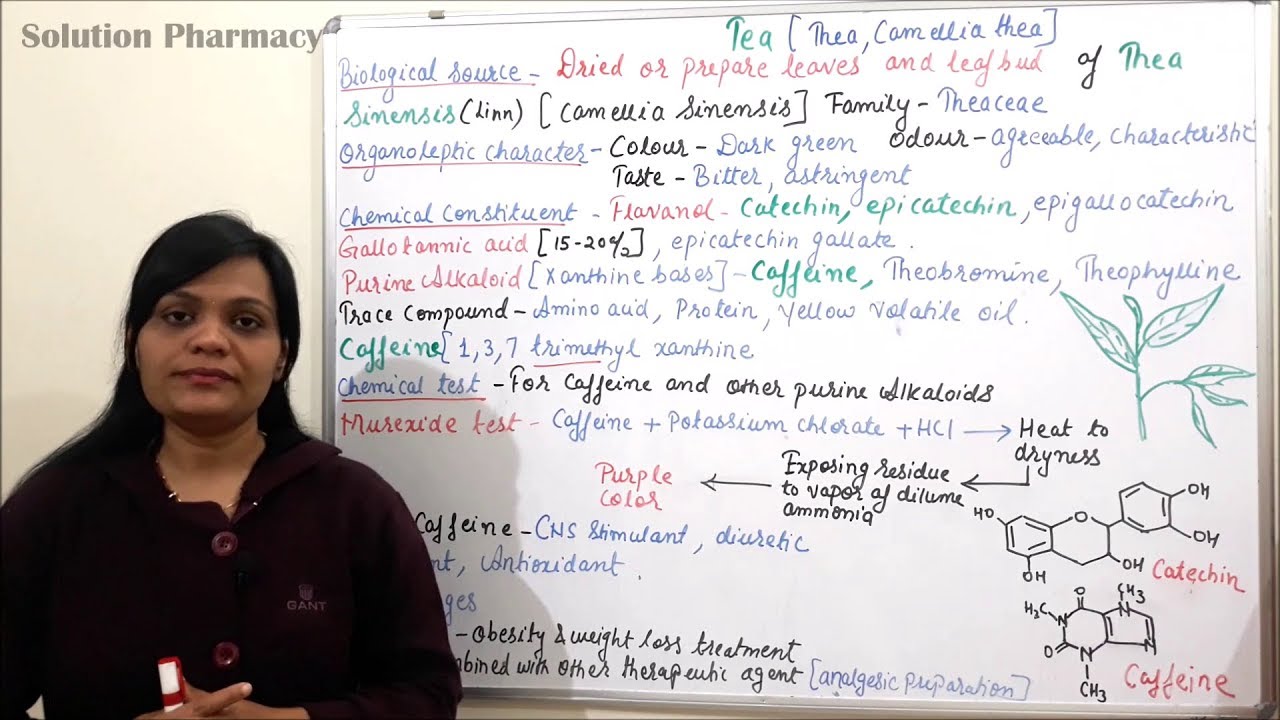
It contains the prepared leaves and leaf buds of Thea sinensis (Linne) kuntz., belonging to family Theaceae.
Geographical Source
It is mainly cultivated in India (Assam), Ceylon, Japan and Java.
Characteristics
Leaves are dark green in colour, lanceolate or elliptical, on short stalks, blunt at apex, base tapering, margins shortly serrate, young leaves hairy, older leaves glabrous.
Chemical Constituents
The leaves are a rich source of caffeine (1–5%). It also contains theobromine and theophylline in minor quantities. The colour of tea leaves is due to tannin (10–20% gallotannic acid). The agreeable odour is due to presence of a yellow volatile oil. Tea leaves also contain protein, wax, resin and ash.
Chemical Test
1. Caffeine and other purine alkaloids, gives murexide colour reaction. Caffeine is taken in a petridish to which hydrochloric acid and potassium chlorate are added and heated to dryness. A purple colour is obtained by exposing the residue to vapours of dilute ammonia. In addition of fixed alkali the purple colour disappears.
2. Caffeine also produces white precipitate with tannic acid solution.
Uses
It is used as stimulant, astringent and also as diuretic.
Get in touch with the solution by just clicking following links-
Facebook Group- / solutionpharamcy
Facebook Page- / pharmavideo
New channel (Pharmacy Dictionary) - / @pharmacydictionary
Instagram- / solutionpharmacy
E-Mail for official and other work - solutionpharmacy@gmail.com
LinkedIn- / pushpendrakpatel
#solutionpharmacy #Pharmacologyclass #GPATonlinetest
Доступные форматы для скачивания:
Скачать видео mp4
-
Информация по загрузке: