2025/08/31-3 Greece/Rhodes: Lindos Acropolis - Spectacular Views - Going Back to Lindos
Автор: Armindo Souza
Загружено: 2025-11-11
Просмотров: 37
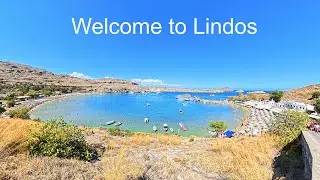
Lindos is an archaeological site, a fishing village and a former municipality on the island of Rhodes, in the Dodecanese, Greece. Since the 2011 local government reform, it is part of the municipality Rhodes, of which it is a municipal unit. The municipal unit has an area of 178.9 km2. It lies on the east coast of the island. It is about 40 km south of the city of Rhodes and its fine beaches make it a popular tourist and holiday destination. Lindos is situated in a large bay and faces the fishing village and small resort of Charaki.
According to myth, Lindos was founded by the Dorians led by the king Tlepolemus of Rhodes, who arrived in about the 10th century BC. It was one of six Dorian cities in the area known as the Dorian Hexapolis. The eastern location of Rhodes made it a natural meeting place between the Greeks and the Phoenicians, and by the 8th century Lindos was a major trading centre. In the 6th century it was ruled by Cleobulus, one of the Seven Sages of Greece. The importance of Lindos declined after the foundation of the city of Rhodes in the late 5th century BC.
In classical times the acropolis of Lindos was dominated by the massive temple of Athena Lindia, which attained its final form in around 300 BC. In Hellenistic and Roman times the temple precinct grew as more buildings were added. In early medieval times these buildings fell into disuse, and in the 14th century they were partly overlaid by a large fortress built on the acropolis by the Knights of St John to defend the island against the Ottomans.
The acropolis - Above the modern town rises the acropolis of Lindos, a natural citadel which was fortified successively by the Greeks, the Romans, the Byzantines, the Knights of St John and the Ottomans. This makes the site difficult to excavate and interpret archaeologically. The acropolis has views of the surrounding harbours and coastline.
On the acropolis of Lindos today parts of the following buildings may still be seen:
The Doric Temple of Athena Lindia, dating from about 300 BC, built on the site of an earlier temple. Inside the temple is the table of offerings and the base of the cult statue of Athena.
The Propylaea of the Sanctuary, also dating from the 4th century BC. A monumental staircase leads to a D-shaped stoa and a wall with five door openings.
The Hellenistic stoa with lateral projecting wings, dating from about 200 BC. The stoa was 87 metres long and consisted of 42 columns.
The well-known relief of a Rhodian trireme (warship) cut into the rock at the foot of the steps leading to the acropolis. On the bow stood a statue of General Hagesander, the work of the sculptor Pythokritos. The relief dates from about 180 BC.
The Hellenistic staircase (2nd century BC) leading to the main archaeological area of the acropolis.
Remains of a Roman temple, possibly dedicated to the Emperor Diocletian and dating from about 300 AD.
The Acropolis is surrounded by a Hellenistic wall contemporary with the Propylaea and the stairway leading to the entrance to the site.
Rhodes is the largest of Greece's Dodecanese islands and their historical capital; it is the ninth largest island in the Mediterranean Sea. Administratively, Rhodes constitutes a separate municipality within the Rhodes regional unit, which is part of the South Aegean administrative region. The principal town of the island and seat of the municipality is the city of Rhodes, home to its 50,636 inhabitants according to its 2011 census. By 2022, the island’s population had grown to 125,113 people. Located northeast of Crete and southeast of Athens, Rhodes is often referred to by several nicknames: the "Island of the Sun" after its patron sun god Helios; "The Pearl Island"; and "The Island of the Knights", a reference to the Knights of Saint John of Jerusalem, who ruled the island from 1310 to 1522.
Historically, Rhodes was famous for the Colossus of Rhodes, one of the Seven Wonders of the Ancient World. The Medieval Old Town of the City of Rhodes has been declared a World Heritage Site. During the early 21st century the island was one of the most popular tourist destinations in Europe.
The island has been known as Ρόδος (Ródos) in Greek throughout its history. Similar-sounding ῥόδον (rhódon) in ancient Greek was the word for the rose, whilst in modern Greek the also similar-sounding ρόδι (ródi) or ρόιδο (róido) refers to the pomegranate. It was also called Lindos (Ancient Greek: Λίνδος).[4][5] In addition, the island has been called Rodi in Italian, Rodos in Turkish, and רודי (Rodi) or רודיס (Rodes) in Ladino. Other ancient names were Ρόδη (Rodē), Τελχινίς (Telchinis) and Ηλιάς (Helias).
The Travels of Sir John Mandeville incorrectly reports that Rhodes was formerly called "Collosus", through a conflation of the Colossus of Rhodes and Paul's Epistle to the Colossians, which refers to Colossae.
The island's name might be derived from erod, Phoenician for snake, since the island was home to many snakes in antiquity.

Доступные форматы для скачивания:
Скачать видео mp4
-
Информация по загрузке:


![10 ЛУЧШИХ МЕСТ В ГРЕЦИИ, КОТОРЫЕ СТОИТ УВИДЕТЬ В ЖИЗНИ [РЕЙТИНГ] - ГРЕЦИЯ 2025](https://image.4k-video.ru/id-video/bWhoE9XC7XQ)



![[4K] RHODES 2026 🇬🇷 Ρόδος 1 HOUR Drone Aerial | Rhodos Rodos GREECE Δωδεκάνησα Dodecanese Ελλάδα](https://image.4k-video.ru/id-video/rVDFVD1oq0k)


![10 ЛУЧШИХ МЕСТ ФРАНЦИИ, КОТОРЫЕ НУЖНО УВИДЕТЬ В ЖИЗНИ [РЕЙТИНГ] - ФРАНЦИЯ 2025](https://image.4k-video.ru/id-video/AC9b41j_J5U)