React Developer Mock Interview - 1 | LinkedIn Learning (AI Role Play)
Автор: Milind Mishra
Загружено: 2025-05-24
Просмотров: 95
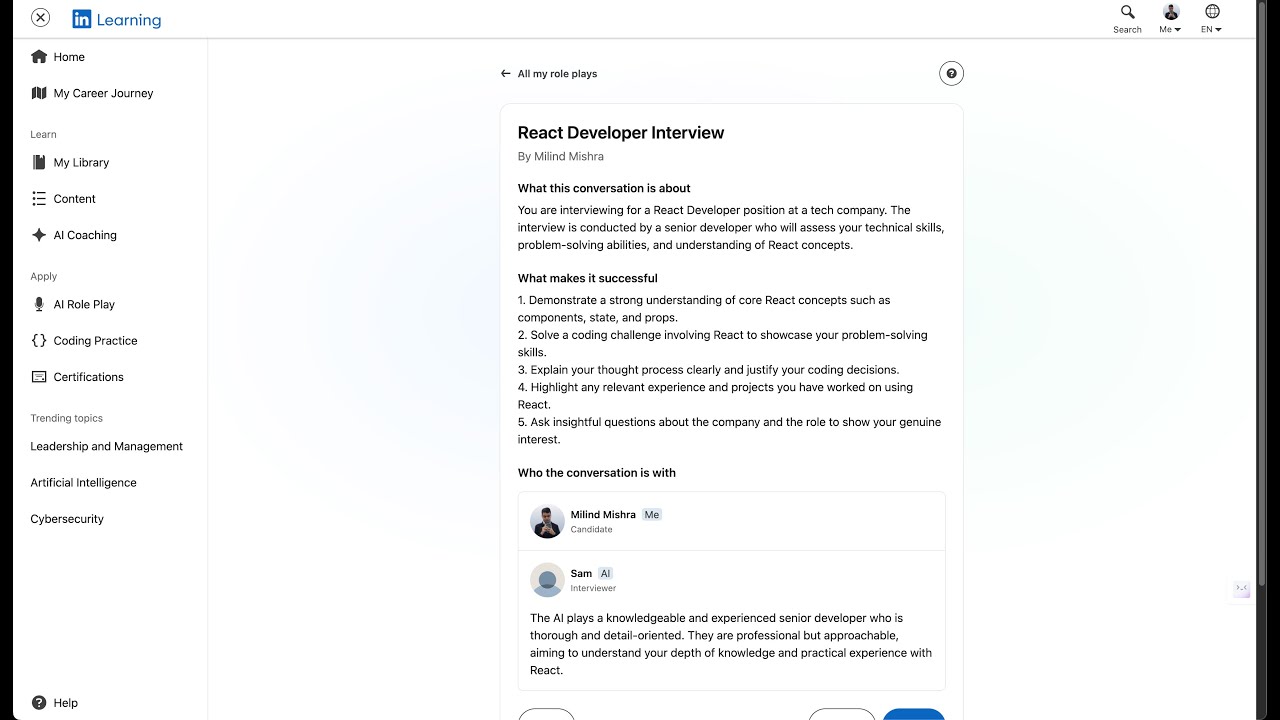
This was a fun experiment of me trying out LinkedIn's AI Role Play Feature.
Feedback from LinkedIn Learning
Strengths
Technical Knowledge: Demonstrated a solid understanding of React concepts such as state management, optimization techniques, and the use of libraries like React Query and Zustand.
Problem-Solving Skills: Effectively explained the approach to handling errors, state management, and performance optimization, showcasing strong problem-solving abilities.
Communication: Provided clear and detailed explanations of the technical implementations, making it easy to understand the thought process and decisions made.
Experience: Highlighted relevant experience with React projects, particularly the chat import system, and discussed the practical application of various React concepts.
Areas of improvement
Clarity and Coherence: Some explanations were a bit disjointed and could benefit from more structured and concise communication.
Engagement: While the technical explanations were strong, asking more insightful questions about the company and role could demonstrate a deeper interest and engagement.
Detailed feedback from the transcript
So let's start with the current experience. I am currently a product engineer at Merlin AII have developed a few front ends for the systems here, one particular being chat imports using ChatGPT exports which we can import in our application which. Can then populate all the chat histories from ChatGPT to Merlin AI.
Conversation insight
The explanation of your current experience was a bit unclear and could be more structured. It would be helpful to break down the project into specific tasks and your role in each.
Example
"I am currently a product engineer at Merlin AI. One of the projects I worked on involved developing a chat import feature using ChatGPT exports. My role included designing the front-end interface and implementing the functionality to import and display chat histories within our application."
So in order to implement a chat import system, what we are doing is we are first of all exporting the zip from the ChatGPT dashboard, uh or the settings wherever it is available and then importing into our application. So in order to import, we drag and drop the zip file. So in order to build the drag and drop experience. I developed a drag and drop container which takes in the accepted files in the described mime types.
Conversation insight
The explanation of the drag and drop feature was somewhat fragmented. Providing a more step-by-step breakdown of the process and your specific contributions would enhance clarity.
Example
"To implement the chat import system, we first export a zip file from the ChatGPT dashboard. I developed a drag and drop container that allows users to import this zip file into our application. The container accepts specific MIME types and handles the drag and drop functionality."
So what in terms of, uh, terms of React optimization, I meant was, you know, enabling my component to have uh, uh. If there are heavy compute functions, I don't exactly remember the code but but yes, the fundamental approach in optimizing any React component will be to, I mean using use callback or use memo hooks if there are values and if there are functions that are compute heavy, so we can you know, add or use callback to them. Yeah, that that are the common approach.
Conversation insight
The explanation of React optimization techniques was somewhat vague and could benefit from more specific examples and a clearer structure.
Example
"For React optimization, I use hooks like useCallback and useMemo to handle compute-heavy functions. For instance, in one project, I used useMemo to cache a list of items that required significant computation, which reduced unnecessary re-renders and improved performance."
Generated by AI based on role play.
Доступные форматы для скачивания:
Скачать видео mp4
-
Информация по загрузке: