Understanding Generics in Java: Filtering Collection T with RandomAccess
Автор: vlogize
Загружено: 2025-09-03
Просмотров: 0
Learn how to create a method in Java to filter collections while ensuring type safety with RandomAccess constraints.
---
This video is based on the question https://stackoverflow.com/q/64579688/ asked by the user 'Eugene' ( https://stackoverflow.com/u/1059372/ ) and on the answer https://stackoverflow.com/a/64579893/ provided by the user 'ernest_k' ( https://stackoverflow.com/u/5761558/ ) at 'Stack Overflow' website. Thanks to these great users and Stackexchange community for their contributions.
Visit these links for original content and any more details, such as alternate solutions, latest updates/developments on topic, comments, revision history etc. For example, the original title of the Question was: generics: filter a Collection T but at the same time bound it to RandomAccess
Also, Content (except music) licensed under CC BY-SA https://meta.stackexchange.com/help/l...
The original Question post is licensed under the 'CC BY-SA 4.0' ( https://creativecommons.org/licenses/... ) license, and the original Answer post is licensed under the 'CC BY-SA 4.0' ( https://creativecommons.org/licenses/... ) license.
If anything seems off to you, please feel free to write me at vlogize [AT] gmail [DOT] com.
---
Understanding Generics in Java: Filtering Collection<T> with RandomAccess
When working with generics in Java, you might sometimes face complications that arise from type constraints. A common scenario is when you want to create a method that not only filters a collection of elements but also imposes certain constraints, like requiring the collection to implement RandomAccess. In this guide, we'll dive into a specific situation involving generics, type bounds, and the challenges you might encounter.
The Problem at Hand
Let's say you have a simple method that filters a collection based on a given predicate. The implementation would look something like this:
[[See Video to Reveal this Text or Code Snippet]]
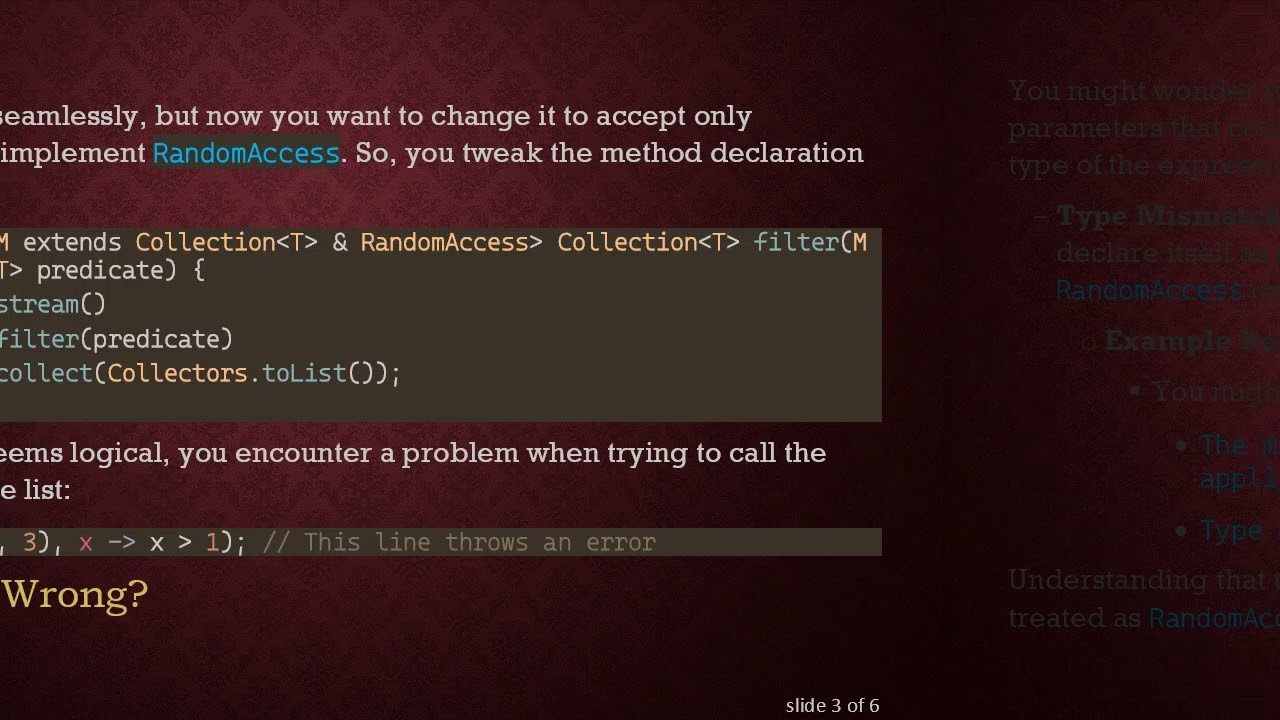
This method works seamlessly, but now you want to change it to accept only collections that also implement RandomAccess. So, you tweak the method declaration like this:
[[See Video to Reveal this Text or Code Snippet]]
While this change seems logical, you encounter a problem when trying to call the method with a simple list:
[[See Video to Reveal this Text or Code Snippet]]
What's Going Wrong?
You might wonder why it fails, particularly since RandomAccess doesn't have any type parameters that could complicate type resolution. The issue here lies in the static type of the expression being passed to the method. Specifically:
Type Mismatch: The List.of(1, 2, 3) returns a List which does not inherently declare itself as implementing RandomAccess, hence it fails to meet the extends RandomAccess constraint specified in your method definition.
Example Resulting Errors:
You might encounter messages like:
The method filter(M, Predicate<T>) in the type Main is not applicable for the arguments (List<Integer>)
Type mismatch: cannot convert from List<Integer> to M
Understanding that the return type of the List.of() expression is not automatically treated as RandomAccess is crucial here.
Recommended Solutions
To rectify this issue, you'll need to use a collection type that is both a Collection and a RandomAccess subtype. Below are two working examples demonstrating this:
[[See Video to Reveal this Text or Code Snippet]]
By wrapping the list in an ArrayList, which qualifies as both a Collection and implements RandomAccess, the method call works smoothly.
Key Takeaways
Be Mindful of Type Constraints: When working with generics, always ensure that the types used in method calls match the constraints specified in method signatures.
Understanding Interactions: Just because a type doesn't have parameters does not mean it won't affect type resolution. Make sure to check how Java handles type inference and constraints to avoid compilation issues.
Now that you’re aware of how to filter collections while maintaining type safety via generics and RandomAccess, you can apply this understanding in your Java projects, ensuring your methods are properly constrained for their intended usage.
If you've faced similar issues with generics and type constraints, or have other Java-related questions, feel free to share your experiences or queries in the comments!
Доступные форматы для скачивания:
Скачать видео mp4
-
Информация по загрузке: