How to Assign HTML Classes to Django Form Input Elements
Автор: vlogize
Загружено: 2025-09-21
Просмотров: 0
Learn how to customize your Django form input elements by assigning HTML classes, making your forms more styled and organized.
---
This video is based on the question https://stackoverflow.com/q/62828921/ asked by the user 'CodeNewbee' ( https://stackoverflow.com/u/5379034/ ) and on the answer https://stackoverflow.com/a/62829100/ provided by the user 'babak gholamirad' ( https://stackoverflow.com/u/13404031/ ) at 'Stack Overflow' website. Thanks to these great users and Stackexchange community for their contributions.
Visit these links for original content and any more details, such as alternate solutions, latest updates/developments on topic, comments, revision history etc. For example, the original title of the Question was: Assign html class to generated Django form input elements
Also, Content (except music) licensed under CC BY-SA https://meta.stackexchange.com/help/l...
The original Question post is licensed under the 'CC BY-SA 4.0' ( https://creativecommons.org/licenses/... ) license, and the original Answer post is licensed under the 'CC BY-SA 4.0' ( https://creativecommons.org/licenses/... ) license.
If anything seems off to you, please feel free to write me at vlogize [AT] gmail [DOT] com.
---
Assigning HTML Classes to Django Form Input Elements
Creating forms is a fundamental aspect of web development, especially when you're working with Django. However, sometimes you'd like to take control and style your forms more elegantly. One common challenge that developers face is how to assign HTML classes to input elements in dynamically generated Django forms. If you've found yourself in a similar predicament, you're not alone!
In this guide, we will explore how to easily customize the HTML classes of your Django form input elements without resorting to manually writing out the HTML for each field.
The Problem: Customizing Form Inputs
When you create a Django form using a ModelForm, the default rendering of the form fields may not always suit your design needs. Here’s an example of a simple Django form defined in a models.py file:
[[See Video to Reveal this Text or Code Snippet]]
When you render this form in your template using the following code:
[[See Video to Reveal this Text or Code Snippet]]
You might notice that there isn't a straightforward way to assign HTML classes to the generated input fields. The question many developers have is: Do I have to write out each input field manually to apply classes?
The Solution: Customizing the Form's _init_ Method
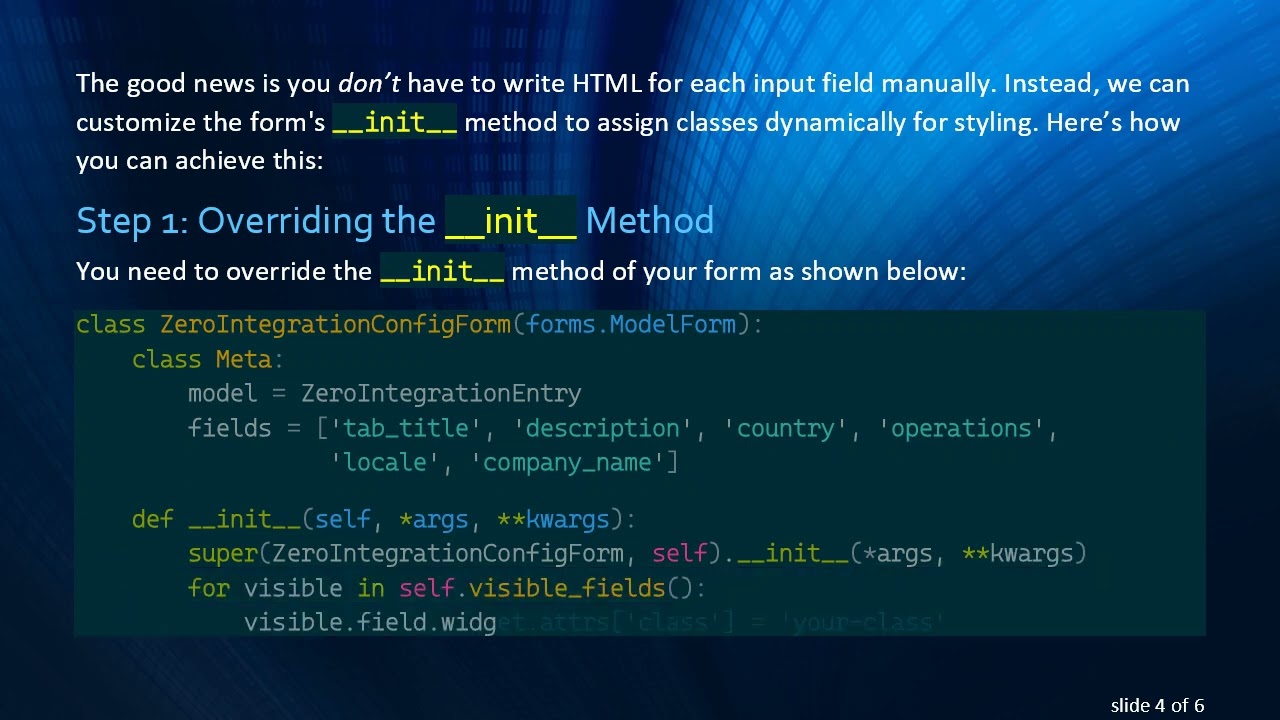
The good news is you don’t have to write HTML for each input field manually. Instead, we can customize the form's _init_ method to assign classes dynamically for styling. Here’s how you can achieve this:
Step 1: Overriding the _init_ Method
You need to override the _init_ method of your form as shown below:
[[See Video to Reveal this Text or Code Snippet]]
Step 2: Assigning Different Classes (Optional)
If you’d like to assign different classes to various input fields, you can use an if statement inside your loop:
[[See Video to Reveal this Text or Code Snippet]]
Step 3: Rendering the Form in Your Template
Once you've customized the form class, you can render it in your template just as you did before:
[[See Video to Reveal this Text or Code Snippet]]
Conclusion
By incorporating these changes, you now have the ability to assign HTML classes to your Django form input elements effortlessly. This not only makes your forms look better but also allows for better styling and custom behavior.
Now you can create more visually appealing forms with specific class attributes without any hassle. Happy coding!
Доступные форматы для скачивания:
Скачать видео mp4
-
Информация по загрузке:




![Суть линейной алгебры: #14. Собственные векторы и собственные значения [3Blue1Brown]](https://image.4k-video.ru/id-video/khMBBxLJLcw)