Top 9 Most Powerful Nuclear Weapons countries in the world | Tamil Zhi | Ravi
Автор: Tamil Zhi
Загружено: 2023-10-03
Просмотров: 141344
Disclaimer: This channel does not promote or encourage Any illegal activities, all contents provided by this channel
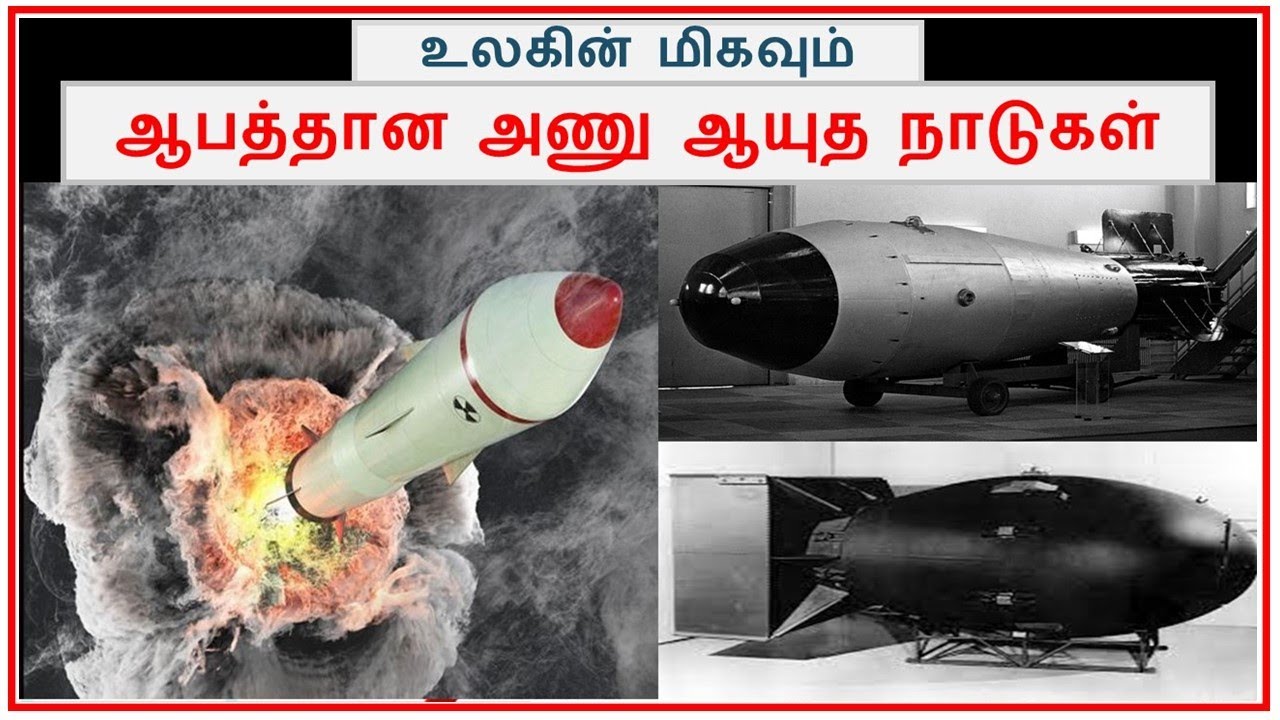
உலகின் மிகவும் ஆபத்தான அனு ஆயுத நாடுகள்
Eight sovereign states have publicly announced successful detonation of nuclear weapons. Five are considered to be nuclear-weapon states (NWS) under the terms of the Treaty on the Non-Proliferation of Nuclear Weapons (NPT). In order of acquisition of nuclear weapons, these are the United States, Russia (the successor of the former Soviet Union), the United Kingdom, France, and China. Of these, the three NATO members, the UK, US, and France, are sometimes termed the P3.
Other states that possess nuclear weapons are India, Pakistan, and North Korea. Since the NPT entered into force in 1970, these three states were not parties to the Treaty and have conducted overt nuclear tests. North Korea had been a party to the NPT but withdrew in 2003.
Israel is also generally understood to have nuclear weapons, but does not acknowledge it, maintaining a policy of deliberate ambiguity. Israel is estimated to possess somewhere between 75 and 400 nuclear warheads. One possible motivation for nuclear ambiguity is deterrence with minimum political cost.
States that formerly possessed nuclear weapons are South Africa (developed nuclear weapons but then disassembled its arsenal before joining the NPT) and the former Soviet republics of Belarus, Kazakhstan, and Ukraine, whose weapons were transferred to Russia.
According to Stockholm International Peace Research Institute (SIPRI), the worldwide total inventory of nuclear weapons as of 2021 stood at 13,080. Around 30% of these are deployed with operational forces, and more than 90% are owned by either Russia or the United States.
In its recent research, SIPRI estimated the total number of nuclear warheads acquired by nuclear states reached 12,512 in January 2023.
Approximately 9,576 are kept with military stockpiles. About 3,844 warheads are deployed with missiles. Two thousand warheads which are primarily from Russia and United States are maintained for high operational alerts.
The United States developed the first nuclear weapons during World War II in cooperation with the United Kingdom and Canada as part of the Manhattan Project, out of the fear that Nazi Germany would develop them first. It tested the first nuclear weapon on 16 July 1945 ("Trinity") at 5:30 am, and remains the only country to have used nuclear weapons in war, devastating the Japanese cities of Hiroshima and Nagasaki. The project expenditure through 1 October 1945 was reportedly $1.845-$2 billion, in nominal terms, roughly 0.8 percent of the US GDP in 1945 and equivalent to about $29 billion in 2020 money.
It was the first nation to develop the hydrogen bomb, testing an experimental prototype in 1952 ("Ivy Mike") and a deployable weapon in 1954 ("Castle Bravo"). Throughout the Cold War it continued to modernize and enlarge its nuclear arsenal, but from 1992 on has been involved primarily in a program of stockpile stewardship. The U.S. nuclear arsenal contained 31,175 warheads at its Cold War height (in 1966). During the Cold War, the United States built approximately 70,000 nuclear warheads, more than all other nuclear-weapon states combined.
India is not a party to the Nuclear Non-Proliferation Treaty. Indian officials rejected the NPT in the 1960s on the grounds that it created a world of nuclear "haves" and "have-nots", arguing that it unnecessarily restricted "peaceful activity" (including "peaceful nuclear explosives"), and that India would not accede to international control of their nuclear facilities unless all other countries engaged in unilateral disarmament of their own nuclear weapons. The Indian position has also asserted that the NPT is in many ways a neo-colonial regime designed to deny security to post-colonial powers.
The country tested what is called a "peaceful nuclear explosive" in 1974 (which became known as "Smiling Buddha"). The test was the first test developed after the creation of the NPT, and created new questions about how civilian nuclear technology could be diverted secretly to weapons purposes (dual-use technology). India's secret development caused great concern and anger particularly from nations that had supplied its nuclear reactors for peaceful and power generating needs, such as Canada. After its 1974 test, India maintained that its nuclear capability was primarily "peaceful", but between 1988 and 1990 it apparently weaponized two dozen nuclear weapons for delivery by air. In 1998 India tested weaponized nuclear warheads ("Operation Shakti"), including a thermonuclear device. India adopted a "no first use" policy in 1998.
Доступные форматы для скачивания:
Скачать видео mp4
-
Информация по загрузке: