How to Override a WordPress Function Wrapped with if (!function_exists)
Автор: vlogize
Загружено: 2025-08-11
Просмотров: 2
Discover the best methods to override functions in WordPress when they're wrapped with the if (!function_exists()) check. Follow our guide for cleaner solutions!
---
This video is based on the question https://stackoverflow.com/q/65102794/ asked by the user 'Yaya Adam' ( https://stackoverflow.com/u/12585042/ ) and on the answer https://stackoverflow.com/a/65104739/ provided by the user 'Diego' ( https://stackoverflow.com/u/1934943/ ) at 'Stack Overflow' website. Thanks to these great users and Stackexchange community for their contributions.
Visit these links for original content and any more details, such as alternate solutions, latest updates/developments on topic, comments, revision history etc. For example, the original title of the Question was: override a function wrapped with if (!function_exists)
Also, Content (except music) licensed under CC BY-SA https://meta.stackexchange.com/help/l...
The original Question post is licensed under the 'CC BY-SA 4.0' ( https://creativecommons.org/licenses/... ) license, and the original Answer post is licensed under the 'CC BY-SA 4.0' ( https://creativecommons.org/licenses/... ) license.
If anything seems off to you, please feel free to write me at vlogize [AT] gmail [DOT] com.
---
Understanding the Problem: Overriding a Function in WordPress
If you are a WordPress developer or a site owner trying to tweak functionality, you may encounter situations where you want to modify a function that is already defined in a plugin. This task becomes particularly tricky when the function in question is wrapped with the if (!function_exists('function_name')) conditional check. This check ensures that the function is only defined if it hasn't been defined already.
For instance, let's say you have a plugin that defines a function like this:
[[See Video to Reveal this Text or Code Snippet]]
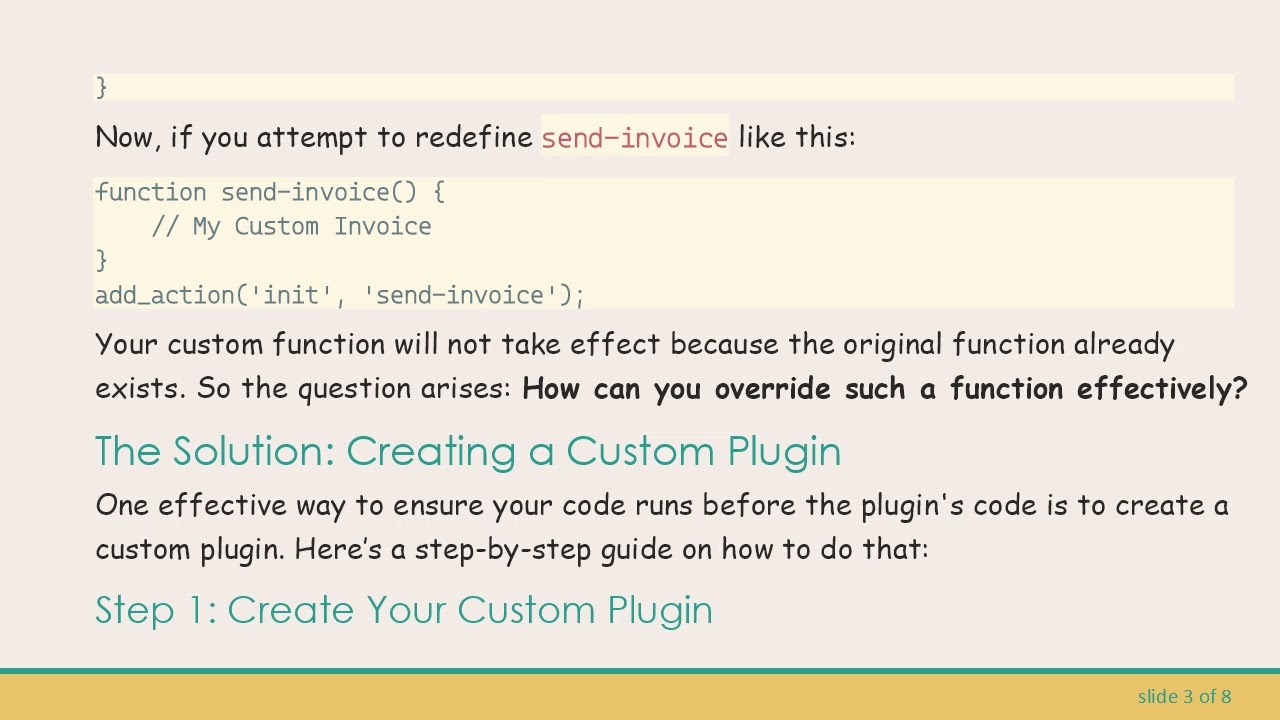
Now, if you attempt to redefine send-invoice like this:
[[See Video to Reveal this Text or Code Snippet]]
Your custom function will not take effect because the original function already exists. So the question arises: How can you override such a function effectively?
The Solution: Creating a Custom Plugin
One effective way to ensure your code runs before the plugin's code is to create a custom plugin. Here’s a step-by-step guide on how to do that:
Step 1: Create Your Custom Plugin
Access the WordPress Plugins Directory:
Navigate to wp-content/plugins directory of your WordPress installation.
Create a New Folder:
Create a new folder for your plugin, naming it something unique (e.g., my-custom-plugin).
Create a PHP File:
Inside this folder, create a new file named my-custom-plugin.php.
Step 2: Add Plugin Header Information
Open the my-custom-plugin.php file and add the following code at the top:
[[See Video to Reveal this Text or Code Snippet]]
Step 3: Override the Function
Add your custom function below the header information in the my-custom-plugin.php file:
[[See Video to Reveal this Text or Code Snippet]]
Step 4: Activate Your Plugin
After saving the file, go to your WordPress dashboard, navigate to the "Plugins" section, and activate your new custom plugin.
Why This Works
The reason this method is effective is due to the alphabetical order in which WordPress loads plugins. Since your custom plugin is likely to be named in a way that it loads before the original plugin (like starting with a), this approach ensures that your function definition comes first.
A Cleaner Approach: Understanding Plugin Loading Order
While creating a custom plugin is the simplest method, there are cleaner approaches that involve understanding how the original plugin works:
Investigate the Plugin's Code:
Dive into the source code of the plugin to identify when it loads the file containing the send-invoice function.
Use Appropriate Hooks:
Instead of simply adding to init, you can investigate the hooks utilized by the original plugin and see if there's a specific hook or action that you can tap into.
Child Themes:
If applicable, use a child theme's functions.php to override functions, but be cautious as this might not always apply, depending on how the plugin checks for existing function names.
Conclusion
Overriding functions in WordPress can be a bit challenging, especially when the original function is wrapped in an existence-checking conditional. However, by creating a simple custom plugin, you can effectively ensure that your custom functionality is loaded before the original. Always consider the cleaner, more maintainable options, but don’t shy away from the straightforward solutions when necessary.
With these insights, you should be well-equipped to modify plugin functionality effectively while maintaining a clean codebase and ensuring your customizations work as intended.
Доступные форматы для скачивания:
Скачать видео mp4
-
Информация по загрузке:


![[4K FULL HD] Relaxing Water Background | 1 HOUR | Calm Water Wallpaper (No Sound)](https://image.4k-video.ru/id-video/y9PTNTSpGJs)


