The Forever Vegetable. One planting, 20 years of food. Why Is This Not in Your Garden?
Автор: Nature Lost Vault
Загружено: 2026-01-08
Просмотров: 52024
This vegetable produces food continuously for 15 to 20 years from a single planting, with almost no water, once established.
In 800 AD, Charlemagne issued an edict requiring 94 plants in every Imperial garden. One plant appeared on the "compulsory list"—essential for any estate. For 1,500 years, it defined European cuisine, appearing in Roman recipes more than garlic or onion. Then in the 1950s, it vanished from American seed catalogs. Not from disease. It was systematically replaced by an annual vegetable that requires purchasing seeds every year.
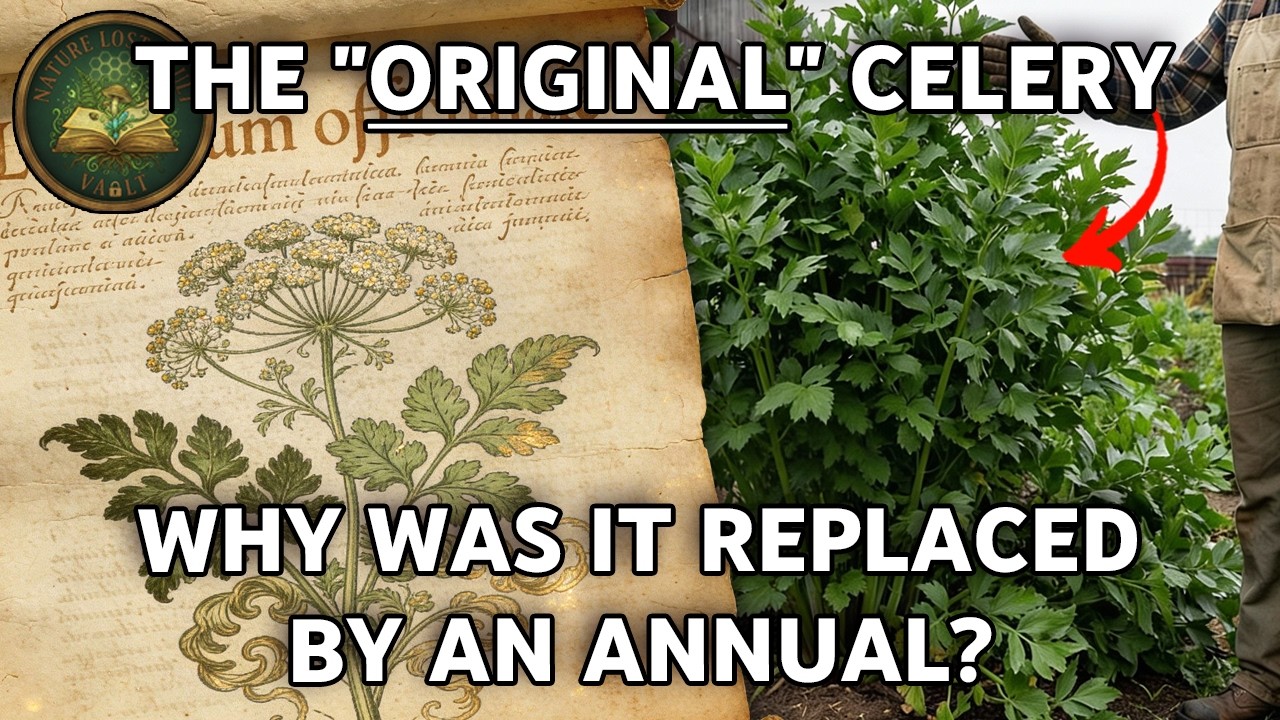
This is lovage (Levisticum officinale), the perennial celery that grows for 15-20 years from a single planting. One plant produces continuously from April through October, surviving to -30°F and requiring almost no maintenance once established. Every part is edible—leaves, stems, roots, and seeds. Nutritionally, it surpasses modern celery in minerals, vitamins, and flavor intensity.
So why did the $2.7 billion celery industry need you to forget it?
In 1919, botanist Ulysses Prentiss Hedrick wrote that lovage's flavor was "too pronounced for modern American tastes." Not poisonous. Not inferior. Too flavorful. American food was being redesigned for industrial production, and lovage's greatest strength—its intensity—became its death sentence.
By the 1950s, Pascal celery had become the industry standard. Mild, uniform, compliant with mechanization. But most importantly: annual. Farmers had to buy new seeds every single year. Lovage's 15-year lifespan made it worthless to seed companies who profit from dependency.
The replacement worked. For them. The global celery market hit $2.69 billion in 2024, with the celery seed market projected to reach $2.6 billion by 2030. That's nearly $5 billion in combined annual revenue from a vegetable that requires constant repurchasing.
Lovage appears in the Capitulare de villis (800 AD) as compulsory for Imperial estates. The Apicius cookbook (circa 400 AD) lists it more than any other herb in ancient Roman cuisine. Medieval monasteries from Ireland to Jerusalem grew it as a staple. For over a millennium, European food was built on lovage.
The plant reaches 6 feet tall with hollow stems and dark green leaves that smell like concentrated celery. It grows in zones 3-9, tolerates drought once established, and produces continuously for 15-20 years. Young leaves go fresh in salads. Mature leaves dry for winter. Hollow stems can be candied or used in soups. Seeds work as a spice (often sold as "celery seed"). Even the roots are edible.
Nutritionally, lovage contains significantly more potassium, calcium, magnesium, and iron than celery. The flavor is more intense—what celery wishes it could be.
Lovage never disappeared completely. Heirloom seed companies still carry it. European gardens never stopped growing it. And now, slowly, it's returning.
📚 SOURCES:
Charlemagne (800 AD). "Capitulare de villis vel curtis imperii" (Of Imperial Lands and Courts), Chapter 70.
Apicius (circa 400 AD). "De re coquinaria" (On Culinary Matters). Ancient Roman cookbook referencing lovage extensively.
Hedrick, U.P. (1919). "Sturtevant's Edible Plants of the World." New York Agricultural Experiment Station. Macmillan Company.
Bailey, L.H. (1914). "The Standard Cyclopedia of Horticulture." Macmillan Company. Historical cultivation practices.
Virtue Market Research (2024). "Global Celery and Coriander Produce Market Report." Market analysis showing $2.69 billion celery industry.
Future Market Report (2024). "Celery Seeds Market Size, Share & Industry Analysis." Projected $2.6 billion market by 2030.
Spence, C. (2023). "Lovage: A Neglected Culinary Herb." International Journal of Gastronomy and Food Science.
Mother Earth News (1979). "Lovage Plant: The Perennial Celery." May/June issue on cultivation.
Denver Public Library (2020). "Trenched Celery, Blanched Celery and Pascal Celery: The Forgotten Story of Colorado's Once Mighty Celery Industry."
Pimenov, M.G. & Leonov, M.V. (1993). "The Genera of the Umbelliferae: A Nomenclator." Royal Botanic Gardens, Kew.
🔔 Subscribe to Nature's Lost Vault to rediscover what industrial agriculture tried to erase
##homesteading #PerennialVegetables #FoodSovereignty #ancientwisdom #HeirloomSeeds #SustainableGardening #permaculture
Доступные форматы для скачивания:
Скачать видео mp4
-
Информация по загрузке: