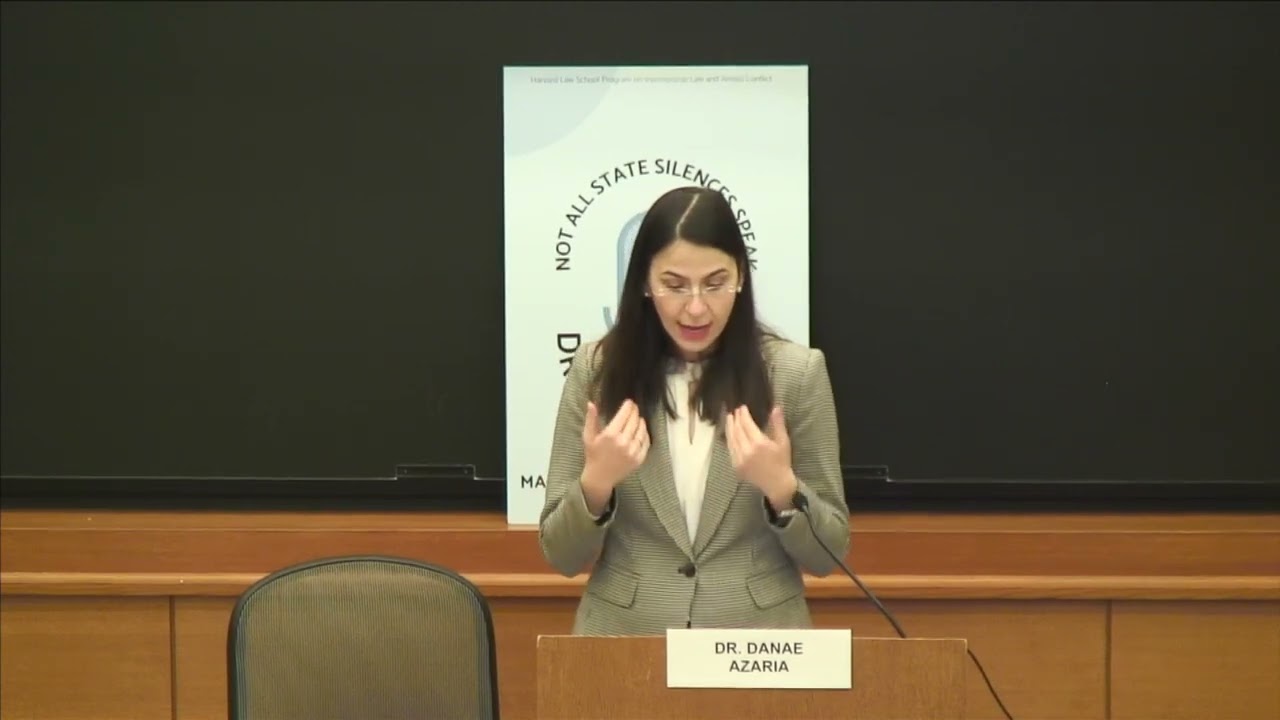
Not All State Silences 'Speak': A Theory of (Non-)Communicative State Silences — Dr. Danae Azaria
Автор: HLS Program on International Law and Armed Conflict
Загружено: 2022-04-11
Просмотров: 1540
Lecture by Dr. Danae Azaria on March 29, 2022 at Harvard Law School, with an introduction by Prof. Naz Modirzadeh. The Harvard Law School Program on International Law and Armed Conflict hosted the event.
Dr Danae Azaria is an Associate Professor at the Faculty of Laws, University College London (UCL), and the Director of the State Silence project funded by a Grant of the EU’s European Research Council. She is a laureate of the Guggenheim Prize in Public International Law (2017), the Book Reviews editor of the British Yearbook of International Law, Co-Rapporteur of the ILA Committee on Submarine Pipelines and Cables, and member of the ILA Committee on Use of Force by Invitation. She is a member of the Advisory Panel of Public International Law of the British Institute of International and Comparative Law, and has held prestigious fellowships including as Senior Humboldt Fellow, Alexander von Humboldt Foundation (Humboldt University Berlin, 2019-2021).
Event Abstract
‘Silence may also speak, but only if the conduct of the other state calls for a response’. In these words the International Court of Justice (‘ICJ’) described in Pedra Branca (Malaysia/Singapore) (2008) the concept of acquiescence. In this article, I disagree with the ICJ’s assumption that a presumption drawn from silence (acquiescence) is silence that speaks. Building on pragmatics, I argue that a distinction can be drawn in international law between on the one hand State silence that speaks, and on the other hand rules on presumptions about the state of mind of a State drawn from the fact of State silence. In the former case, State silence is functionally equivalent to a speech act communicating an intended message. In the latter case, State silence does not communicate any message – the silent State may be trying to conceal its intentions by remaining silent. However, from the fact of State silence an ‘assessor’ (a court or other States) presumes acceptance (e.g. acquiescence) or opposition (e.g. establishing the existence of a dispute and thus the jurisdiction of an international court, as is currently pleaded in the ongoing proceedings in The Gambia v. Myanmar before the ICJ). Both instances require ‘reactive’ State silence, and both instances are subject to strict conditions. However, their distinction is important because: first, the conditions to which they are subject as well as the rationale behind them differ; and second, because it is not entirely clear that presumed consent as opposed to communicated intention is required for making an international agreement, and giving consent to an otherwise internationally wrongful act, such as the use of force in one’s own territory, cannot be presumed.
Доступные форматы для скачивания:
Скачать видео mp4
-
Информация по загрузке: