How to Validate One Field by Another in Django Models
Автор: vlogize
Загружено: 2025-10-06
Просмотров: 0
Learn how to validate one field against another in Django models, ensuring data integrity with user-friendly error messages.
---
This video is based on the question https://stackoverflow.com/q/64026817/ asked by the user 'Alex Burla' ( https://stackoverflow.com/u/9570942/ ) and on the answer https://stackoverflow.com/a/64027019/ provided by the user 'Andrey Maslov' ( https://stackoverflow.com/u/7186864/ ) at 'Stack Overflow' website. Thanks to these great users and Stackexchange community for their contributions.
Visit these links for original content and any more details, such as alternate solutions, latest updates/developments on topic, comments, revision history etc. For example, the original title of the Question was: How to validate one field by another in a model in Django?
Also, Content (except music) licensed under CC BY-SA https://meta.stackexchange.com/help/l...
The original Question post is licensed under the 'CC BY-SA 4.0' ( https://creativecommons.org/licenses/... ) license, and the original Answer post is licensed under the 'CC BY-SA 4.0' ( https://creativecommons.org/licenses/... ) license.
If anything seems off to you, please feel free to write me at vlogize [AT] gmail [DOT] com.
---
How to Validate One Field by Another in Django Models
In web development, data validation plays a crucial role in maintaining the accuracy and integrity of your application. When working with Django models, you might find yourself needing to validate one field based on the value of another field within the same model. This is a common scenario, especially when certain conditions must be met before saving data to the database. In this guide, we will explore how to effectively implement this validation in your Django applications.
The Problem: Ensuring Data Integrity
Let's say you have a model like the one below:
[[See Video to Reveal this Text or Code Snippet]]
In your application, you need to validate the value field to ensure that its length does not exceed the limit specified by the maxSize field. If a user enters a value that is longer than the maximum allowed, you want to provide them with a clear and specific error message. So, how do you accomplish this in Django?
The Solution: Custom Validation Methods
Django allows you to implement custom validation methods in your model forms, which gives you the flexibility to enforce the necessary rules. Here are two ways you can perform this validation.
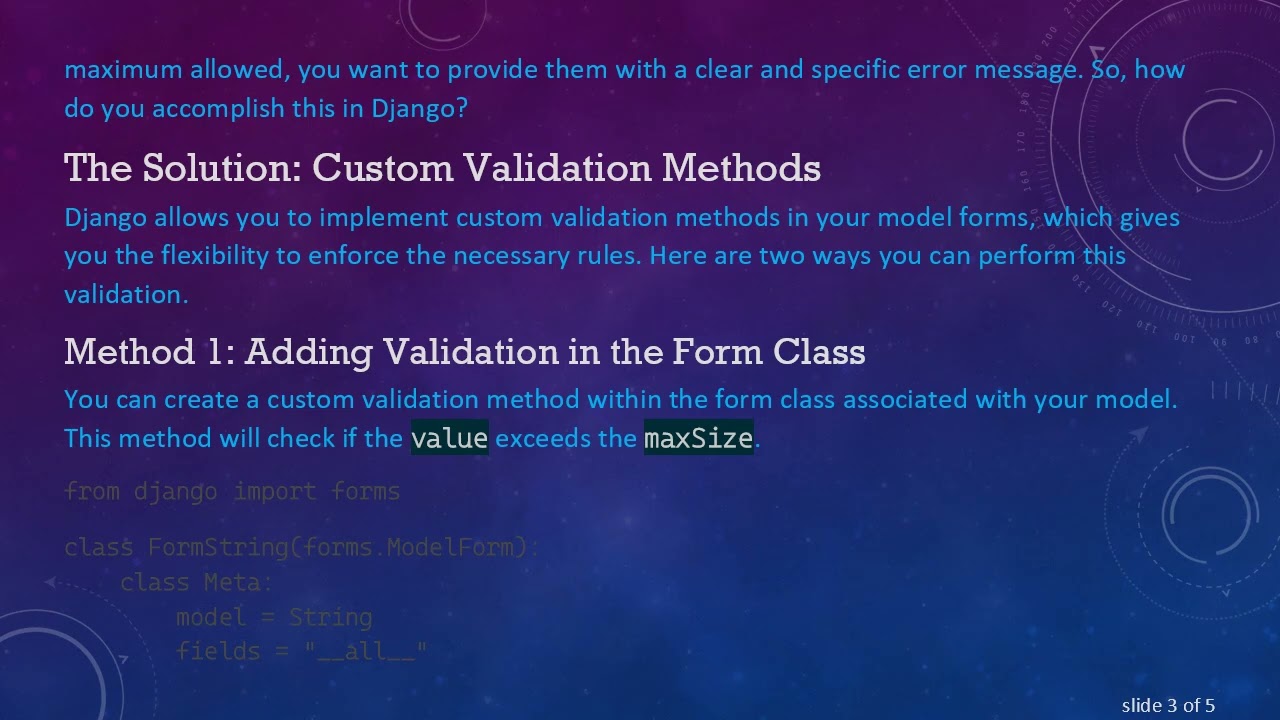
Method 1: Adding Validation in the Form Class
You can create a custom validation method within the form class associated with your model. This method will check if the value exceeds the maxSize.
[[See Video to Reveal this Text or Code Snippet]]
Method 2: Using the Clean Method
Alternatively, you can override the clean method in your form to perform the validation. This method allows you to validate multiple fields at once, which can be useful if you need to check relationships between several fields.
[[See Video to Reveal this Text or Code Snippet]]
Conclusion
By implementing these custom validation methods, you ensure that users receive meaningful feedback when their input does not meet the required criteria. This not only improves user experience but also helps maintain the integrity of the data stored in your Django application. Always remember to test your validations thoroughly to catch any edge cases!
With the knowledge gained from this post, you should now be able to effectively validate one field against another in your Django models, keeping your application robust and user-friendly.
Доступные форматы для скачивания:
Скачать видео mp4
-
Информация по загрузке: