Resolving NULL Issues in @ RequestPayload with Spring WS
Автор: vlogize
Загружено: 2025-08-22
Просмотров: 4
Discover how to tackle the `NULL` values in your Spring WS @ RequestPayload and what solution to consider for effective SOAP service operations.
---
This video is based on the question https://stackoverflow.com/q/64101968/ asked by the user 'Vikram R' ( https://stackoverflow.com/u/8618598/ ) and on the answer https://stackoverflow.com/a/64118049/ provided by the user 'Vikram R' ( https://stackoverflow.com/u/8618598/ ) at 'Stack Overflow' website. Thanks to these great users and Stackexchange community for their contributions.
Visit these links for original content and any more details, such as alternate solutions, latest updates/developments on topic, comments, revision history etc. For example, the original title of the Question was: getting NULL in @ RequestPayload
Also, Content (except music) licensed under CC BY-SA https://meta.stackexchange.com/help/l...
The original Question post is licensed under the 'CC BY-SA 4.0' ( https://creativecommons.org/licenses/... ) license, and the original Answer post is licensed under the 'CC BY-SA 4.0' ( https://creativecommons.org/licenses/... ) license.
If anything seems off to you, please feel free to write me at vlogize [AT] gmail [DOT] com.
---
Tackling NULL Values in @ RequestPayload with Spring WS
When dealing with web services, particularly in Spring WS, it's not uncommon to encounter frustrating issues such as receiving NULL values in your @ RequestPayload. This guide delves into the problem, explores potential causes, and provides a clear, step-by-step guide to resolving it effectively.
Understanding the Problem
In the scenario described, a developer is working with a pre-generated WSDL for a SOAP web service using Spring WS. After making a call to the service, they find that the response contains NULL values. This issue typically arises due to mismatches between the request structure defined in the WSDL and the actual request being made from the client (in this case, SOAP UI).
Key Points to Consider:
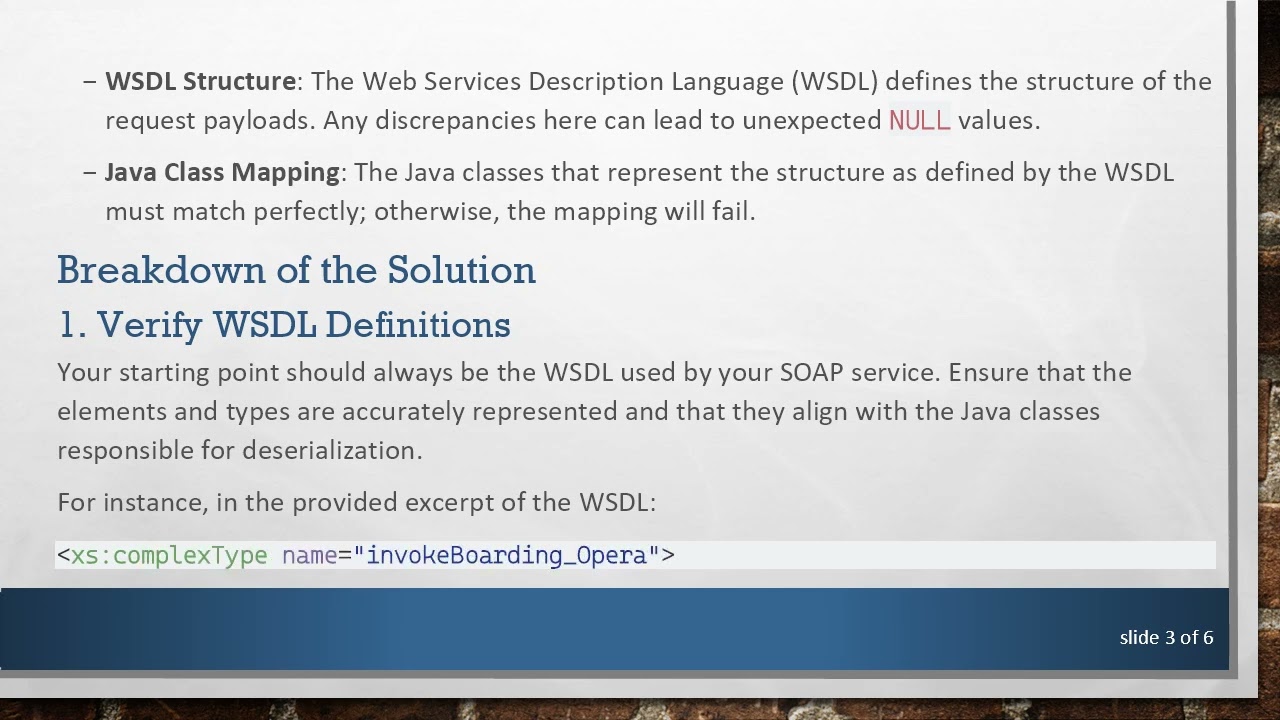
WSDL Structure: The Web Services Description Language (WSDL) defines the structure of the request payloads. Any discrepancies here can lead to unexpected NULL values.
Java Class Mapping: The Java classes that represent the structure as defined by the WSDL must match perfectly; otherwise, the mapping will fail.
Breakdown of the Solution
1. Verify WSDL Definitions
Your starting point should always be the WSDL used by your SOAP service. Ensure that the elements and types are accurately represented and that they align with the Java classes responsible for deserialization.
For instance, in the provided excerpt of the WSDL:
[[See Video to Reveal this Text or Code Snippet]]
Make sure that the BoardingRequest element is correctly defined and corresponds to the Java class representation.
2. Check Java Class Annotations
Ensure that your Java class InvokeBoarding_Opera and its properties are correctly annotated for XML processing. For example:
[[See Video to Reveal this Text or Code Snippet]]
Key Annotations to Review:
@ XmlRootElement: This specifies the root element of the XML when marshaling/unmarshaling.
Property Accessors: Ensure that you have appropriate getter/setter methods for the properties.
3. Change to Alternate Framework if Necessary
If you are unable to resolve the issue using Spring WS, it might be worth considering the alternative approach as shared by the user – switching to Apache CXF.
By moving to Apache CXF, many developers have found it resolves incompatibilities and provides a more seamless experience with SOAP services. This change allowed the user to move past the NULL value issue and get their service operating effectively.
Conclusion
Dealing with NULL values in your @ RequestPayload can be highly frustrating, but with the right approach, you can often trace the source of the problem to discrepancies in your WSDL and Java class mapping. Ensure they are in sync, and don’t hesitate to consider alternatives like Apache CXF if issues persist.
By following the steps in this post, you can navigate these challenges effectively and move your web services forward without the headache of debugging NULL values.
Доступные форматы для скачивания:
Скачать видео mp4
-
Информация по загрузке: