Mastering Python Nested Loops for File Renaming
Автор: vlogize
Загружено: 2025-09-21
Просмотров: 0
Learn how to efficiently rename files in Python using nested loops with this comprehensive guide for beginners. Enhance your Python skills today!
---
This video is based on the question https://stackoverflow.com/q/62839102/ asked by the user 'Etiende' ( https://stackoverflow.com/u/13901036/ ) and on the answer https://stackoverflow.com/a/62839232/ provided by the user 'nagyl' ( https://stackoverflow.com/u/11080283/ ) at 'Stack Overflow' website. Thanks to these great users and Stackexchange community for their contributions.
Visit these links for original content and any more details, such as alternate solutions, latest updates/developments on topic, comments, revision history etc. For example, the original title of the Question was: Python nested loops for renaming files
Also, Content (except music) licensed under CC BY-SA https://meta.stackexchange.com/help/l...
The original Question post is licensed under the 'CC BY-SA 4.0' ( https://creativecommons.org/licenses/... ) license, and the original Answer post is licensed under the 'CC BY-SA 4.0' ( https://creativecommons.org/licenses/... ) license.
If anything seems off to you, please feel free to write me at vlogize [AT] gmail [DOT] com.
---
Mastering Python Nested Loops for File Renaming: A Beginner's Guide
When you're working with file management in Python, you might encounter situations that require renaming multiple files systematically. This can be especially challenging if you're a beginner and are just getting acquainted with Python programming, loops, and file handling. In this post, we'll delve into a specific problem: renaming files using the os.rename() function with nested loops.
The Problem Statement
Imagine you have a list of prefixes for filenames, and you'd like to rename your files using these prefixes in a specific format. For instance, your target format for the filenames is <prefix>_<number>.jpg, where the prefix comes from a predefined list and the numbers range from 1 to 10. When the number hits 10, the next prefix should be used for the subsequent files.
Here’s an example of how the filenames should appear:
2_1.jpg
2_2.jpg
3_1.jpg
3_2.jpg
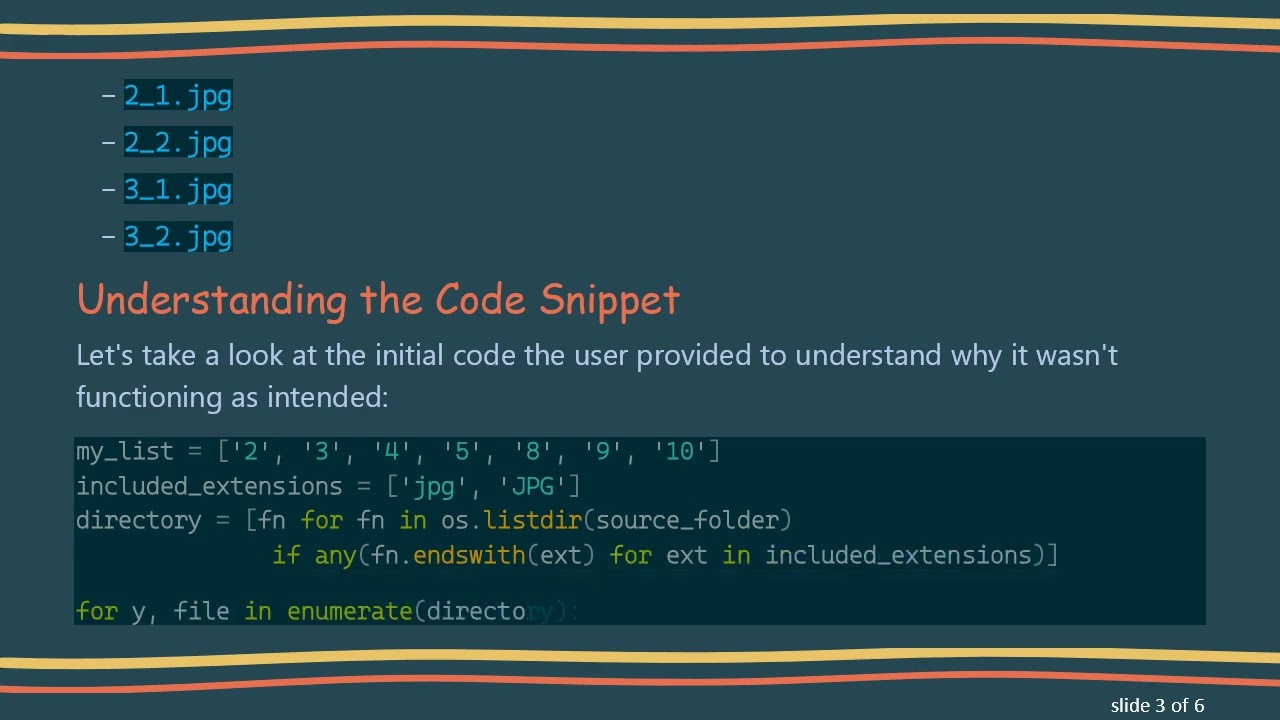
Understanding the Code Snippet
Let's take a look at the initial code the user provided to understand why it wasn't functioning as intended:
[[See Video to Reveal this Text or Code Snippet]]
Issues in the Original Code:
File Overwriting: In the nested loops, only the first file is processed correctly. Subsequent runs cannot access renamed files because their original names no longer exist.
Loop Logic Error: The inner for loop was overwriting the value of x, which caused issues as the code was trying to rename the same file repeatedly.
The Solution
To tackle these issues, a well-structured nested loop is essential. Below is a revised version of the code that accurately accomplishes the renaming task:
[[See Video to Reveal this Text or Code Snippet]]
Key Breakdown of the Code:
Using an Index Tracker: The variable i is used to keep track of which file is being processed in the directory list. This avoids repetition and ensures every file is accounted for.
Outer Loop for Prefix: The outer loop iterates through each item in my_list, which represents the prefixes for your file names.
Inner Loop for Numbering: The inner loop handles numbering from 1 to 10, thus formatting the filenames correctly.
Conditional Statement: This ensures that you do not attempt to access an index outside of the directory list's length, thus preventing IndexError.
Conclusion
By leveraging nested loops properly in Python, you can efficiently rename multiple files in a systematic and organized manner. This is a fundamental skill that will aid you as you continue your journey in programming. Remember to track the indices carefully and take care to understand the structure of your loops to prevent pitfalls associated with variable overwriting. Happy coding!
Доступные форматы для скачивания:
Скачать видео mp4
-
Информация по загрузке: