Automate Row Nesting in Excel: A Step-by-Step Guide to Grouping Data Using VBA
Автор: vlogize
Загружено: 2025-10-11
Просмотров: 2
Discover how to automatically nest rows in Excel using VBA by grouping data based on level values. This guide simplifies the process, ideal for large datasets.
---
This video is based on the question https://stackoverflow.com/q/68463240/ asked by the user 'Stitt' ( https://stackoverflow.com/u/10942864/ ) and on the answer https://stackoverflow.com/a/68466999/ provided by the user '5202456' ( https://stackoverflow.com/u/5202456/ ) at 'Stack Overflow' website. Thanks to these great users and Stackexchange community for their contributions.
Visit these links for original content and any more details, such as alternate solutions, latest updates/developments on topic, comments, revision history etc. For example, the original title of the Question was: How to automatically nest rows of an Excel spreadsheet using level values?
Also, Content (except music) licensed under CC BY-SA https://meta.stackexchange.com/help/l...
The original Question post is licensed under the 'CC BY-SA 4.0' ( https://creativecommons.org/licenses/... ) license, and the original Answer post is licensed under the 'CC BY-SA 4.0' ( https://creativecommons.org/licenses/... ) license.
If anything seems off to you, please feel free to write me at vlogize [AT] gmail [DOT] com.
---
Automate Row Nesting in Excel: A Step-by-Step Guide to Grouping Data Using VBA
When working with large datasets in Excel, organizing your spreadsheet can become quite a daunting task. One common requirement is to automatically nest rows based on level values, especially when you have data that indicates different hierarchical structures. In this guide, we will address the problem of how to apply grouping in Excel 2016 by leveraging a VBA script, making it easy to interpret and visualize your data.
Understanding the Problem
Imagine you have a long dataset that's about 800 lines, and each row contains numerical values that indicate which rows belong to which group. Here’s a simplified version of the data format:
[[See Video to Reveal this Text or Code Snippet]]
The first column (Column A) shows levels: rows 3, 4, and 5 are "children" of row 2 and should be grouped together.
The maximum level in this specific dataset reaches 5, while Excel can handle up to 8 levels of grouping.
Doing this manually is clearly not efficient, which leads us to look for a better solution using Excel’s capability to automate tasks via VBA (Visual Basic for Applications).
The VBA Solution: Grouping Rows Automatically
To solve the problem of automatically nesting rows based on level values, we can employ a simple VBA script. This script will group the rows according to the level values given in Column A. Below, we break down the key components of the script to help you understand how it works:
Key Features of the Script
Level Validation:
The script checks that levels start from one and increase sequentially. For instance, levels like 1, 1, 2, 3, 3, 4, 4, 5 are valid, while 1, 1, 2, 2, 2, 4, 4, 5 will cause an error because level 3 is skipped.
Maximum Level Check:
Excel can handle a maximum of eight group levels. If the script detects a higher level, it will terminate with a warning message.
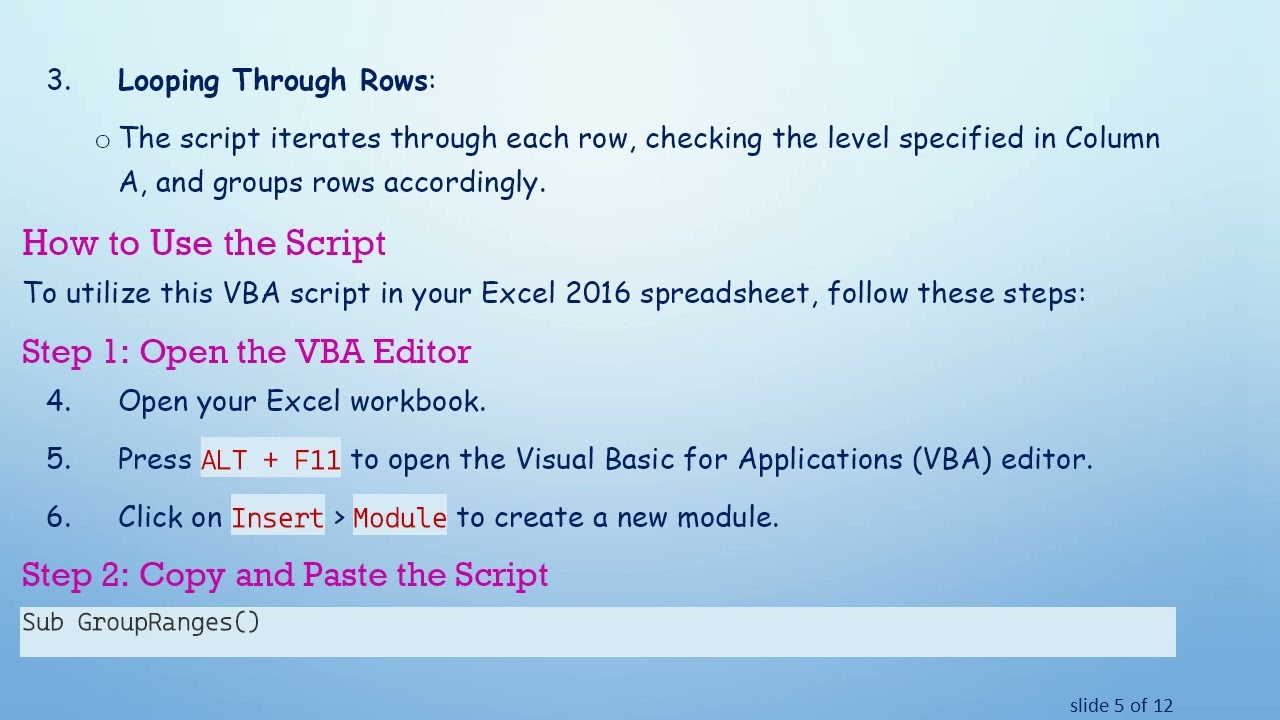
Looping Through Rows:
The script iterates through each row, checking the level specified in Column A, and groups rows accordingly.
How to Use the Script
To utilize this VBA script in your Excel 2016 spreadsheet, follow these steps:
Step 1: Open the VBA Editor
Open your Excel workbook.
Press ALT + F11 to open the Visual Basic for Applications (VBA) editor.
Click on Insert Module to create a new module.
Step 2: Copy and Paste the Script
[[See Video to Reveal this Text or Code Snippet]]
Step 3: Run the Script
Close the VBA editor.
Back in your Excel worksheet, press ALT + F8, select GroupRanges, and click Run.
After executing this script, you will see that the rows are automatically grouped according to the levels specified in Column A. This not only saves time but also ensures that your data is presented clearly.
Conclusion
Automating the nesting of rows in Excel using VBA is a powerful way to simplify data management, especially for large datasets. By following the steps outlined and employing the provided script, you can easily transform your spreadsheets into a neatly organized format, making data interpretation much more manageable.
With this knowledge, you can apply similar automation techniques to other complex spreadsheet tasks in Excel. Happy Excel-ing!
Доступные форматы для скачивания:
Скачать видео mp4
-
Информация по загрузке: