How to Use java.util.function.Function for JSON Deserialization in Java
Автор: vlogize
Загружено: 2025-03-31
Просмотров: 1
Learn how to effectively utilize `java.util.function.Function` for deserializing JSON into a list of objects in Java, with practical code examples and solutions.
---
This video is based on the question https://stackoverflow.com/q/73652495/ asked by the user 'bostonjava' ( https://stackoverflow.com/u/3473925/ ) and on the answer https://stackoverflow.com/a/73652962/ provided by the user 'Alexander Ivanchenko' ( https://stackoverflow.com/u/17949945/ ) at 'Stack Overflow' website. Thanks to these great users and Stackexchange community for their contributions.
Visit these links for original content and any more details, such as alternate solutions, latest updates/developments on topic, comments, revision history etc. For example, the original title of the Question was: Applying java.util.function.Function to JSON Deserialization
Also, Content (except music) licensed under CC BY-SA https://meta.stackexchange.com/help/l...
The original Question post is licensed under the 'CC BY-SA 4.0' ( https://creativecommons.org/licenses/... ) license, and the original Answer post is licensed under the 'CC BY-SA 4.0' ( https://creativecommons.org/licenses/... ) license.
If anything seems off to you, please feel free to write me at vlogize [AT] gmail [DOT] com.
---
Handling JSON Deserialization with Java's java.util.function.Function
JSON deserialization is a common task in Java applications, especially when dealing with APIs and services that communicate in JSON format. A frequent issue developers encounter is how to leverage Java's Function interface for this purpose, specifically when deserializing JSON into a list of objects. In this guide, we'll walk through the problem and offer a clear solution to properly implement this functionality.
The Problem
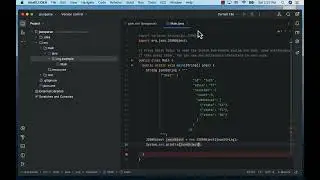
You have a class that accepts a Function<ByteBuffer, T> deserialize as a constructor argument and your goal is to create a function that converts JSON into a list of objects. The initial attempt you might have made typically looks like this:
[[See Video to Reveal this Text or Code Snippet]]
However, this approach runs into syntax issues, primarily because the ObjectMapper.readValue() method can throw a checked exception, IOException, which cannot be propagated through the Function.
The Solution
Instead of trying to force the Function to handle exceptions, a more robust approach is to use a lambda expression within your function to catch and handle the exception. Here’s how you can structure your function:
Corrected Function Implementation
[[See Video to Reveal this Text or Code Snippet]]
Breakdown of the Solution
Lambda Expressions: The buffer -> { ... } syntax allows you to implement the Function interface's apply method easily.
Exception Handling: By wrapping the readValue call in a try-catch block, you can gracefully handle IOExceptions without JNI errors breaking your application flow.
Returning Values: Choose how to handle the case of an exception. In the example, we log the error and return null, but you could also consider ways to signal to the caller that deserialization has failed.
Alternative Utility Method
If you want to handle deserialization more cleanly, consider crafting a utility method in a separate class, which might look like the below:
[[See Video to Reveal this Text or Code Snippet]]
Advantages of a Utility Method
Separation of Concerns: By moving deserialization logic out of the Function, you can keep your application clean and focused on its responsibilities.
Easier Error Handling: The utility method can throw the IOException, allowing you to handle it further up the call stack if need be.
Conclusion
In summary, while it's perfectly feasible to use java.util.function.Function for deserializing JSON in Java, it requires careful handling of checked exceptions. By employing lambda expressions and error handling wisely, you can successfully convert JSON into Java objects. Alternatively, consider implementing a utility method for cleaner and more maintainable code.
By adopting these approaches, you'll enhance both the functionality and robustness of your Java applications dealing with JSON data.
Доступные форматы для скачивания:
Скачать видео mp4
-
Информация по загрузке: